Story code: ST-000271
Part 3: The Condemnation Clause
The harsh fluorescent lighting of the municipal chambers made the deep purple bruising around Wade’s wrists throb in time with his pulse. He sat perfectly still in the back row of the crowded city council meeting, a thick, unsealed manila envelope resting on his lap. At the front podium, the cashmere-clad lawyer-now wearing an equally expensive tailored navy suit-was just wrapping up his presentation.
On the projector screen above the five seated council members, a blurred image of Wade’s stolen neighborhood watch roster was displayed in bold, ominous contrast next to the words “Active Community Threats.”
“And so, under the proposed Emergency Risk and Public Threat Ordinance, we are asking this council to finalize the injunction today,” the lawyer said, his voice echoing with a practiced, mournful gravity. “This town cannot allow unauthorized, organized militia groups to terrorize its residents. As my client’s primary petitioner, Elena, has certified to this body, the psychological toll on victims of past violence is simply too great to ignore.”
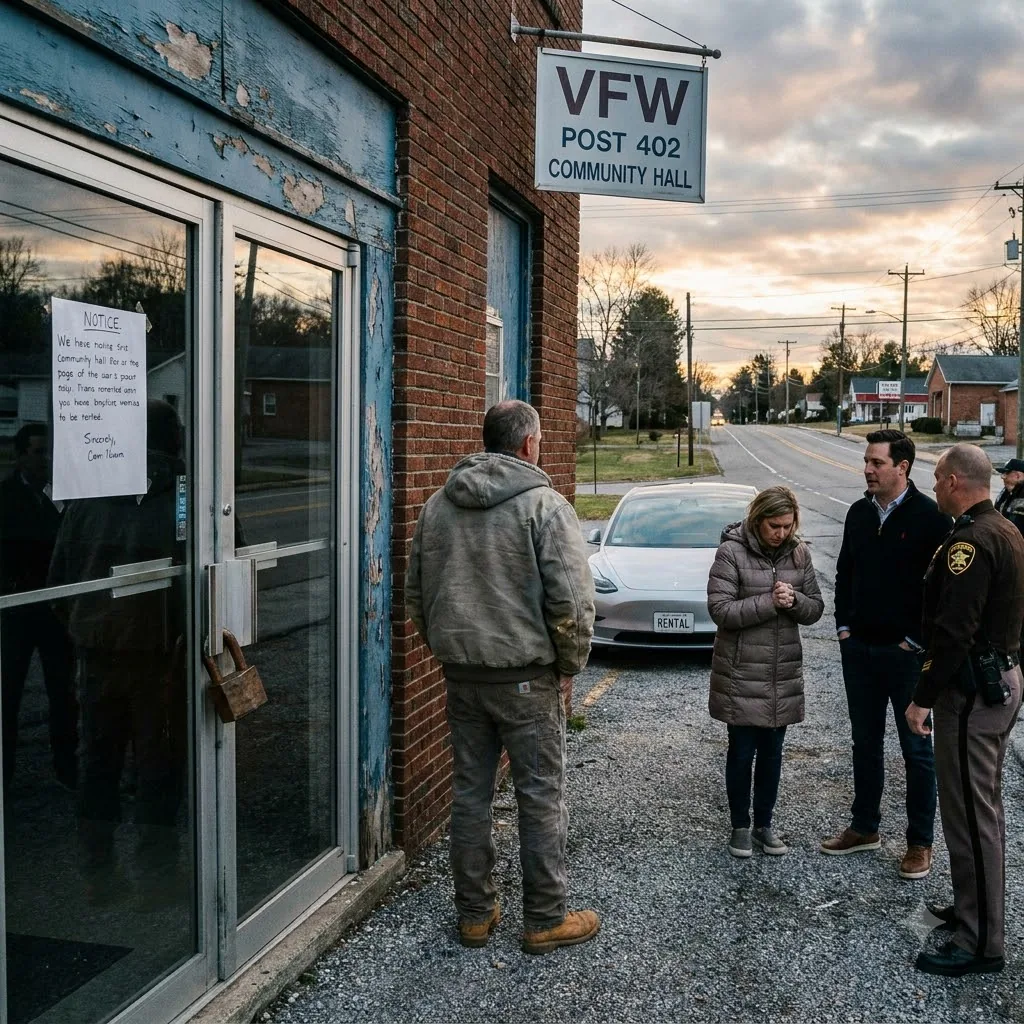
Elena sat rigidly in the front row, staring at her lap, her posture identical to how she had stood in the VFW parking lot two nights prior.
“Thank you, Counselor,” the council president said, adjusting his glasses and checking his watch. “Before we vote on codifying this ordinance, we will open the floor for the mandatory public comment period. Three minutes per speaker.”
Wade stood. The heavy scrape of his metal chair against the linoleum drew every eye in the room. He didn’t rush. He walked down the center aisle, feeling the immediate, hostile spike of tension from the black-clad private security contractors flanking the rear exits. Deputy Miller stood near the front row, his hand resting near his duty belt, looking acutely uncomfortable.
Wade stepped up to the public microphone. He placed his manila envelope flat on the wooden podium.
“Mr. Harrison,” the council president said, frowning deeply. “Given the pending civil charges against you and your group, I strongly advise-”
“I’m here as a property owner and a registered taxpayer,” Wade interrupted calmly, leaning slightly into the microphone so his voice filled the chamber. “And I’m here to talk about Section Four, Paragraph B of the ordinance you’re all about to vote on.”
The lawyer stepped forward immediately, moving laterally to block Wade’s line of sight to the council. “Mr. President, this man is the ringleader of the very vigilante group we are trying to disband. He is using this municipal platform for intimidation.”
Wade ignored him. He looked directly past the tailored suit at the five council members. “When the counselor’s private security team assaulted me on camera and stole my volunteer roster, they didn’t just get a list of names. They got a list of addresses. Mostly retirees. People who own their homes outright in the Oak Creek subdivisions.”
Wade opened his envelope. He slid a crisp, heavily highlighted legal document onto the overhead projector glass, replacing the lawyer’s threatening slide.
“Section Four, Paragraph B,” Wade read aloud, his voice steady and carrying to the very back of the hushed room. “If a property owner is deemed a public threat under this ordinance, the municipality is authorized to invoke immediate emergency condemnation of their real estate, bypassing standard eminent domain hearings to ensure public safety.”
A low murmur rippled through the gallery. Several council members leaned forward, squinting at the screen.
“It’s standard boilerplate for seizing properties used in organized crime,” the lawyer said smoothly, projecting absolute authority, though Wade noticed a microscopic tightening around the corners of the man’s eyes. “A necessary deterrent against the stockpiling of weapons.”
“It’s a demolition loophole,” Wade countered. He pulled a second stack of papers from his envelope and laid them flat on the projector. The new documents bore the sleek, modern logo of an out-of-state corporation. “After I posted bail yesterday, I did some digging into the ‘property management firm’ that bought the VFW’s debt to shut us out. It’s a shell LLC for Apex Innovations. Your client isn’t a property manager. He’s a Silicon Valley tech executive looking to build a massive, fifty-acre server farm in this county, and he needs the Oak Creek subdivision to do it.”
“This is absurd, defamatory conjecture,” the lawyer snapped, his voice rising a fraction of a decibel. He reached toward the projector to pull the papers away, but Deputy Miller unexpectedly stepped between them. The local cop put a firm, unyielding hand on the lawyer’s chest to stop him.
“Let him finish,” Miller said, his jaw set tight as he stared the lawyer down.
Wade didn’t miss a beat. He spread the final pages across the illuminated glass. They were municipal legal templates, completely filled out with official property markers, lacking only the final signatures of the city clerk.
“These were filed with the county clerk’s provisional office yesterday morning, pending the passage of tonight’s ordinance,” Wade said, tapping the glass with a bruised finger. “They are pre-drafted municipal purchase offers. Apex Innovations is offering to buy the ‘condemned’ properties from the city at twenty cents on the dollar the very moment this council seizes them.”
Wade picked up a copy of his original watch roster and held it up next to the screen.
“Look at the addresses on those deeds,” Wade told the room. “Arthur Pendelton on Elm Street. Sarah Higgins on Oak. Every single house targeted in these purchase offers matches the home address of a senior citizen on my neighborhood watch schedule. You didn’t write this ordinance to stop a militia. You wrote it to steal their land.”
The silence in the chamber was absolute. The council president stared at the pre-drafted deeds on the screen, his mouth slightly open as the sheer scale of the corporate fraud sank in.
Elena stood up slowly from the front row. She turned around to face the lawyer, her trembling hands clenching into tight fists. The hollow, traumatized compliance was completely gone from her eyes, replaced by a sharp, furious clarity. She looked at the screen, seeing exactly how her horrific past had been weaponized to quietly evict the elderly neighbors who had brought her casseroles and checked on her for two agonizing years.
“You told me…” Elena’s voice shook, but the microphone on the podium picked it up perfectly. “You told me it was about keeping the streets safe. You were going to take Sarah’s house?”
The lawyer’s pristine composure finally shattered. He looked at the undeniable proof projected on the wall, then at the furious survivor he had dragged here as his human shield, and finally at the five council members whose political careers were suddenly strapped to a live explosive. He opened his mouth, but for the first time since he had arrived in town, not a single word came out.