Story code: ST-001098
Part 1: The Syllabus
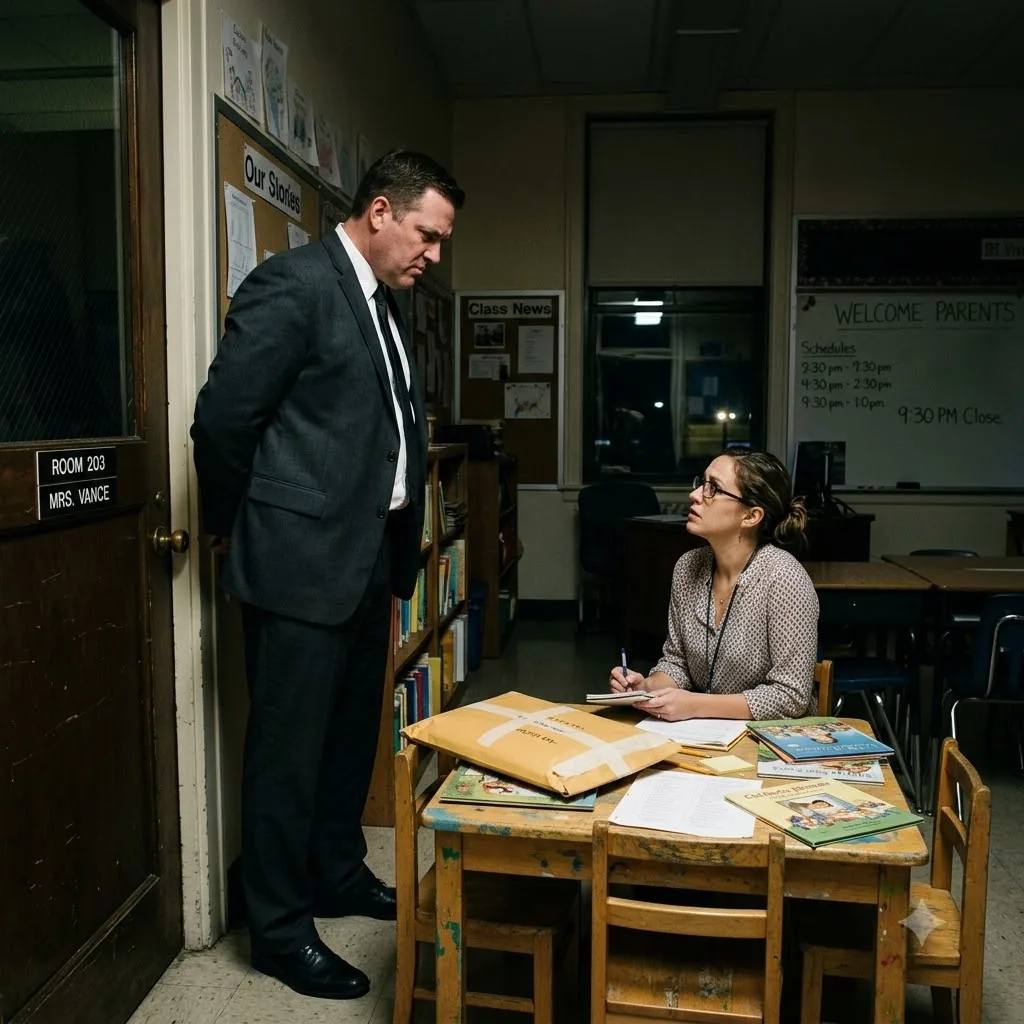
The air in Room 114 smelled of stale dry-erase markers and cheap cafeteria coffee, but the real suffocation came from the man wedged into a student desk across from me. Richard Vance, the school board president, did not do Parent-Teacher Night like normal parents. He leaned forward, his elbows encroaching on my side of the reading table, trapping my grading pen under his heavy wrist. He tapped a printed copy of my senior civics syllabus with a meticulously manicured fingernail. His voice was pitched low, a deliberate rumble meant to stay within the cinderblock walls of my classroom. He stated my unit on the criminal justice system was an unacceptable, agenda-driven deviation from the state standards.
I tried to slide my chair back to create some breathing room, but the cold metal of the filing cabinet immediately dug into my spine. There was nowhere to retreat. I explained that the curriculum matched the approved textbook chapter for chapter, keeping my tone carefully measured and professional. Vance smiled, a thin, humorless stretching of his lips that did not reach his cold eyes. He leaned closer, his broad shoulders blocking the harsh glare of the fluorescent light above us. He told me the board would not tolerate ideological indoctrination disguised as social studies. He called it woke garbage meant to undermine municipal authority and poison the minds of the youth. I nodded slowly, maintaining the neutral, passive expression I had spent the last five years perfecting in front of mirrors. I told him I would review the reading list if he felt the material was too heavy for high school seniors.
That was when his vocabulary shifted, and the temperature in the room seemed to plummet. Vance stopped talking about PTA guidelines and community standards. He looked at my unit on prison reform and pointed directly at a subsection on mass incarceration. He told me the county was not interested in funding a critique of Title 15 compliance metrics.
The phrase hit my ears like a blaring siren. I felt the blood drain from my face. Normal school board presidents complained about property taxes, teacher salaries, and inappropriate library books. They did not casually cite the specific administrative codes governing county jail facilities and inmate management. I stared at the syllabus, forcing my breathing to remain perfectly even. I informed him Title 15 was just a historical reference in the supplementary text.
Vance shook his head, his eyes locking onto mine with a cold, practiced authority that made my stomach turn. He mentioned that discussing conditional release violations and the exact operational costs of recidivism matrices crossed a massive line. Those were not terms you picked up from watching the evening news or reading an online encyclopedia. Those were precise operational phrases used exclusively by wardens, parole boards, and private corrections contractors.
My pulse hammered against my stiff collar. I gripped the undersides of the reading table, forcing my hands to stay completely still. I told Vance the students just needed to understand basic civic structures and local governance. I reminded him that the syllabus had been approved by the principal months ago. He ignored my response entirely. He brought up Section 4030 of the penal code, casually dropping the exact statute detailing strip search regulations in holding facilities. He stated that minors had no business reading such things, especially not from an instructor who lacked the proper moral standing to teach it.
The hair on the back of my neck stood up. I knew that statute. I knew all of them, though I had spent half a decade burying that knowledge under a pile of tweed jackets, lesson plans, and a carefully constructed fake identity. Vance was not here to debate pedagogy or complain about the woke agenda.
I made a sudden move to stand up, signaling that the conference time was officially over. I told him I had to lock up the building. Vance moved much faster than a man his size should be able to. He stood up and planted a heavy, unyielding hand on my shoulder, forcing me hard back down into the cramped chair. The hallway outside was dead silent, the other parents having cleared out twenty minutes ago. The custodian always cleaned the opposite wing first. We were completely alone.
He stepped around the small desk, standing directly between me and the only door. His shadow swallowed the remaining space around me. With his free hand, he reached inside his tailored suit jacket. I braced myself, my muscles locking tight as long-dormant survival instincts flared to life. I prepared for the absolute worst.
Instead of a weapon, he pulled out a thick, heavily taped manila envelope. He slid it across the reading table until it hit my chest, pinning it there with his palm. The top left corner bore the unmistakable, embossed blue seal of the State Department of Corrections.
The air in Room 114 smelled of stale dry-erase markers and cheap cafeteria coffee, but the real suffocation came from the man wedged into a student desk across from me. Richard Vance, the school board president, did not do Parent-Teacher Night like normal parents. He leaned forward, his elbows encroaching on my side of the reading table, trapping my grading pen under his heavy wrist. He tapped a printed copy of my senior civics syllabus with a meticulously manicured fingernail. His voice was pitched low, a deliberate rumble meant to stay within the cinderblock walls of my classroom. He stated my unit on the criminal justice system was an unacceptable, agenda-driven deviation from the state standards.
I tried to slide my chair back to create some breathing room, but the cold metal of the filing cabinet immediately dug into my spine. There was nowhere to retreat. I explained that the curriculum matched the approved textbook chapter for chapter, keeping my tone carefully measured and professional. Vance smiled, a thin, humorless stretching of his lips that did not reach his cold eyes. He leaned closer, his broad shoulders blocking the harsh glare of the fluorescent light above us. He told me the board would not tolerate ideological indoctrination disguised as social studies. He called it woke garbage meant to undermine municipal authority and poison the minds of the youth. I nodded slowly, maintaining the neutral, passive expression I had spent the last five years perfecting in front of mirrors. I told him I would review the reading list if he felt the material was too heavy for high school seniors.
That was when his vocabulary shifted, and the temperature in the room seemed to plummet. Vance stopped talking about PTA guidelines and community standards. He looked at my unit on prison reform and pointed directly at a subsection on mass incarceration. He told me the county was not interested in funding a critique of Title 15 compliance metrics.
The phrase hit my ears like a blaring siren. I felt the blood drain from my face. Normal school board presidents complained about property taxes, teacher salaries, and inappropriate library books. They did not casually cite the specific administrative codes governing county jail facilities and inmate management. I stared at the syllabus, forcing my breathing to remain perfectly even. I informed him Title 15 was just a historical reference in the supplementary text.
Vance shook his head, his eyes locking onto mine with a cold, practiced authority that made my stomach turn. He mentioned that discussing conditional release violations and the exact operational costs of recidivism matrices crossed a massive line. Those were not terms you picked up from watching the evening news or reading an online encyclopedia. Those were precise operational phrases used exclusively by wardens, parole boards, and private corrections contractors.
My pulse hammered against my stiff collar. I gripped the undersides of the reading table, forcing my hands to stay completely still. I told Vance the students just needed to understand basic civic structures and local governance. I reminded him that the syllabus had been approved by the principal months ago. He ignored my response entirely. He brought up Section 4030 of the penal code, casually dropping the exact statute detailing strip search regulations in holding facilities. He stated that minors had no business reading such things, especially not from an instructor who lacked the proper moral standing to teach it.
The hair on the back of my neck stood up. I knew that statute. I knew all of them, though I had spent half a decade burying that knowledge under a pile of tweed jackets, lesson plans, and a carefully constructed fake identity. Vance was not here to debate pedagogy or complain about the woke agenda.
I made a sudden move to stand up, signaling that the conference time was officially over. I told him I had to lock up the building. Vance moved much faster than a man his size should be able to. He stood up and planted a heavy, unyielding hand on my shoulder, forcing me hard back down into the cramped chair. The hallway outside was dead silent, the other parents having cleared out twenty minutes ago. The custodian always cleaned the opposite wing first. We were completely alone.
He stepped around the small desk, standing directly between me and the only door. His shadow swallowed the remaining space around me. With his free hand, he reached inside his tailored suit jacket. I braced myself, my muscles locking tight as long-dormant survival instincts flared to life. I prepared for the absolute worst.
Instead of a weapon, he pulled out a thick, heavily taped manila envelope. He slid it across the reading table until it hit my chest, pinning it there with his palm. The top left corner bore the unmistakable, embossed blue seal of the State Department of Corrections.