Story code: ST-001098
Part 2: The Inventory
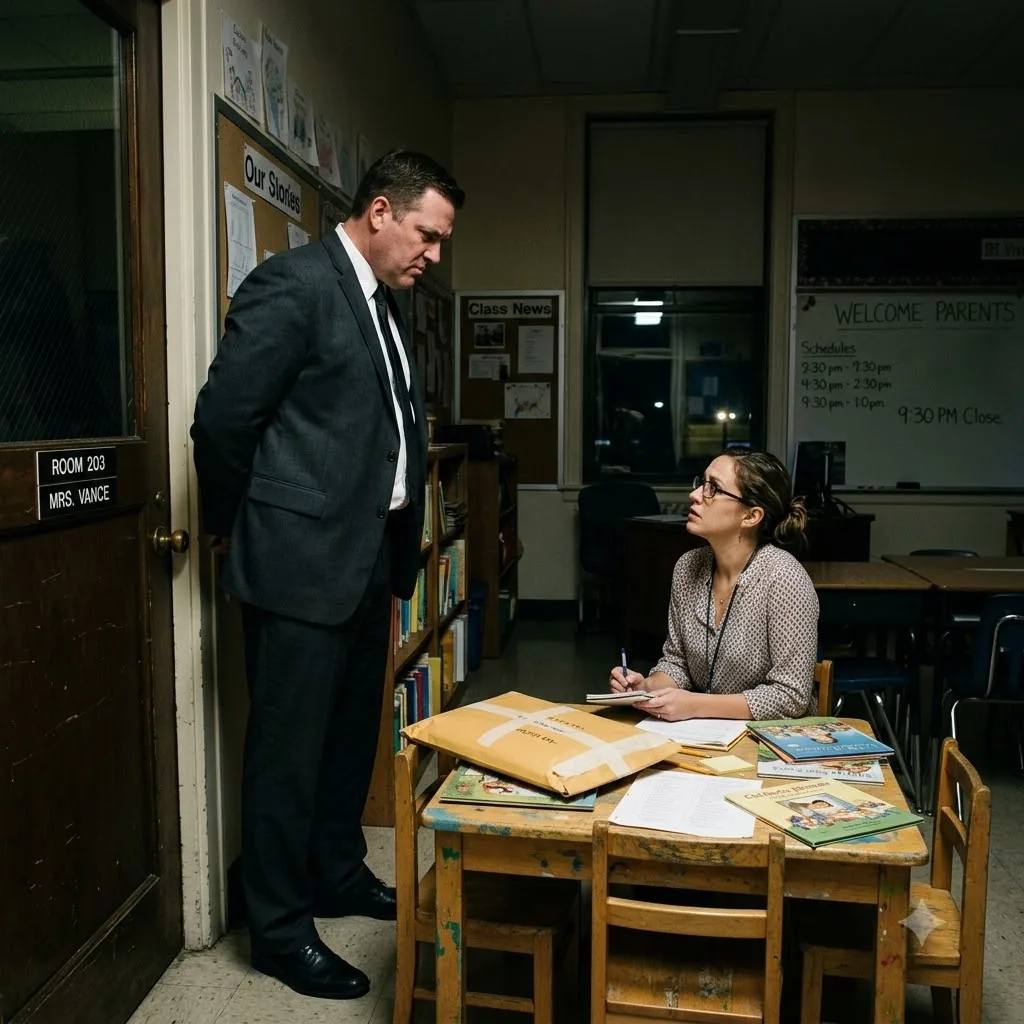
The blue seal of the State Department of Corrections stared up at me, a tiny embossed anchor dragging me back down into the deep water I had spent five years swimming away from. I didn’t look at Vance. I kept my eyes fixed on the manila envelope, the weight of his broad palm still pressing it into my sternum. The fluorescent lights overhead buzzed, a low, mechanical hum that sounded exactly like the cell block locking mechanisms at San Quentin.
“Open it,” Vance commanded. His voice wasn’t loud, but it possessed the density of a man entirely used to total compliance.
My fingers felt numb, detached from my body, as I fumbled with the heavy tape. I didn’t want to break the seal. Breaking the seal meant acknowledging the contents, and acknowledging the contents meant Marcus the dedicated civics teacher was dead. I pulled the flap back. A stack of paper slid out onto the scratched laminate of the reading table.
The top page was a booking sheet. The photograph in the upper right corner showed a younger, harder version of me. My head was shaved, my eyes hollow and defiant, a line of bruised stitches tracking over my left eyebrow. Below the photo, my real name was printed in stark, block letters: *Miller, Thomas J.* Next to it were the felony conviction codes, the sentencing mandates, and the parole conditions I was currently violating by standing in a public high school under an assumed name with forged background check documents.
“Thomas,” Vance said, testing the name like a new brand of whiskey. “I have to admit, your forged credentials are spectacularly good. It took my security director three weeks to flag the biometric discrepancy in the state teacher database. You’ve built a very nice, quiet life for yourself here in the suburbs. Pension plan. Dental. Respect.”
I kept my hands flat on the table, away from the papers. “What do you want?” I asked, my voice rasping in my dry throat.
“I want what I said I wanted,” Vance replied, stepping back just enough to let me breathe, though the invisible pressure in the room only intensified. “I want you to fix your syllabus. But more importantly, I want you to understand the ecosystem you are currently trying to disrupt.”
He reached out and tapped a second document beneath the booking sheet. It was a municipal zoning map, overlaid with red and blue shaded areas. I recognized the county limits, the impoverished east side, and the sprawling industrial park on the outskirts of town.
“You’re teaching these kids about systemic inequity and the prison-industrial complex,” Vance said, his tone conversational, almost academic. “You’re making them question authority. You’re making the parents question the school board. This moral panic you’re so stubbornly fighting? The angry moms shouting at board meetings about woke indoctrination and juvenile delinquency? It’s not about politics, Thomas. It’s about inventory.”
The word hit me like a physical blow. *Inventory.*
Vance traced a manicured finger over a massive red square in the industrial park. “The county just approved a seventy-five-million-dollar contract to expand the regional juvenile detention facility. A facility managed by a private holding group I happen to chair. We have two thousand new beds opening up next fall. The state pays us a per-diem rate for every occupied bed, but if occupancy drops below eighty percent, we eat the overhead. We cannot afford to eat the overhead.”
I stared at the red square on the map, the nausea rising in my throat. I understood exactly what he was saying. They were drumming up a local panic over out-of-control youth to justify a massive police crackdown and zero-tolerance policies in the schools. They needed the kids in my classroom to fail. They needed them angry, marginalized, and funneled directly into the criminal justice system to keep Vance’s profit margins in the black. My curriculum-teaching kids how the system worked, how to navigate their rights, how to avoid the traps-was directly threatening his supply chain.
“You want me to feed them to you,” I whispered, the horror leaking into my voice.
“I want you to be pragmatic,” Vance corrected smoothly. “You know better than anyone that the system always gets fed. If you step in the way, it will just eat you instead.”
He picked up the booking photo, holding my past between his thumb and forefinger. “Here is how this works, Thomas. Tomorrow night is the open school board meeting. You are going to stand up at the podium during the public comment period. You are going to apologize to the community for your misguided, ideologically driven curriculum. You will present a revised syllabus-one that heavily emphasizes zero-tolerance policies, respect for law enforcement, and the severe, unavoidable consequences of juvenile rebellion. You will validate their fear.”
“And if I don’t?” I asked, though I already knew the answer.
Vance smiled, that same thin, humorless stretch of his lips. “If you don’t, I hand this envelope to the superintendent. The police will be called. Your students will watch their favorite teacher led out of the building in handcuffs. You will go back to the state penitentiary for a minimum of five years for violating your parole and defrauding the state. Your fragile new life disappears in an afternoon.”
He dropped the booking photo back onto the table. It landed face up, my younger, angrier self staring back at me.
“Tomorrow night, Thomas,” Vance said, adjusting his suit jacket. “Eight p.m. Have your apology prepared.”
He turned and walked out of the classroom, his expensive leather shoes clicking rhythmically against the linoleum hallway until the sound faded completely. I was left alone in the stifling silence of Room 114, staring at the shattered pieces of my fake life, the heavy manila envelope waiting for my answer.