Story code: ST-001054
Part 2: The Hard Lockout
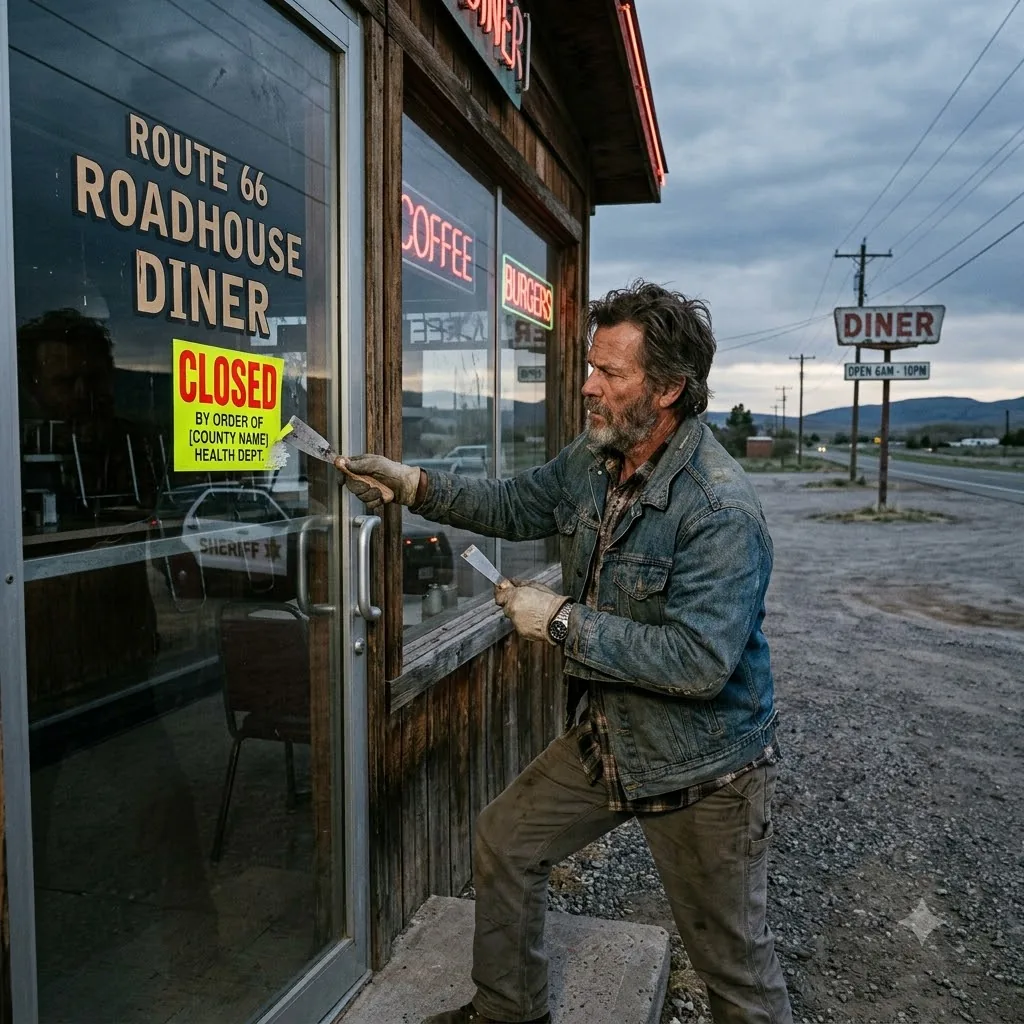
The deputy left the cruiser door hanging open, the morning heat already baking the dark interior of the vehicle. Silas recognized the man’s heavy, rolling gait immediately. Deputy Jim Miller. A man who had eaten chicken fried steak at the Elkhorn’s corner booth every Sunday for a decade, a man who had brought his children in for milkshakes after Little League games. Today, though, Miller wasn’t making eye contact with the same familiar warmth. His gaze dropped immediately to the neon orange scraps scattered over the concrete porch, then snapped up to the heavy plastic handle locked tight in Silas’s fist.
“Morning, Silas,” Miller said. His voice was entirely devoid of its usual neighborly drawl, flattened instead into the careful, measured cadence of a law enforcement officer assessing a threat. He stopped at the bottom of the wooden porch steps, keeping a calculated, tactical distance. “I’m going to need you to set the blade down on the ledge there.”
“I’m cleaning my front door, Jim,” Silas said, refusing to move his arm. The scraper felt intensely heavy in his palm, its purpose suddenly magnified and distorted. To Silas, it was a simple tool, stained with years of scraping grease off the flat top and old paint off the trim. But the way Miller stared at the exposed, gleaming razor edge made the stifling air between them crackle with dangerous electricity.
“We both know what you’re cleaning off it,” Miller said. He shifted his weight, his right hand moving deliberately away from his heavy belt buckle to rest on the bright yellow grip of his Taser. “Maya Lin called dispatch. Said you were actively destroying a county health notice. Seeing as how it’s shredded all over your work boots, I’d say she wasn’t exaggerating. Put the tool down, Silas. Now.”
“It’s vandalism,” Silas countered, his voice rising, carrying out over the empty expanse of the dirt parking lot. “She came onto my private property in the middle of the night and defaced my building. I’m taking out the trash. You should be arresting her for trespassing.”
“It’s a lawful order, and you’re violating it,” Miller replied. The radio pinned to his broad shoulder barked a sudden burst of static, followed by a dispatcher’s garbled voice confirming an address. Miller reached up with his left hand and clicked the mic, his eyes never leaving Silas. “Unit four, I’m on scene. Suspect is non-compliant. Send the county works truck.”
Silas felt a cold, jagged spike of adrenaline pierce right through the center of his anger. County works. He lowered the scraper just a fraction of an inch. “What works truck? What are you talking about, Jim?”
Miller dropped his hand from the radio, his expression hardening into an unreadable mask. “You broke the seal, Silas. The health department’s protocol for a breached notice on a critical fire hazard is a hard lockout. Maya signed the emergency work order five minutes ago. They’re bringing a hardened steel chain and a padlock. They’re going to run it right through the handles of your double doors.”
The words hit Silas like a physical blow to the chest, knocking the breath from his lungs. He turned his head slightly, looking at the familiar, worn brass handles of the Elkhorn Cafe. His grandfather had installed those handles. His father had polished them every evening. The thought of thick, greasy county chains wrapping around them, locking him out of his own life, was fundamentally incomprehensible. If they chained the doors, the Elkhorn wasn’t just closed. It was a cage. And he would be trapped on the outside of it, standing in the dust, possessing a piece of paper that meant absolutely nothing. His obsession with his rights would leave him without a building to exercise them in.
“They aren’t touching my doors,” Silas said, his voice dropping to a low, dangerous gravel. He took a half-step sideways, positioning his body squarely in front of the entrance. His grip on the scraper tightened again until his knuckles turned a mottled, bone-white.
Miller’s demeanor shifted instantly from cautious to explicitly tactical. He took one heavy step up onto the bottom stair of the porch. The old wood groaned in protest under his boots. He unclasped the retaining strap on the Taser holster with a distinct, sharp snap that echoed loudly against the glass storefront.
“Listen to me very carefully, Silas. I don’t want to drop you on your own porch,” Miller said. The professional detachment in his voice slipped just enough to reveal genuine, mounting strain. “But you are holding a razor blade, you are agitated, and you are obstructing a lawful county operation. If you do not put that blade on the window ledge right now and step away from the door, I am going to deploy my weapon. Then I am going to arrest you, put you in the back of my cruiser, and watch them chain your diner shut while you sit in a holding cell.”
The morning heat pressed down heavily on Silas’s shoulders, suffocating and thick. The electrical hum of the neon sign buzzing above the awning seemed to grow deafening, vibrating deep in his jaw. He looked past Miller, out toward the shimmering asphalt of the two-lane highway at the edge of the lot. A heavy, flatbed utility truck with a flashing yellow light on its cab was slowing down, its turn signal blinking rhythmically through the heat distortion. The county works crew.
He looked back at the glass door, completely clean now, reflecting his own sweat-drenched face and the tense, armed deputy standing on his stairs. If he fought, he went to jail, and the diner died today. If he surrendered, he gave them absolute permission to chain up his legacy, validating their authority over his property. The heavy truck crunched onto the loose gravel lot, its diesel engine rumbling ominously, boxing Silas into a claustrophobic corner where every single path forward required him to sacrifice everything he was fighting to keep.