Story code: ST-001714
Part 2: The Pedestrian Loophole
The silence inside the cabin was sudden and absolute. Mateo stared at the blank screen of the dispatch tablet, his breathing the only sound competing with the ticking of the cooling engine block. Turning off the primary communication console was a fireable offense, a blatant violation of the driver handbook’s section on insubordination. But leaving it on meant acknowledging an unwinnable conversation while the meter ran on his suspension.
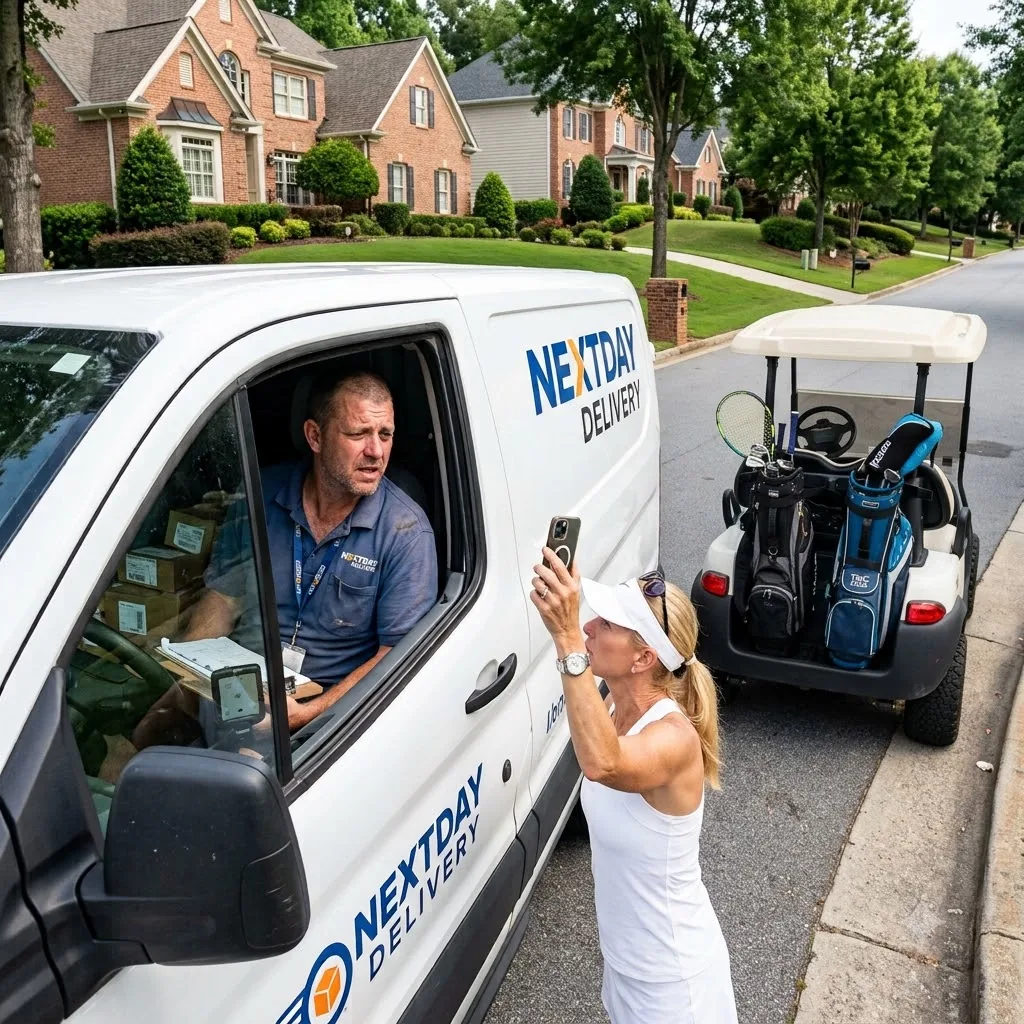
Outside the window, the woman adjusted her grip on her phone, angling it to capture the darkened screen on his dashboard.
“The driver has now disabled his tracking equipment,” she narrated to her live stream, her voice rising in pitch to ensure it carried through the glass. “He is attempting to conceal his activities. I need someone to call the precinct. Tell them we have a rogue commercial vehicle at the end of Oak Creek Lane.”
Mateo unbuckled his seatbelt. The metallic click echoed in the small space. He had three packages left for this cul-de-sac. Company policy stated a route wasn’t abandoned if the driver was actively delivering freight. If he emptied the manifest, he wasn’t trapped; he was working.
He grabbed his handheld scanning device from its cradle, the plastic warm from the sun, and shoved it into his back pocket. Instead of opening the driver’s side door and stepping directly into her phone camera, Mateo pivoted, slipping through the interior bulkhead door into the sweltering cargo bay.
The back of the step van felt like an oven. Cardboard dust danced in the shafts of light bleeding through the roof vents. He located the final three packages stacked on the rear shelf: two small padded mailers and one heavy, rectangular box wrapped in reinforced tape.
He stacked the mailers on top of the box, hoisted the load against his chest, and moved to the passenger side door. He shoved the heavy metal door open, stepping down onto the burning asphalt of the street, deliberately putting the bulk of the delivery van between himself and the golf cart. He locked the doors behind him with the remote fob. The heavy clunk of the deadbolts engaging was loud enough to make the woman pause her narration.
Mateo didn’t look at her. He kept his eyes fixed on the house numbers. 4102. 4104. 4106. The three properties lining the curved end of the cul-de-sac.
He marched toward 4102, a sprawling stucco home with a manicured lawn that looked too green for the current drought restrictions. His boots hit the pavement with heavy, rhythmic thuds.
“Hey!” the woman shouted. Her tennis shoes scuffed against the asphalt as she scrambled around the front of the delivery van to keep him in frame. “Where do you think you’re going? You are not authorized to approach these properties!”
Mateo reached the porch of 4102. He set the heavy box down on the Welcome mat, pulled out his handheld scanner, and scanned the barcode. The device let out a sharp beep. He snapped the required photographic proof of delivery, swiped to complete the stop, and turned back to the street.
The woman was standing at the end of the driveway, completely blocking the sidewalk. Behind her, the front door of 4104 opened, and a man in a polo shirt and khaki shorts stepped out, clutching a heavy brass garden hose nozzle like a weapon.
“Brenda, what’s going on?” the man called out, his eyes darting from the parked van to the locked golf cart, and finally to Mateo.
“He’s refusing to identify himself, Tom!” the woman, Brenda, yelled back, never lowering the phone. “He tried to run me over, then he shut off his tracker, and now he’s trespassing on the Jenkins’ property!”
Mateo walked down the driveway, keeping his pace steady and predictable. He held up the two remaining padded mailers where both Brenda and the phone camera could see them.
“I am a delivery driver,” Mateo said, directing his voice to the man on the porch rather than the phone in his face. “I am delivering mail. Excuse me.”
He stepped off the concrete driveway and onto the grass to bypass Brenda.
“Do not step on that turf!” Brenda shrieked, lunging sideways to cut him off. She thrust her phone so close to Mateo’s face that the edge of the plastic case bumped his chin.
Mateo stopped immediately, freezing his momentum. He raised his hands, keeping the mailers visible, ensuring his palms were open. Any physical contact, even accidental, would be framed as assault. The handbook was explicitly clear: *Create space.*
“Ma’am, you just made physical contact with me,” Mateo said, keeping his volume level. “Please step back.”
“I have it all on video!” Brenda countered, her chest heaving. “You aggressively walked into my device!”
“Brenda, I’m calling security,” Tom shouted from his porch, retreating into his doorway but leaving the heavy wooden door open. “Just keep him there!”
Mateo calculated the distance to the next house. 4104. Tom’s house. The label on the top padded mailer confirmed it. He looked at the man retreating inside, then at the envelope in his hand.
Suddenly, the handheld scanner in Mateo’s back pocket began to vibrate violently against his leg. It wasn’t the standard pulse of a new stop added to the queue. It was a sustained, rapid buzzing-the emergency override from the regional dispatch center. By turning off the dashboard tablet, he had forced the system to route the escalation directly to his personal device.
He pulled the scanner out. The screen was flashing bright red, a color strictly reserved for critical safety violations or immediate termination notices.
A bold text box dominated the small screen: *UNAUTHORIZED DISCONNECT. RETURN TO VEHICLE IMMEDIATELY TO AVOID ABANDONMENT CHARGES. SUPERVISOR EN ROUTE. POLICE DISPATCHED BY RESIDENT.*
Mateo looked from the flashing screen to his van. The vehicle was completely blocked by the locked golf cart. The key to the cart was lost in a thick patch of ivy fifty feet away. If he retreated to the sweltering, locked van, he was trapped in a metal box until the police arrived to hear Brenda’s version of events. If he stayed out here, he was abandoning his vehicle according to the blinking red text in his hand.
Two more front doors opened down the street. The low hum of voices began to echo across the cul-de-sac as neighbors stepped out onto their lawns, phones raised, forming a loose perimeter around the sidewalk.
Mateo looked down at the last two packages in his hand, then at the flashing red screen demanding his surrender to a trap he couldn’t drive out of.