Story code: ST-001714
Part 4: The Metric Toll
Mateo didn’t pull back. He didn’t push her away. The driver handbook’s mandate on physical altercations echoed in his mind: *Create space. Never engage.*
As Brenda’s nails dug into his forearm, tearing through the top layer of his skin, Mateo simply let go of the resistance she was pulling against. He stepped sharply to the right, pivoting his hips and raising the heavy commercial dashcam high and out of her reach.
Deprived of her anchor, Brenda’s own violent momentum betrayed her. She stumbled forward, her pristine white tennis shoes tangling against the sharp edge of the concrete curb. With a breathless shriek, she pitched forward, arms flailing wildly as she crashed headfirst into the expansive, aggressively manicured flowerbed bordering the Jenkins’ driveway.
The impact was a wet, heavy thud. A cloud of dark, imported mulch plumed into the humid air, followed instantly by the sharp scent of crushed snapdragons and damp peat moss. Brenda thrashed in the dirt, her visor askew, her white tennis outfit smeared with thick, dark mud.
Before she could even spit the dirt from her mouth to scream, the chirp of a short police siren sliced through the heavy afternoon air.
Mateo turned. Two county sheriff cruisers swung sharply into the cul-de-sac, their lightbars painting the surrounding houses in frantic flashes of red and blue. They parked in a tight V-formation, effectively blocking the entrance to the street and trapping the neighbors who had come out to watch.
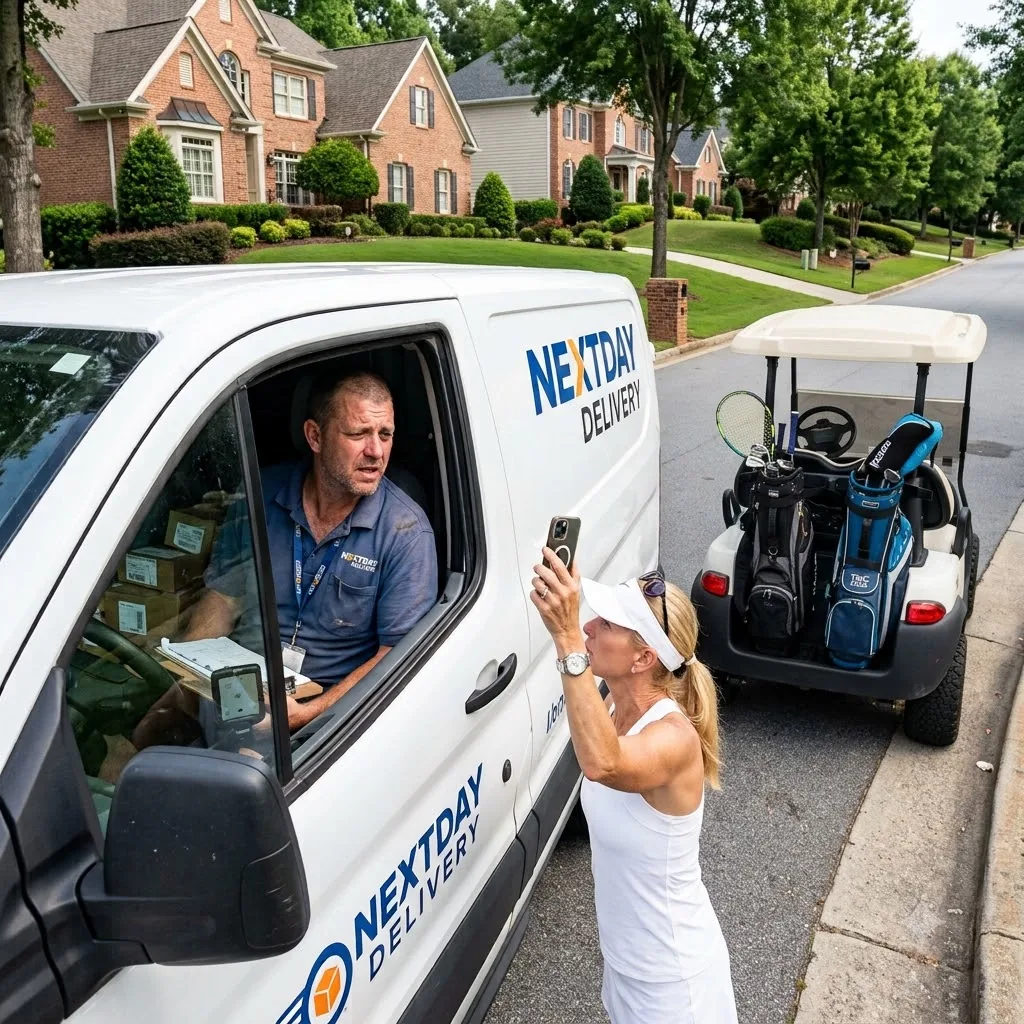
Doors popped open. Three officers stepped out, hands resting cautiously on their duty belts as they took in the chaotic scene: a delivery van boxed in by a locked, candy-apple-red golf cart, a loose perimeter of neighbors hovering on their lawns, a man in a torn uniform holding a blinking black box, and a woman covered in mud pulling herself out of a ruined flowerbed.
“He attacked me!” Brenda shrieked, pointing a shaking, dirt-caked finger at Mateo. She scrambled to her knees, wiping a smear of mud across her forehead that completely ruined her makeup. “He threw me into the dirt! Arrest him! I have it all on… I had it on video!”
She looked down at her phone, still lying on the asphalt where she had dropped it. The screen was spider-webbed with cracks, completely dead.
An officer approached Mateo, his eyes dropping to the bleeding crescent-moon scratches on Mateo’s forearm and the torn flap of his chest pocket.
“Put the device on the hood of the van, sir. Slowly,” the officer instructed.
Mateo complied immediately. He set the dashcam down. The green emergency battery light was still blinking its steady, rhythmic pulse.
“I am a commercial driver,” Mateo said, keeping his voice carefully level and devoid of emotion. “That device is a corporate telematics recorder. It captures audio and wide-angle video. It has been recording for the last fifteen minutes. The footage will show that resident barricading my vehicle, locking the steering column, hiding the key, and physically assaulting me when I informed her she was committing false imprisonment.”
The officer looked from Mateo to the blinking black box, then over to Brenda, who had suddenly stopped shouting. The color drained from her dirt-streaked face.
“Is that true, ma’am?” the second officer asked, stepping toward the flowerbed.
“He… he was violating neighborhood protocols!” Brenda stammered, her voice shrinking. She brushed frantically at the wet mulch clinging to her shorts, looking around at her neighbors for support. None of them stepped forward. Tom, the man with the hose nozzle, quietly stepped back inside his house and closed his heavy front door until the deadbolt clicked.
It took forty-five minutes to untangle the mess. The officers didn’t need a forensics team; they just plugged a heavy-duty USB cable from their cruiser’s field laptop into the side of the dashcam. Mateo sat on the curb in the suffocating heat, watching silently as the lead officer reviewed the unblinking, high-definition truth.
By the time the playback finished, the neighborhood audience had completely dispersed, retreating into their air-conditioned homes to avoid the humiliation bleeding off the street. An officer ordered Brenda to find the key to her golf cart or face immediate impoundment. She spent ten minutes crawling through the thick ivy, weeping quietly in her ruined clothes, before finally producing the small brass key.
The officers took Mateo’s statement, photographed his bleeding arm for the assault report, and handed back his dashcam. They told him he was free to go. Brenda was placed in the back of a cruiser, muddy and hyperventilating, while they sorted out the federal implications of detaining a commercial freight carrier.
Mateo didn’t stay to watch her leave. He climbed back into the suffocating oven of his delivery van. He remounted the dashcam to the windshield and plugged it back into the primary power array.
He reached into his pocket and pulled out his handheld scanner. The emergency override screen was gone, replaced by his daily metrics dashboard.
Mateo stared at the numbers. His delivery-per-hour rate was in the single digits. The algorithm had logged a sixty-two-minute unexcused idle delay. The bright green bar that tracked his weekly performance bonus-money he desperately needed for rent this month-was gone, replaced by a flat, gray zero. The system didn’t care about false imprisonment or torn shirts. It only cared that the packages were stationary.
He wiped a bead of sweat from his forehead, wincing as the salt stung the fresh scratches on his arm. He put the van in gear, the heavy diesel engine rattling to life. He still had sixty stops left on his route, and all he felt was a bitter, bone-deep exhaustion.