Story code: ST-001316
Part 4: The Oakhaven Ghost
“You are making a catastrophic mistake,” Brenda said. The practiced HR cadence was gone. Her voice was flat, reduced to the cold, mechanical hum of an engine shifting gears.
She didn’t reach for the printout. She knew better than to lunge for it in a crowded diner. Instead, she placed her hand on the Voluntary Resignation agreement and pulled it back across the sticky table.
“If you walk out that door, you are terminated for cause,” Brenda said, her eyes locked on his. “No severance. No references. And your health benefits expire at midnight tonight.” She let her gaze drift deliberately to his left temple, where he had been aggressively massaging his head yesterday afternoon. “Including your top-tier prescription coverage. I know what those neurology consultations cost, Elias. I know what the sumatriptan costs out of pocket. You cannot afford to fight a corporate legal team, and you certainly can’t afford to do it with untreated migraines.”
Elias looked at her. His head was already throbbing, a dull, familiar pressure building behind his left eye from the diner’s harsh neon window sign. But the paralyzing fear that had gripped him in the locked lobby was gone, replaced by a strange, hollow clarity.
He reached out and took the folded printout of the transit logs, slipping it safely back into the inner breast pocket of his wool coat.
“I’ll manage,” Elias said.
He slid out of the cracked vinyl booth. Two tables away, the men in the charcoal suits instantly stood, their hands dropping smoothly to their sides. But the Starlight Diner was filling up. A waitress carrying a massive tray of ceramic coffee mugs bustled past them, and a family of four squeezed into the booth directly across the aisle. Brenda raised a single, rigid hand. The security men stopped, their faces tight with frustration, and stepped back to let him pass.
Elias didn’t look back as he pushed through the heavy glass doors of the diner.
The morning sun was already brutal, beating down on the asphalt parking lot with a heavy, oppressive heat that promised a miserable August afternoon. Elias walked past a row of idling pickup trucks, his heavy winter coat suddenly suffocating. He didn’t take it off. He kept his hand pressed against the breast pocket until he reached his ten-year-old sedan.
He unlocked the door and slid behind the steering wheel. The interior of the car was an oven, the trapped air smelling faintly of hot plastic and old dust. He didn’t turn the key to start the air conditioning. He just sat there in the sweltering silence, the sweat beginning to prickle at the back of his neck.
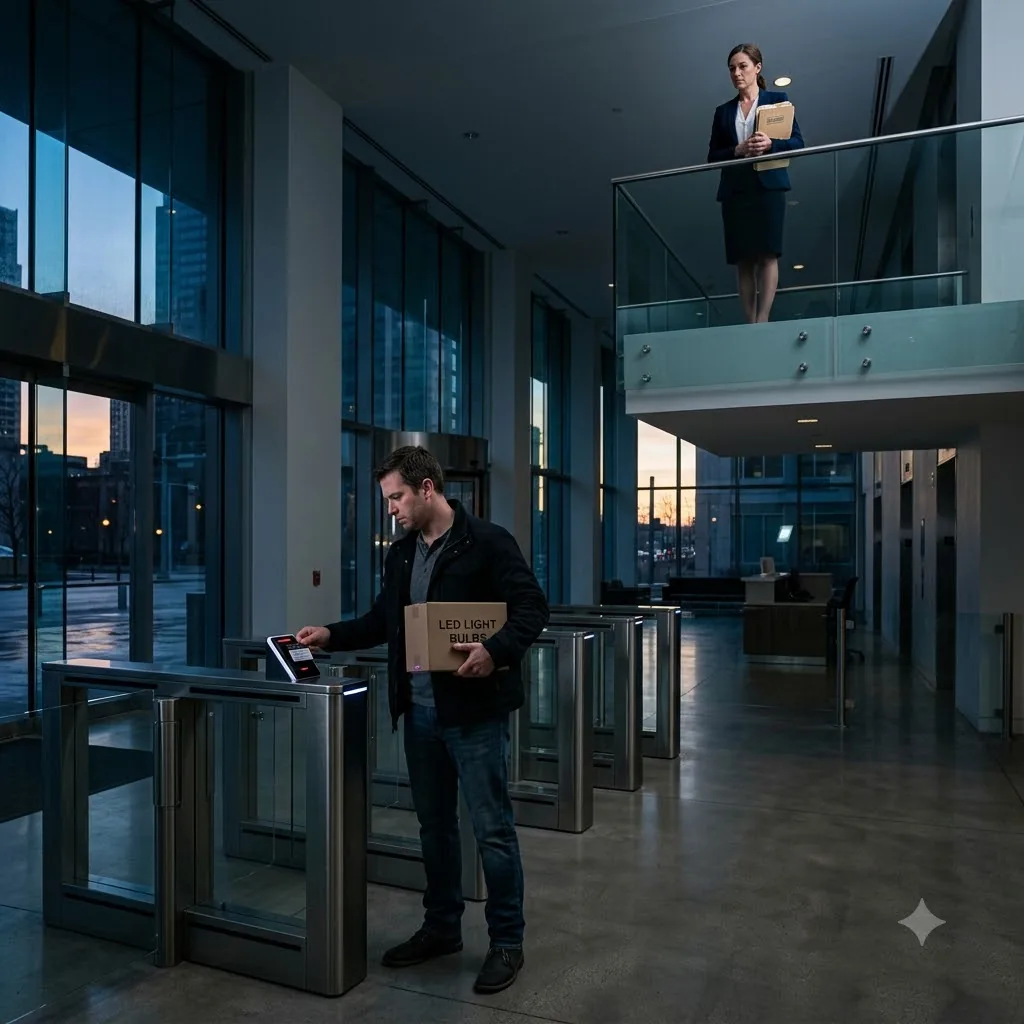
On the passenger seat, sitting perfectly undisturbed, was the cardboard four-pack of soft-white lightbulbs.
Elias stared at the cheap cardboard box. It was a mundane, ridiculous thing. Six dollars’ worth of fragile glass and tungsten filament that had inadvertently triggered a massive corporate security response. He had just wanted to soften the glare in his cubicle so he could finish his shift in peace. Instead, the bulbs had blown his cover before he was entirely ready, costing him his livelihood, his health insurance, and any remaining illusion of safety.
He reached into his coat and pulled out the folded papers again. He smoothed them out over the worn, sun-cracked leather of the steering wheel.
His finger traced down the crisp black ink, stopping at Column F. The falsified routing numbers. The empty dirt lot in Oakhaven.
The company had categorized the missing high-grade commercial electronics as standard inventory shrinkage. But Elias knew exactly what pallets 409 through 450 contained. They weren’t consumer laptops or flat-screen televisions. They were heavy-duty industrial relays and localized grid-stabilizers.
They were the exact hardware the logistics center had been contracted to deliver to the Oakhaven municipal power grid last winter.
When the historic February freeze had hit, the Oakhaven substation had failed spectacularly. The company had issued a sterile press release citing “unforeseen global supply chain delays” as the reason the backup stabilizers hadn’t been installed in time. The rolling blackouts had lasted four days. The entire county had gone dark, temperatures plummeting into the single digits.
And in that dark, his older brother David’s oxygen concentrator had simply powered down.
Elias pressed his palm hard against the steering wheel. His chest tightened, a jagged, breathless ache that had nothing to do with the stifling heat of the car. David had died in a freezing apartment while the company executives dodged reporters and blamed international shipping lanes.
But there had been no supply chain delays. The hardware had been in the regional warehouse all along. It had been systematically diverted, quietly routed off the books to a phantom dirt lot, likely sold to private commercial bidders for three times the municipal contract rate while the city froze.
They hadn’t just stolen inventory. They had traded David’s life for a profit margin.
Elias picked up the box of lightbulbs and tossed them into the back seat. He didn’t need them anymore. He wouldn’t be returning to the fluorescent glare of the fourth floor. He folded the printouts carefully, treating the fragile paper like glass, and placed them in the glove compartment. His head pounded, the impending migraine flashing a jagged, blinding aura at the edge of his vision, but his hands were perfectly steady as he finally turned the ignition.