Story code: ST-001282
Part 4: The Silent Strike
The silence stretched. Thorne’s thick neck flushed a deeper, more dangerous shade of purple. He was a man accustomed to compliance through terror, but terror required a reaction. The twenty-five men sitting on the floor gave him nothing. They were a stone wall, absorbing his screaming outburst without a single crack. Unable to bear the suffocating quiet a second longer, Thorne reached up and keyed the radio mic on his shoulder.
“Code Red,” Thorne barked, his voice ragged and breathless. “Vocational Wing. Full facility lockdown.”
Caldwell snapped out of his paralyzed state, his eyes widening in absolute horror. “Thorne, are you insane? Cancel that order! The state oversight committee is in the admin block!”
“They’re refusing orders!” Thorne roared back, pointing at the seated men.
“They aren’t doing anything!” Caldwell shrieked, his voice cracking.
It was too late. The facility’s klaxons kicked in, a deafening, mechanical wail that vibrated deep in Martha’s teeth. Red strobe lights recessed in the ceiling began to spin, washing the cinderblock walls in rhythmic, violent flashes of crimson.
At the very first mechanical shriek of the alarm, Marcus did not hesitate. He calmly lifted his hands from his makeshift lap-desk, placed the maroon board neatly beside his knee, and lay flat on his stomach. He laced his fingers tightly behind his head. Beside him, the next man did exactly the same. Within five seconds, all twenty-five men were prone on the linoleum, perfectly aligned, absolutely compliant, and utterly silent.
Thorne stood stranded in the center of the grid, the siren wailing around his humiliation. He had just triggered the highest-level security protocol, a panic button that instantly nullified the prison’s safety compliance ratings, over men lying quietly on their stomachs next to math homework.
Caldwell dragged his hands down his face, pulling his skin taut. His “optimized overhead” memo was meaningless now. A Code Red during a mandatory state audit, without a weapon or a riot to justify it, was an automatic, unmitigated failure. His quarterly metrics were destroyed, and his budget surplus would be frozen pending a state investigation. He spun around, turning his panicked, furious eyes on Martha.
“You’re done,” Caldwell spat over the blare of the klaxons, his face inches from hers. “Contract terminated. Effective this second.”
Martha kept her back straight. “For teaching them fractions?”
“For inciting a riot!” Thorne yelled over the noise, desperate to justify his own massive catastrophic error.
“They are the only ones in this room not rioting,” Martha said, her voice dropping to a calm, steady register that cut right through their hysteria.
“Get her out of my sight!” Caldwell ordered Higgins. “Escort her off the property. Don’t let her pack her desk. Just get her out!”
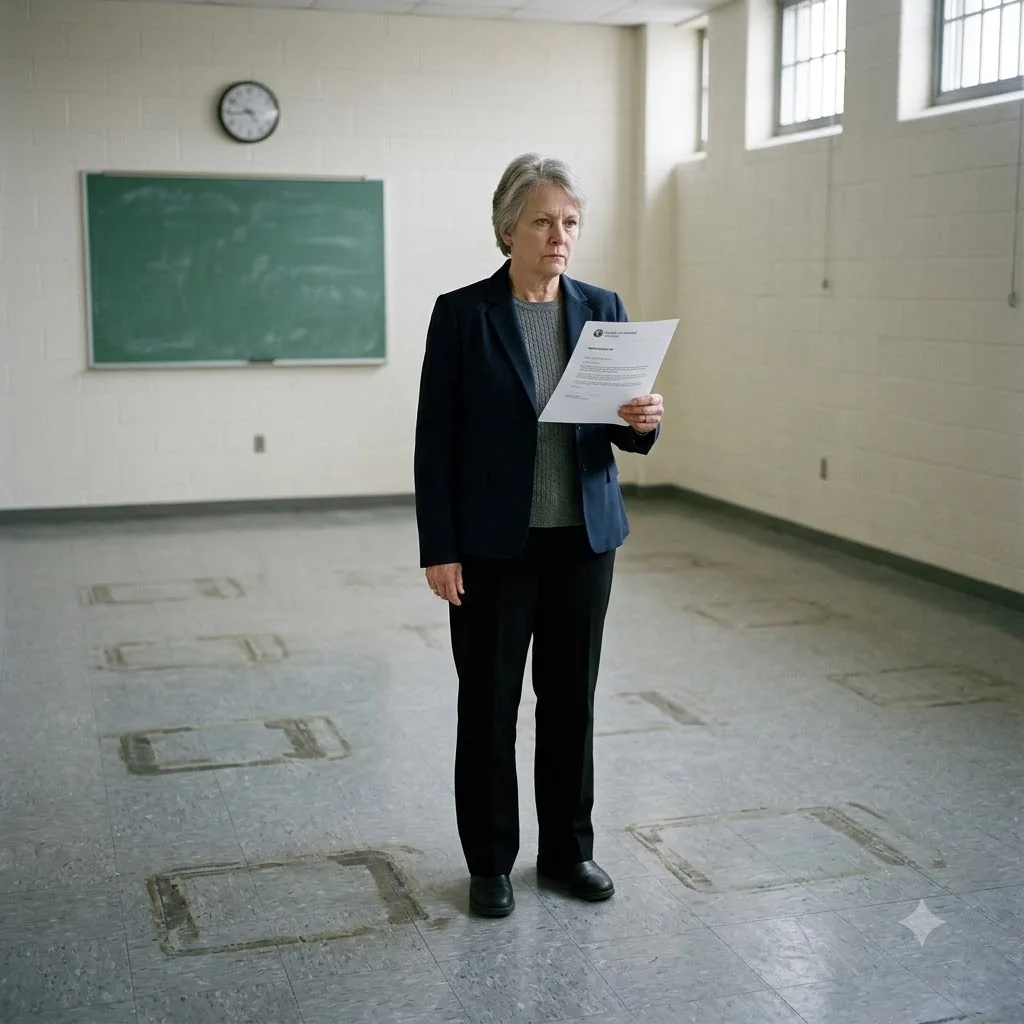
Higgins grabbed Martha by the elbow. His grip was tight, propelled by the nervous adrenaline of the flashing lights. She didn’t resist. She let him turn her toward the open doorway. As she stepped over the scattered, torn pages of the GED worksheets, she looked back one last time. Marcus’s cheek was pressed against the cold linoleum, but his eyes were locked on hers. He gave the smallest, almost imperceptible nod.
The journey down the central corridor was a surreal, flashing march. Guards sprinted past them, their heavy boots thundering toward the vocational wing with drawn batons, expecting fires and bloodshed, only to find a room full of prone men and shredded paper.
As Martha and Higgins reached the main rotunda, the klaxons abruptly died. The sudden absence of sound left a high-pitched ringing in Martha’s ears. The red strobes halted. The PA system crackled to life. It wasn’t Caldwell’s voice, nor Thorne’s. It was the clipped, bureaucratic tone of the state oversight chairman.
“Lockdown canceled. Unverified threat. All inmates resume afternoon work details immediately.”
Thorne’s unprovoked panic had been officially overridden. Higgins kept a firm grip on Martha’s arm, guiding her past the expansive reinforced glass windows that overlooked the prison’s industrial laundry and the main cafeteria kitchen. As the lockdown officially lifted, the heavy steel doors of the cell blocks rolled open with a synchronized, mechanical groan. Hundreds of men in gray uniforms filed out, heading to their mandated labor assignments.
Martha slowed her pace. Higgins tugged her, but she planted her boots on the tile.
“Keep moving,” Higgins muttered, though his own eyes drifted to the glass.
In the laundry facility below, forty men walked in. They did not move toward the massive industrial washers. They did not pick up the heavy canvas bins of dirty uniforms. Instead, the lead inmate stopped in the center of the concrete floor. He sat down, crossing his legs. The man behind him did the same.
Through the adjacent glass, Martha watched the kitchen crew. Fifty men marched into the stainless-steel prep area. The ovens remained dark. The massive soup kettles sat empty. The men found their spaces on the damp tile and lowered themselves to the ground.
No one shouted. No one threw a punch. They just sat. Shoulder to shoulder. Knee to knee. The guards in the kitchen started yelling, waving their hands, pointing aggressively to the unlit stoves. The inmates didn’t blink. They stared straight ahead, a wall of perfect, immovable discipline.
Higgins’s hand fell away from Martha’s elbow. He pressed his palm against the glass, his mouth slightly open, realizing the sheer magnitude of what he was witnessing. The unity she had inadvertently forged in the hollowed-out classroom had spread. The administration could take away their desks, their books, and their teacher, but they could not force them to work. The prison ran on inmate labor, and without it, the facility would grind to a halt before dinner.
Martha adjusted her cardigan. She didn’t need to stay to see what happened next. Caldwell’s control was an illusion, and Thorne’s authority was entirely broken. The men had found their leverage, and it was loud, organized, and perfectly silent. She turned away from the glass and walked the rest of the way to the front exit alone.