Story code: ST-001896
Part 3: The Polaroid
Eli’s hands remain on the cold iron drop-bar. The familiar voice echoing through the steel door belongs to Julian, a twenty-something food blogger and self-appointed neighborhood watchdog who has spent the last year building a massive online following. Julian has been in the diner a dozen times, always ordering a single side dish, always asking leading questions, always filming.
The pounding on the exterior steel stops. “Five minutes, Eli,” Julian calls out, his tone dripping with the performative righteousness of a man who knows an audience is watching. “Don’t make this worse.”
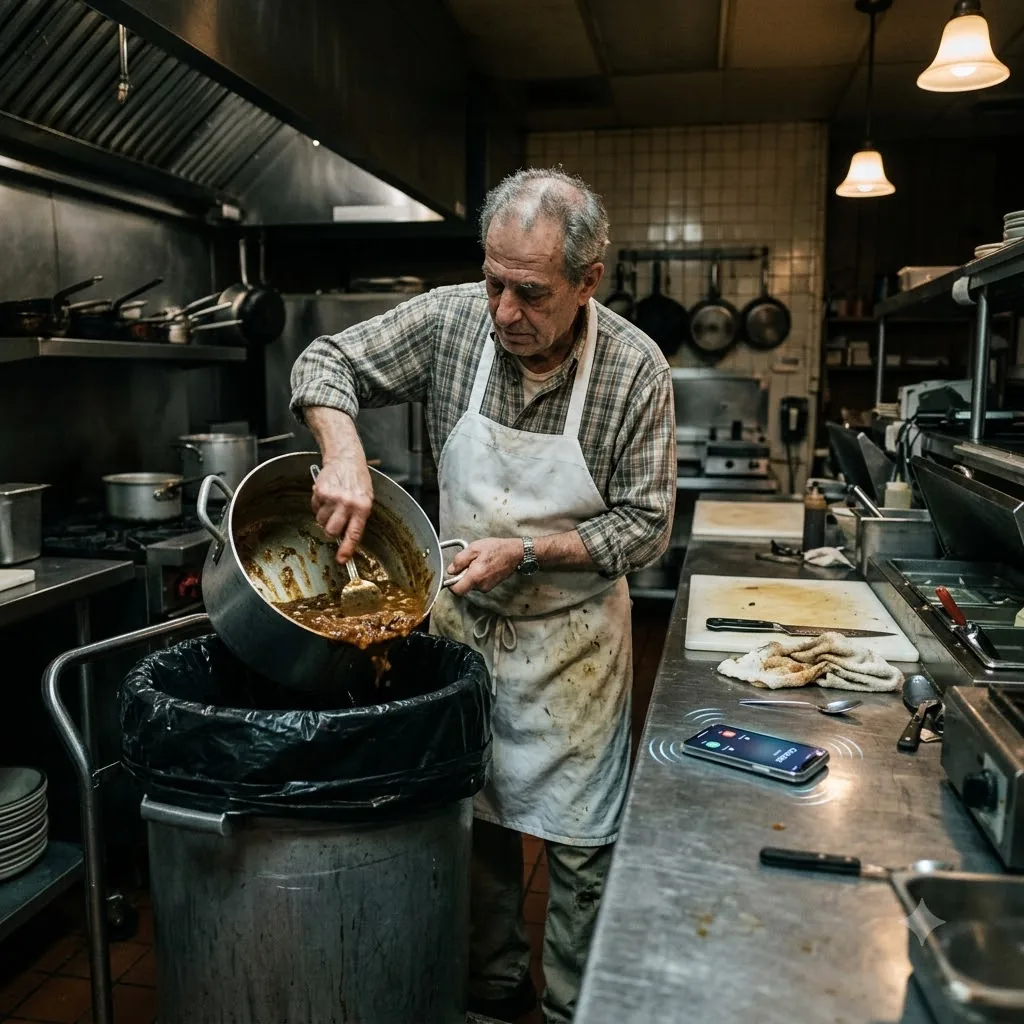
Eli looks back at the kitchen. The caustic fumes of the industrial bleach are already mingling with the smell of caramelized onions, creating a toxic, heartbreaking perfume. His life’s work is currently dissolving in a plastic trash bag. He has no money to buy a new round of ingredients, and tomorrow, the new management group will fire him for insubordination. There is nothing left to protect inside the building.
He grabs the iron drop-bar and heaves it upward. It clears the metal brackets with a loud scrape. He twists the deadbolt and pushes his weight against the heavy fire door, swinging it out into the cool night air of the back alley.
Julian is standing ten feet away, holding a phone clamped to a blinding LED ring light. Behind him, three teenagers linger nervously near the dumpsters, their own phones raised. Julian instantly thrusts his camera forward, centering Eli in the harsh white glare.
“There he is,” Julian says to the lens, his voice projecting loud enough to bounce off the brick walls. “Fourteen thousand of you watching right now. We caught him trying to sneak out the back.”
Eli squints against the light, his shoulders slumped. “Put the camera away, Julian.”
“Not a chance,” Julian snaps, stepping closer. He pulls a folded piece of paper from his jacket pocket and waves it in front of the lens. “We have the receipts, Eli. Literally. We got a picture of the invoice from the Apex Foods delivery driver this morning. Fifty gallons of artificial beef base, caramel coloring, and chemical thickeners. You’ve been feeding the neighborhood literal poison.”
Eli wipes his bleach-stained hands on his apron. The exhaustion in his bones feels terminal. “I didn’t order that delivery.”
“Your diner’s name is on the bottom line!” Julian shouts, playing entirely to his audience. “You expect my chat to believe it just magically appeared? You’re a gentrifying hack, Eli. You bought a restaurant in our neighborhood, slapped some fake authenticity on the menu, and stole our culture to make a buck. You charge twenty dollars a bowl for a heritage dish, and when real meat gets too expensive, you switch to corporate chemical slop to protect your profit margins. You’re poisoning our food.”
Eli listens to the accusations bouncing off the alley walls. He looks at the phone screen, barely visible behind the blinding light. The chat box is scrolling so fast it is just a blur of angry text and red siren emojis. Julian’s narrative is airtight. It is the perfect villain story for the internet.
Except it is entirely wrong.
Eli reaches a shaking hand into his back pocket.
“What are you doing? Keep your hands where I can see them!” Julian barks, taking a quick half-step backward, momentarily dropping his brave facade.
Eli pulls out his wallet. The worn brown leather is held together by habit and friction. He opens it, his thick, scarred fingers bypassing the folded bills and the vendor business cards. He reaches into the hidden slip behind the plastic ID window and carefully extracts a photograph.
It is a Polaroid. The iconic white borders are yellowed, soft and frayed at the corners from decades of being moved from wallet to wallet.
Eli steps completely out of the doorway, moving directly into the harsh, sterile halo of Julian’s ring light.
“Point that at this,” Eli says. He holds the photograph out, keeping his hand perfectly still.
Julian hesitates. He looks at his chat, then aims the lens at the faded square. “What is this? Another fake document?”
“Look at it,” Eli commands. His voice suddenly carries the sharp, undeniable authority of an executive chef on a busy line. The sheer weight of the command startles Julian into silence.
The camera focuses on the Polaroid.
The image is from 1988. The colors are slightly washed out, but the details are unmistakable. It is the exact same kitchen Eli just left. The same cracked terracotta tiles on the floor. The same dented fifty-quart aluminum pot simmering on the six-burner stove.
Standing in front of the stove is a young Afro-Caribbean woman with a bright, exhausted smile. She is holding the exact same long wooden spoon Eli was using an hour ago. She is wearing a flour-dusted apron over a faded t-shirt.
“Her name was Gabriela,” Eli says. His anger bleeds out into the cold air, leaving only a hollow, vibrating ache. “My wife. We opened this place together.”
Julian stares at the photo, his eyes flicking nervously between the young woman in the picture and the tired man holding it.
“That is her family’s recipe,” Eli says, looking directly past the ring light and into the lens of the phone. “From Trinidad. Passed down from her grandmother. In 1988, we put it on the menu because oxtail was the cheapest, toughest cut of meat the butchers had. It was a struggle meal. It was the only way we could stretch our budget and keep the lights on so the bank wouldn’t take the building.”
Julian’s mouth opens slightly. He glances at his phone screen. The rapid-fire waterfall of angry comments in the chat box has suddenly slowed to a crawl.
“She died in 1999,” Eli continues, his words heavy and deliberate. “I have made her stew every single Friday since. Exactly the way she taught me. Up until three hours ago, when the new investment group that bought my lease dropped off their artificial base and told me to use it to cut costs.”
Julian swallows hard. The performative swagger is entirely gone. “Then… why were you throwing it away? The live stream out front saw you dumping it.”
“I made today’s batch with my own money. The real way,” Eli says, stepping closer, forcing Julian to hold his ground. “But the investors own the diner now. If I left it in the walk-in, they would have served Gabriela’s stew tomorrow, taken the credit, and seamlessly mixed it with their chemical garbage next week. I refused to let them have it.”
Eli points a stained finger back toward the open kitchen door. The sharp, toxic scent of industrial floor cleaner wafts out into the alley.
“So I threw my wife’s legacy in the garbage,” Eli says, his voice dropping to a harsh whisper. “And I poured bleach over it so those corporate parasites couldn’t touch it. And you stood out front, banging on my window, calling me a thief.”
Julian looks from the Polaroid in Eli’s hand to the dark, reeking kitchen behind him. He looks down at his phone. The viewer count is still holding at fourteen thousand, but the chat is dead silent. The entire narrative Julian had built, the righteous anger he had monetized for the last three hours, has completely shattered.
Julian slowly lowers the ring light, the harsh white halo dipping away from Eli’s face and pointing uselessly toward the cracked asphalt. He opens his mouth, desperately searching for a pivot, an angle, a way to save his stream.
He finds nothing.