Story code: ST-001704
Part 2: The Dead Battery
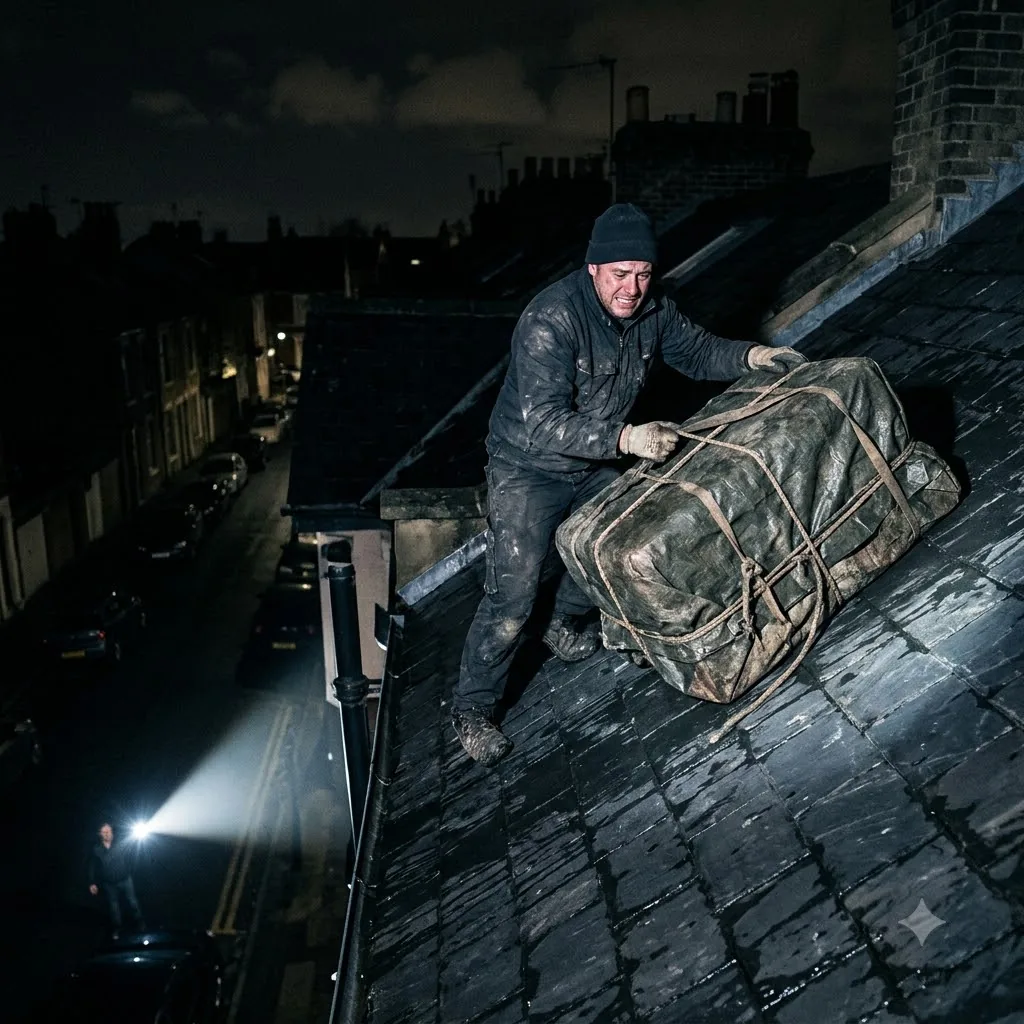
Marcus squeezed the trigger. The drill screamed, its high-pitched whine tearing through the dead silence of the blackout. The hardened steel bit bit into the century-old slate, grinding stone to dust before sinking violently into the ancient timber beneath. The vibration rattled up Marcus’s arms, jarring his teeth, but he leaned his entire body weight into the tool, forcing it deeper.
Down on the lawn, Arthur Pendelton’s voice hit a pitch of pure, bureaucratic hysteria. “Intentional destruction! You are on camera, Marcus! I am documenting this! That is a structural violation of the highest order!”
Marcus reversed the drill, backed it out, and immediately slotted a heavy lag bolt into the hole. He drove it down until the metal bracket crushed flat against the roof. One corner was secure. He still had three more to go, and the heavy rectangle balanced precariously on the slope was threatening to slide with every movement he made.
“Arthur, listen to me!” Marcus shouted over his shoulder, blindly reaching for his tool belt while squeezing his eyes shut against the blinding glare of the tactical flashlight. “The medication in the cooler is biologic! It has to stay below forty degrees!”
“Then put it in a refrigerator!” Arthur yelled back, the beam of light shaking slightly as he presumably adjusted his phone to get a better angle of the crime.
“The grid is down! It’s ninety-four degrees out here!”
“Take it to the hospital, then! Buy ice! You do not get to destroy a heritage roofline because you failed to prepare for a summer storm!”
Marcus gritted his teeth. He didn’t have the breath or the time to explain that the hospitals were running on emergency generators, accepting only critical trauma patients, not outpatient pharmaceutical storage. He couldn’t explain that ice would freeze the delicate protein structures in the vials, ruining them just as thoroughly as the heat. The temperature had to be exact. The specialized cooler provided that exactness, but its battery was meant to last for two hours of transit, not a twelve-hour municipal grid failure.
From the open bedroom window below, the rhythmic beep of the cooler seemed to mock him. It was faster now. A frantic, double-pulse warning. Ten minutes left. Maybe less.
Marcus crab-walked to the opposite side of the tarp-wrapped object. The slate was slick with the stagnant humidity and his own dripping sweat. He gripped the second bracket, trying to line it up with the pre-drilled holes in the heavy aluminum frame.
“If you drive another bolt, the fine doubles!” Arthur boomed. “I am calling the board’s emergency structural injunction line! The police will be here in ten minutes to remove you for vandalism!”
Marcus ignored him, lining up the drill bit. But as he pressed the trigger, Arthur aggressively shifted his position on the lawn, sweeping the high-lumen beam directly across Marcus’s face. The sudden, blinding flare washed out Marcus’s vision entirely.
Startled, Marcus flinched and shifted his weight. His left sneaker lost its grip on the steep pitch.
He slipped.
Gravity seized him instantly. His chest slammed hard against the hot slate, forcing the air from his lungs in a violent rush. He slid downward, his hands scrambling against the smooth, unforgiving stone. The heavy drill tumbled from his grip, clattering loudly as it bounced down the roofline, vaulted over the copper gutters, and crashed into the rosebushes two stories below.
Marcus threw his right arm out, his fingers desperately hooking the edge of the lead flashing around the chimney base. The metal bit into his skin, slicing the side of his palm, but his downward momentum stopped. He hung there, breathing raggedly, his legs dangling over the lower slope of the roof.
“Property damage!” Arthur cried out from the darkness. “You’ve likely loosened three original tiles with that stunt! I am adding a reckless endangerment multiplier to your citation!”
Marcus pulled himself up, his muscles trembling wildly from the adrenaline dump. Blood welled in the cut on his hand, mixing with the sweat and making his grip dangerously slick. He had lost the drill. He still had the socket wrench in his belt, but securing the remaining bolts by hand would eat up precious minutes he didn’t have.
He crawled back up to the peak, ignoring the throbbing pain in his ribs. He grabbed the edge of the blue plastic tarp and yanked it hard. The zip ties snapped, and the tarp tore away, exposing the sleek, black glass of the hundred-watt solar panel to the stifling night air.
Down below, Arthur gasped loudly.
“Is that… an industrial solar array?” Arthur’s voice trembled with absolute disgust. “Good god, Marcus, it’s an abomination! Section Seven, Paragraph D explicitly forbids modern utility installations visible from the street! You have lost your mind!”
Marcus didn’t care what Arthur thought of the panel. He just needed the morning sun to hit it. But first, he had to connect it. He uncoiled the thick, heavy-gauge copper cables attached to the back of the panel. His plan was crude but necessary: drop the cables straight down the chimney flue, reach into the bedroom fireplace, pull them through, and wire them to the cooler’s intake adapter. By dawn, the panel would take over, charging the cooler and saving the medication.
He pulled the chimney cap loose, the rusted metal screeching in protest. The heat rising from the brick shaft was suffocating, smelling of old ash and damp soot. He fed the heavy, weighted ends of the solar cables into the black square, paying out the line hand over hand.
Three feet. Four feet. Six feet.
Then, the cable stopped.
The line went slack in his hands. Marcus frowned, pulling it up a few inches and dropping it again. It hit something solid with a dull thud. He jiggled it, trying to find a gap, a way through. He pushed harder, the stiff wire bending against his bloody palm. It didn’t budge. The old Victorian chimney had a collapsed flue tile, or a closed iron damper rusted shut from decades of disuse. The cable was blocked. It wasn’t going to reach the bedroom.
Before Marcus could pull the wire back out to try and force a different angle, the sound drifting up from the dormer window changed.
The frantic, double-pulse warning beep of the cooler stopped entirely.
For a second, the neighborhood was completely silent, save for Arthur’s heavy breathing down on the lawn.
Then, a long, agonizingly steady flatline tone echoed from the bedroom. The battery was dead. The cooling compressor had shut off. The internal temperature of the reinforced box was now rising, degree by degree, matching the brutal ninety-four-degree heatwave baking the house.