Story code: ST-000422
Part 4: The Beautiful Noise
The two construction workers stood motionless on Peggy’s crushed petunias, the plastic zip-ties dangling uselessly from their calloused hands. They looked to Carter for a countermand, but the HOA president’s meticulously crafted, philanthropic smile had completely evaporated. His face had mottled into an ugly, blotchy crimson. He stared at the leather-bound 1988 charter tucked under Peggy’s arm as if it were a live grenade.
“Take it down,” Carter finally hissed, his voice entirely stripped of its usual televised warmth.
The workers exchanged a confused glance before drawing their box cutters. The sharp snaps of severed plastic echoed down the street as the bright orange mesh fence fell to the grass. Carter didn’t wait to watch his men load the metal stakes back onto the flatbed. He turned sharply on his heel and fast-walked across the street toward his own property. The heavy front door of his pristine, colonial-style home slammed shut so hard the sound reverberated through the quiet neighborhood.
Over the next three weeks, the manicured stagnation of Whispering Pines vanished. To legally maintain her provisional status under Municipal Ordinance 14-B, Peggy had to physically prepare her home for multiple senior tenants. That meant pulling municipal permits, which superseded any HOA architectural bylaws, and it meant making noise.
A loud, diesel-chugging cement mixer backed into Peggy’s driveway early on a Tuesday morning. A crew of city-approved contractors began tearing up her front walkway to pour a wide, ADA-compliant wheelchair ramp leading directly up to her porch. The screech of circular saws cutting through timber and the heavy, rhythmic thud of nail guns became the new daily soundtrack of the block.
Peggy stood on her porch, a clipboard of her own in hand, checking off the construction milestones. She felt a profound sense of satisfaction every time she glanced across the street. Carter’s house, with its razor-sharp edging and aggressively green grass, now sat directly opposite a chaotic, bustling construction zone.
The aesthetic facade of the neighborhood was fracturing, and with it went Carter’s absolute control. Without the threat of immediate foreclosure to keep the residents compliant, the fear that had kept the community silent began to curdle into anger. Arthur’s forced departure had been a heartbreaking wake-up call, but Peggy’s highly public defiance served as the catalyst for a full rebellion.
To further break the HOA’s stranglehold, Peggy spent her evenings hosting small gatherings in her living room. She pulled out David’s original 1988 charter and let the neighbors photograph the exemption clauses with their phones. The whispered conversations over coffee and stale cookies revealed just how deep Carter’s extortion ran. Families who had been quietly draining their savings to pay off fabricated landscaping and masonry fines realized they had been victims of an organized scam. The community meetings shifted from shared terror to organized resistance. Carter’s cartel crumbled under the scrutiny. The out-of-town investors, spooked by the sudden legal complexities and the unified neighborhood front, formally withdrew all their cash offers.
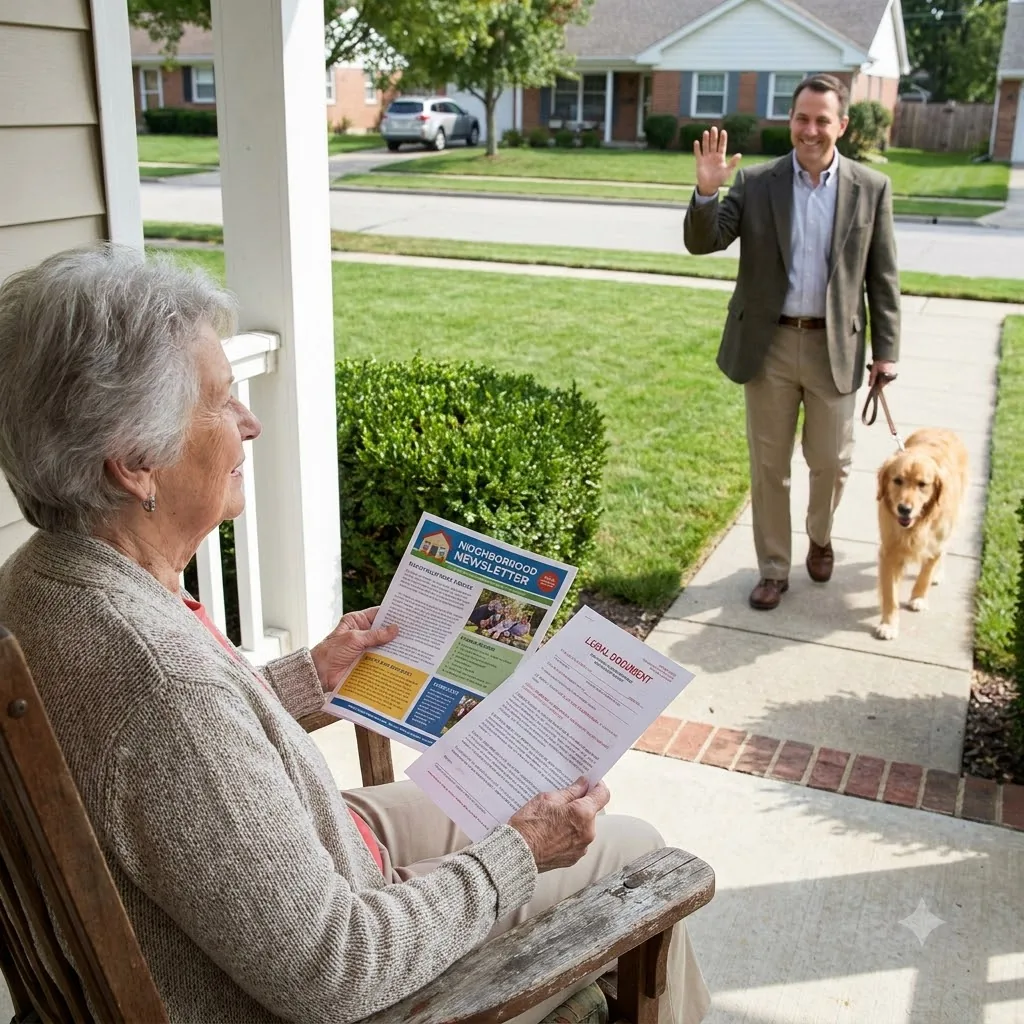
Carter emerged from his house on a warm Friday afternoon, his golden retriever pulling restlessly at its leash. He wore his usual pastel polo, but the collar was rumpled, and the dark circles under his eyes betrayed weeks of sleepless nights. He stood at the edge of his driveway, glaring across the asphalt as a delivery truck dropped a massive load of framing lumber onto Peggy’s front lawn with a thunderous crash.
Peggy walked down her newly poured concrete ramp, holding a tall glass of sweet iced tea. She stopped behind her low wrought-iron gate, taking a long, refreshing sip.
“You’re destroying the property values!” Carter yelled over the street, not bothering to cross over to her side. There was no faux-pity left in his tone, only the bitter resentment of a man whose lucrative grift had been permanently derailed. “This is an exclusive community, Peggy! Not a halfway house!”
“It’s a city-sanctioned senior boarding facility, Carter,” Peggy called back, keeping her voice perfectly even. “And according to the municipal noise ordinances, my contractors are legally allowed to work until seven o’clock in the evening. Have a wonderful stroll.”
Carter’s jaw clenched so tightly Peggy could see the muscle jumping from all the way across the street. He jerked the golden retriever’s leash, abandoning his morning walk entirely, and stormed back inside his house, slamming the door for the second time that month.
Peggy leaned against her metal gate, the condensation from the glass dripping cool against her palm. She turned away from Carter’s pristine lawn and looked back at her own home. The colorful petunias were gone, replaced by functional concrete pathways and stacks of fresh lumber, but the house felt more alive than it had in years. Next week, three elderly women from the city’s housing waitlist-widows who had been aggressively priced out of their own neighborhoods-were moving into the newly renovated spare bedrooms.
She tilted her head back and looked up at her perfectly fine slate roof. It gleamed in the late afternoon sun, untouched and fully intact. The suffocating weight of the thirty thousand dollar phantom lien was gone, replaced by the deep, resonant comfort of a home that was finally secure. She took another sip of her iced tea, listening to the loud hum of the power tools, and smiled at the beautiful, disruptive noise of a community finding its voice.