Story code: ST-001330
Part 2: The Founding Charter
Brenda tapped her acrylic nail against the laminated page. She read aloud, her voice adopting a practiced, bureaucratic cadence. “Section 4B, Subsection 9. The presiding officer retains unilateral discretion to classify unauthorized vegetation as a critical blight, bypassing standard thirty-day board review to prevent immediate property value degradation.”
Marcus stared at the dense block of text, the tiny print swimming before his eyes. He demanded to know what unauthorized vegetation she was talking about. He told her his yard was nothing but dirt and standard grass.
Brenda smiled, shifting her ceramic mug to her other hand. She pointed a manicured finger past Marcus’s shoulder, aiming directly at the massive, dormant oak tree shading his driveway. She informed him it was a Water Oak. The approved community guidelines, which she had personally amended during an emergency executive session the previous night, only permitted Live Oaks and Red Maples. Therefore, his sixty-year-old shade tree was now officially classified as an invasive weed.
Marcus felt a vein throb in his neck. He pointed out the tree had been planted when the subdivision was built in the nineteen seventies. He told her she could not retroactively outlaw a mature hardwood just to steal his house.
Brenda flipped the binder shut. She reminded him the fine was now twelve hundred and fifty dollars, as a new billing cycle had begun at eight o’clock. She advised him to call a real estate agent before he drowned in legal fees, then turned and walked back inside. The heavy mahogany door clicked shut in his face.
Marcus walked back down the asphalt, his work boots feeling incredibly heavy. The morning sun was burning off the dew, and he spotted his next-door neighbor, Dave, furiously scrubbing a completely pristine concrete driveway with a stiff-bristled push broom.
Marcus crossed the property line and said Dave’s name. Dave jumped, nearly dropping the broom. Marcus held up the neon yellow citation and asked if Brenda was going after anyone else. He asked if the rest of the board knew she was weaponizing the bylaws.
Dave refused to look at the yellow paper. He kept his eyes locked on the soapy concrete. He muttered that he could not get involved. He quickly explained that Brenda had threatened him with a five-hundred-dollar fine because his son’s portable basketball hoop was visible from the street, and she had promised to waive it if Dave kept his head down. Dave turned his back, scrubbing the driveway with frantic, terrified energy, and begged Marcus to just pay the fine or move before she ruined them both.
Inside his own house, the quiet felt suffocating. Marcus sat at his scratched kitchen table, staring at his laptop screen. He had forty-three dollars in his checking account and a maxed-out credit card. He searched for local real estate attorneys and dialed a firm that advertised free consultations.
After holding for twenty minutes, a paralegal finally took his call. Marcus explained the retroactive tree ban and the compounding fine. The paralegal’s sigh came through the receiver, heavy with professional pity. She explained that in their state, homeowners associations held immense, almost untouchable statutory power. Because the HOA foreclosure process was non-judicial, Brenda did not need a judge’s permission to seize his house. She only needed to file the lien with the county clerk and wait thirty days to auction the property.
Marcus gripped the edge of the table. He asked how he could stop it.
The paralegal told him he would need to file a temporary restraining order in civil court to halt the foreclosure. The retainer for their firm to draft and file the motion was five thousand dollars, due immediately. Marcus thanked her quietly and hung up.
He was entirely on his own. If he could not afford to fight her in court, he had to figure out how to destroy her authority from the inside.
Marcus dragged a heavy plastic storage bin out of his hall closet. He popped the lid and dug past old tax returns and appliance manuals until he found the thick manila envelope from his mortgage closing three years ago. He dumped the contents onto the kitchen table. Dozens of pages of closing disclosures, property surveys, and the original covenants, conditions, and restrictions for the neighborhood spilled out.
He pushed the mortgage paperwork aside and grabbed the faded, stapled packet detailing the neighborhood’s founding charter. The document was dated October 1974. The paper was rough, the text laid down by an old mechanical typewriter. He began reading every line, searching for a limitation on executive power, a loophole for mature landscaping, or a definition of board quorums.
Hours passed. The coffee in his mug went cold. He read through arcane rules about television antennas and approved paint colors. Then, near the back of the packet, he found an amended plat map from the original developer. It detailed the historical easements and the foundational property lines of the subdivision.
Marcus traced his finger along the faded ink lines. He stopped at the corner lot. Brenda’s lot.
According to the 1974 developer’s charter, the structural footprint of her pristine, wraparound porch crossed directly over an unvacated municipal utility easement. It was an ironclad, founding rule of the neighborhood: no permanent structures could be built within fifteen feet of the streetward property line to allow for historical drainage. If the original charter was still valid, Brenda’s entire front porch was an illegal structure.
Before Marcus could process the weight of the discovery, heavy footsteps pounded up his front porch stairs.
He went to the window and pulled the blind back an inch. A man in a faded polo shirt was taping a thick white envelope to his front door, directly beneath where the yellow citation had been. The man took a photo of the door with a tablet and walked quickly back to an unmarked sedan idling at the curb.
Marcus opened the door and tore the envelope free. It bore the seal of the county clerk’s office. He ripped it open, his heart hammering against his ribs.
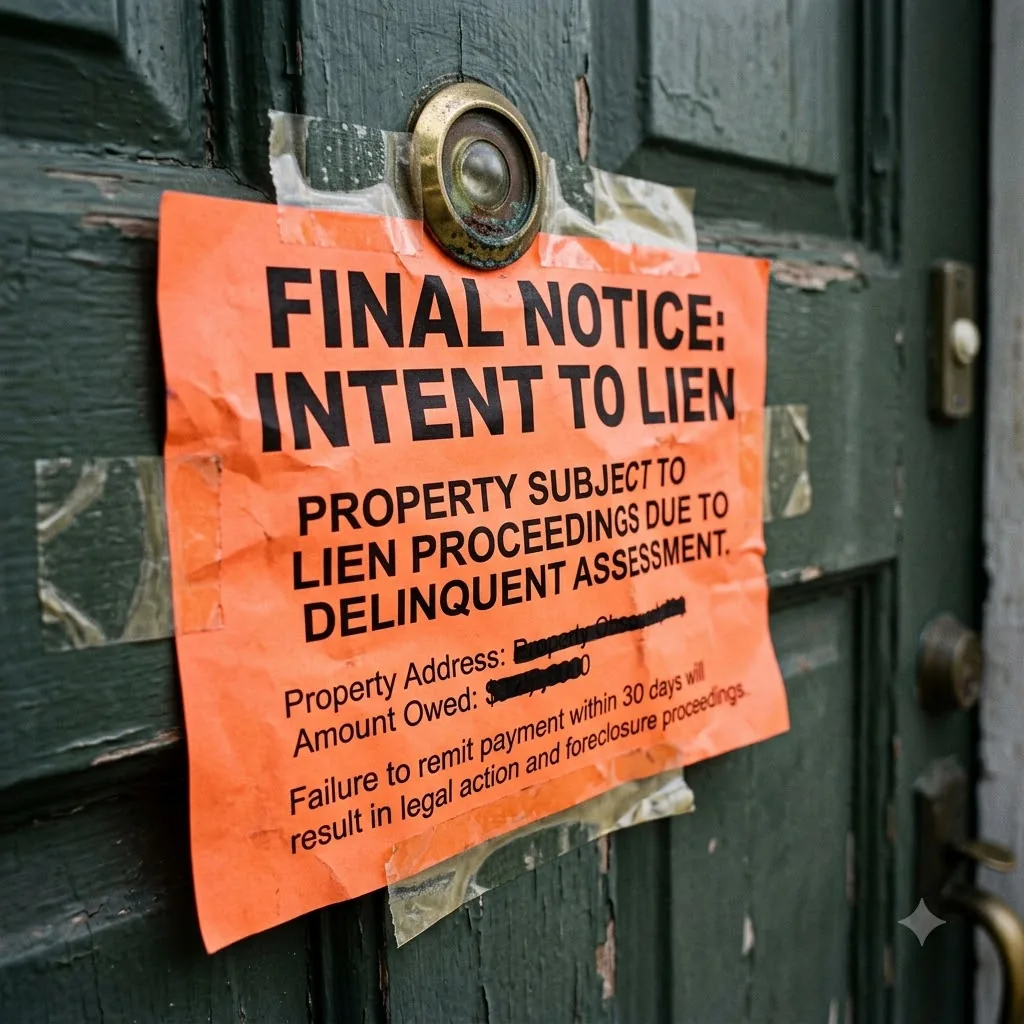
It was a formal Notice of Default. Brenda had not waited the standard thirty days. Claiming the invasive weed posed an emergency threat to the neighborhood’s structural foundation, she had expedited the lien process. The paperwork stated his property would be scheduled for public auction in exactly fourteen days unless the balance of thirteen hundred dollars, plus a newly added thousand-dollar administrative legal fee, was paid in full.
Marcus looked from the terrifying legal summons in his hand back to the kitchen table, where the 1974 plat map lay flat. He had two weeks to prove the HOA president was in violation of the neighborhood’s most ancient law, or he was going to lose his home over a tree.