Story code: ST-001330
Part 4: The Master Declaration
The silence in the gymnasium stretched until the hum of the digital projector sounded like a jet engine. Brenda’s hand remained suspended over the power button, shaking, unable to press it without admitting defeat.
In the second row, the young couple who had just been lectured about the unapproved beige paint on their mailbox stood up. The husband reached out, took his wife’s hand, and without a single word to the folding table, they walked down the center aisle and pushed through the double doors into the night.
That movement broke the spell. Dave stood up from his metal folding chair in the back row. He did not look at his shoes this time. He looked directly at the front of the room. He loudly announced that his son’s portable basketball hoop was going back in the driveway tomorrow afternoon, and if the association wanted its five hundred dollars, they could try taking him to court. Dave turned and walked out.
Within two minutes, the mass exodus was complete. The anxious, captive energy of the room dissolved into muttered disgust and scraping metal chairs. Fifty people filed out of the middle school gymnasium, leaving Brenda sitting entirely alone at her long folding table, bathed in the glaring light of the 1958 racially restrictive covenants projected on the painted cinderblock wall behind her.
Marcus did not gloat. He did not ask her for an apology. He simply walked up to the table, unplugged his HDMI cable from his laptop, closed the lid, and walked out the side exit.
But a moral victory did not instantly erase a county-recorded debt.
Three days later, Marcus stood in his kitchen, staring at the formal Notice of Default still sitting on his scratched table. He had spoken to the legal clinic again. The paralegal had been impressed by his ambush at the HOA meeting, but her professional pity remained. She explained that exposing Brenda’s motives did not automatically invalidate the paperwork she had already filed with the county clerk. To remove the non-judicial foreclosure lien, the neighborhood board would have to hold a special election, formally remove Brenda from power, establish a new quorum, and legally vote to rescind the penalty.
That process took at least thirty days. Marcus’s house was scheduled for public auction in eleven.
He was still trapped in the bureaucratic machinery Brenda had set in motion. He would still have to file an emergency injunction to stop the auction, and he still did not have the five thousand dollars for the retainer. The structural financial ruin looming over him had not evaporated just because the neighborhood had seen the truth. The machine was built to be slow to stop, even when the person driving it had been thrown from the wheel.
Marcus stepped out onto his front porch. The evening air was thick and humid. The massive, sixty-year-old oak tree cast deep, long shadows over the driveway. He sat down on the top wooden step.
Across the street, a motion-sensor LED floodlight snapped on, cutting through the dusk with blinding, artificial intensity. It belonged to the neighbor directly opposite him-a retired man who had served on Brenda’s architectural committee. The light was angled aggressively high, specifically calibrated to spill over the property line and wash Marcus’s porch in a harsh, interrogating glare. It was a petty, silent retaliation. A glowing reminder that the neighborhood’s foundational rot was not entirely gone.
Marcus did not shield his eyes. He sat perfectly still in the blinding white light, listening to the distant tick of a sprinkler and the hum of a pool pump. He looked down the street toward the corner lot. Brenda’s pristine wraparound porch was completely dark. No porch lights, no landscape uplighting illuminating her symmetrical boxwood hedges. Her heavy mahogany door had remained firmly shut since Thursday night.
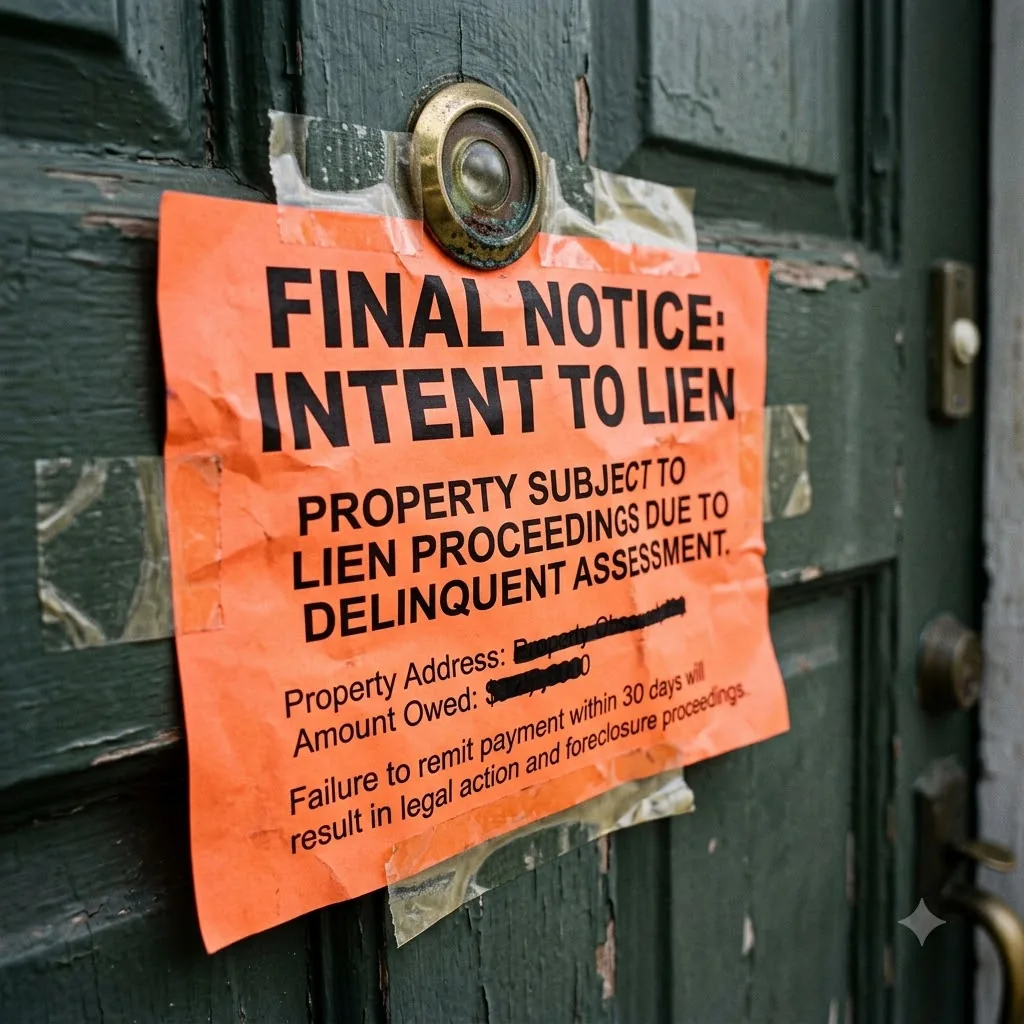
He looked down at his hands. He was holding the original neon yellow intent to lien, the heavy cardstock still wrinkled from where he had crushed it in his fist days ago, along with the white county envelope containing his eviction warning.
He reached beside him and picked up his worn canvas work bag. He pulled out a heavy-duty stapler and his spiral-bound teacher’s planner. He was out of personal days, and his eighth-grade students had a state standardized test coming up at the end of the month. The bureaucracy of the county clerk’s office was going to do whatever it was going to do tomorrow morning, but right now, he had a job to do.
Marcus pressed the yellow citation and the formal foreclosure warning flat against the inside cover of his planner. He drove three heavy staples through the thick paper, pinning the threats to the cardboard backing so they wouldn’t slip out. He smoothed his hand over the neon yellow page one last time, feeling the sharp metal edges of the staples.
He turned to a blank, lined page in the planner. Sitting alone on his dark porch, illuminated by the hostile glare of a neighbor’s floodlight, Marcus uncapped his pen and began to write tomorrow’s history lesson plan.