Story code: ST-000888
Part 3: The Necessary Pivot
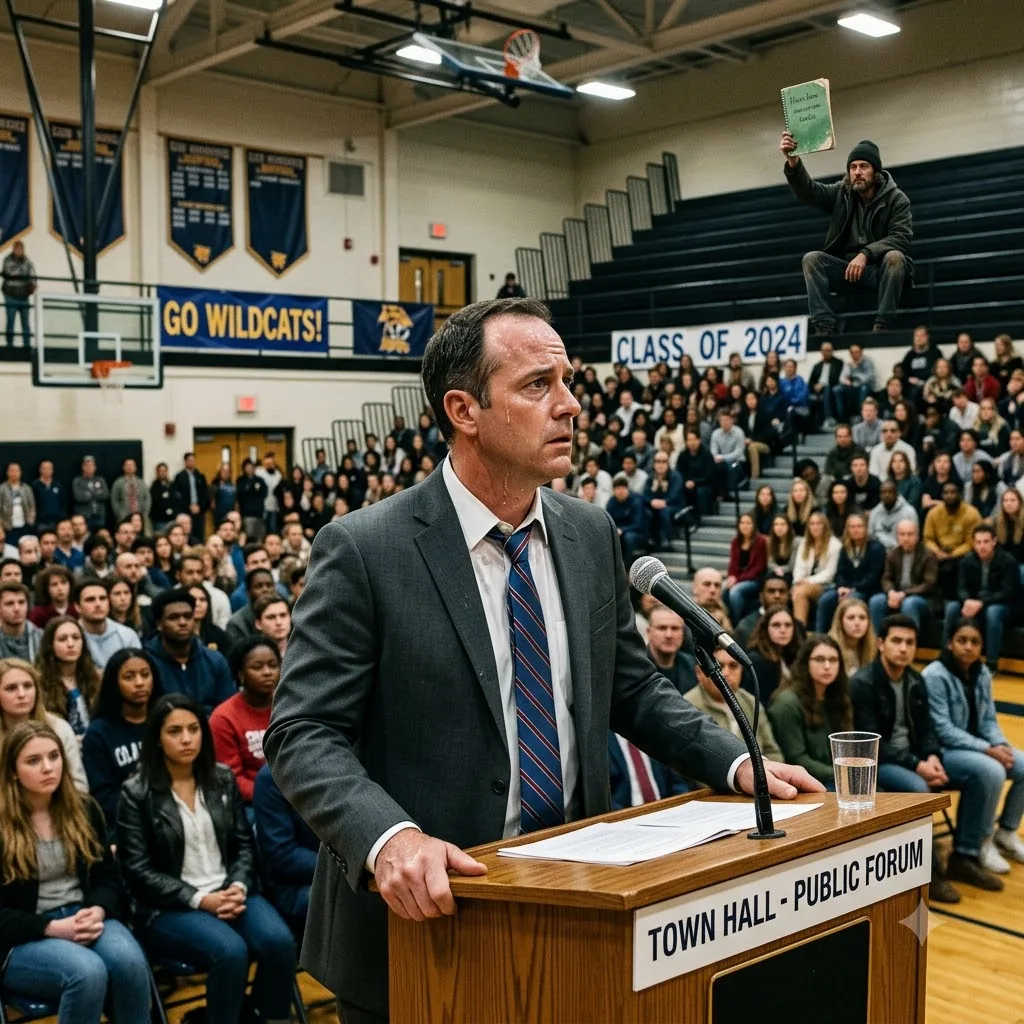
Wade stared at the silver adapter cable swaying from Marcus’s fingers. It looked like a metal noose. The silence in the Oakhaven High School gymnasium had grown so dense it felt like a physical pressure against Wade’s eardrums. The crowd of four hundred locals sat frozen, their desperate hunger for economic salvation warring with the sudden, ugly reality unfolding by the VIP folding chairs.
Wade’s hand dropped instinctively to his waist. His thumb found the small plastic receiver clipped to his leather belt. He slid the switch downward. A tiny red LED flickered on, and the faint ambient hum of the PA system abruptly vanished. He was off the mic.
He stepped down from the wooden stage, his polished oxfords hitting the scuffed hardwood with sharp, purposeful cracks. He had to contain this. He had to close the physical distance and manage the blast radius before Marcus could take another step toward the podium.
“Marcus,” Wade hissed, keeping his voice pitched at a harsh, frantic whisper. He stopped mere inches from his former partner, deliberately using his own body to block the mayor’s line of sight to the adapter cable. “Put the cable away. You have absolutely no idea what you’re interfering with.”
Marcus didn’t retreat. The faint scent of stale rain and cheap motel soap clung to his frayed canvas jacket, a jarring contrast to Wade’s bespoke sandalwood cologne. “I know you’re artificially liquidating this town to build your empire, Wade. The code is right there in the mayor’s hand.”
“The code is outdated!” Wade spat, glancing nervously over his shoulder. The mayor and the city council were watching them with wide, terrified eyes, unable to hear the whispered exchange. Wade turned back to Marcus, his mind racing, pulling up the only defense he had left: the brutal, unvarnished truth of the business model. If Marcus wanted engineering logic, Wade would give it to him.
“The commercial logistics play was a loss leader, Marcus,” Wade whispered, his eyes wide and manic. “The regional warehousing sector tanked eighteen months ago. You think we’re actually building a fulfillment center here? You think I’m putting these people on forklifts to move cardboard boxes?”
Marcus stared at him, the silver cable hanging limp in his hand.
“It was a necessary pivot,” Wade insisted, leaning in closer, his corporate polish cracking to reveal the raw, predatory ambition underneath. “The algorithm didn’t just bankrupt Oakhaven Auto and the local lumber yard. It rezoned the entire industrial sector. Do you have any idea what the state Department of Corrections pays per bed for minimum-security overflow? It’s a recession-proof government contract, Marcus. It’s guaranteed revenue.”
Marcus’s brow furrowed, a flicker of genuine shock finally breaking his stoic facade. “You’re building a prison.”
“I’m building an economic engine!” Wade corrected fiercely, jabbing a manicured finger against Marcus’s chest. “We’re converting the foreclosed warehouses into a private detention facility. Why do you think we needed the town’s local economy to flatline? We need bodies to fill the cells, and we need a desperate, localized workforce willing to take fifteen dollars an hour to guard them! It’s a perfectly closed algorithmic loop. It’s elegant!”
Wade’s breathing was shallow and fast. He felt a twisted sense of pride welling up in his chest. He had taken Marcus’s naive, altruistic supply chain code and forged it into a multi-million-dollar government subsidy machine.
“I’m saving this town,” Wade continued, his voice trembling with unhinged conviction. “Four hundred jobs! Wardens, guards, perimeter maintenance, food service. Who cares if the facility is holding freight or inmates? It’s a necessary pivot to ensure Apex Logistics survives. I weaponized your little startup project to guarantee a permanent return on investment, and you’re going to ruin it because you don’t have the stomach for real business!”
Wade stopped, panting slightly, waiting for the devastating logic to sink in. He waited for Marcus to realize that the machine was already in motion, that the contracts were signed in dark ink, that stopping it now would only leave Oakhaven with nothing but empty lots.
But Marcus just looked at him. The profound, exhausting pity in Marcus’s eyes hadn’t faded; it had deepened into something resembling sheer disgust.
A strange sound rippled through the gymnasium.
It started in the second row of the bleachers. A sharp, digital chime. Then another. A buzzing notification from a pocket. A whistle ringtone. Within seconds, a wave of distinct, overlapping pings cascaded across the packed wooden bleachers, cutting through the heavy silence.
Wade frowned, stepping back from Marcus. He looked up at the crowd. The sea of faces was no longer staring down at the stage in hushed suspense. Hundreds of heads were suddenly bowed, illuminated by the harsh, bluish glow of smartphone screens.
“You always were obsessed with controlling the room, Wade,” Marcus said softly.
Wade whipped his head back. Marcus wasn’t looking at the projector anymore. He was reaching into the open breast pocket of his faded canvas jacket.
“I didn’t bring the cable to plug into your podium,” Marcus said, letting the silver adapter drop to the hardwood floor with a useless, hollow clatter. “I just needed you to walk off the stage. I needed you to think you had me cornered.”
Marcus pulled his hand out of his pocket. He was holding a smartphone with a cracked screen. The camera lens had been perfectly leveled at Wade’s chest the entire time. In the top corner of the screen, a small, bright red icon pulsed steadily.
LIVE.
“The Oakhaven Community Board on Facebook,” Marcus said, his voice deadly calm. “Three thousand, two hundred active members.”
Wade felt the blood drain from his face, leaving his skin cold and prickling. His hands began to shake. He looked down at the plastic receiver on his belt, the red mute light mocking him. He had silenced the gymnasium speakers, but he hadn’t silenced the room.
“You didn’t just confess to me, Wade,” Marcus whispered, lowering the phone slightly so Wade could see the stream of furious, real-time comments scrolling rapidly up the cracked glass.
Slowly, Wade turned his head toward the front row. Mayor Higgins was staring at her phone, her face pale, her hand trembling so violently she nearly dropped the device. She looked up at Wade, her eyes filled with a sudden, absolute horror.
Then, from a hundred tiny phone speakers scattered across the cavernous gymnasium, Wade heard it. A chaotic, echoing, three-second delay of his own manic voice bouncing around the rafters, broadcast in crystal clear fidelity.
*…need a desperate, localized workforce willing to take fifteen dollars an hour…*
*…perfectly closed algorithmic loop…*
*…weaponized your little startup project…*
Wade stood frozen on the polished hardwood, trapped in the inescapable, overlapping chorus of his own undoing.