Story code: ST-000127
Part 4: The Wreckage
The silence in the mudroom stretched, heavy and suffocating. Richard stood frozen under the harsh glare of the halogen lights, his fingers still clutching the mutilated manila envelope. The sliced edge of the padded mailer bit into his palm, a physical anchor in a room that suddenly felt entirely devoid of gravity.
Leo didn’t break eye contact. He stood barefoot on the imported slate tiles, his posture relaxed but completely impenetrable. There was no defiance left in his gaze, only a terrifying, hollow certainty.
Richard’s mouth opened, his mind frantically scrolling through his internal databases for a protocol, a script, a damage-control strategy. “Leo, we… we can fix this,” Richard stammered, his corporate vocabulary slipping out through sheer muscle memory. “If you’re feeling isolated, we can adjust your environment. We can look into counseling. We can reallocate resources to make sure you-”
“Reallocate resources?” Leo repeated, his voice barely a whisper, yet it cut through the sterile air sharper than the titanium box cutter resting on the marble counter. “I’m your son, Dad. I’m not a disrupted supply chain.”
Richard took a step backward, bumping into the doorframe that led into the massive, open-concept kitchen. The physical contact with the wall offered no stability. He looked at the book on the counter, the illustration of the two boys, the handwritten notes about being trapped. He had spent weeks tracking a phantom leak in a municipal logistics network, completely blind to the fact that his own son was suffocating under his roof, desperately throwing lifelines to strangers.
He retreated further into the kitchen, his dress shoes clicking erratically against the polished hardwood. He needed to reestablish order. He needed to compartmentalize the variables. But the variables were Claire, sedated into oblivion upstairs to escape the quiet, and Leo, standing before him as a complete stranger.
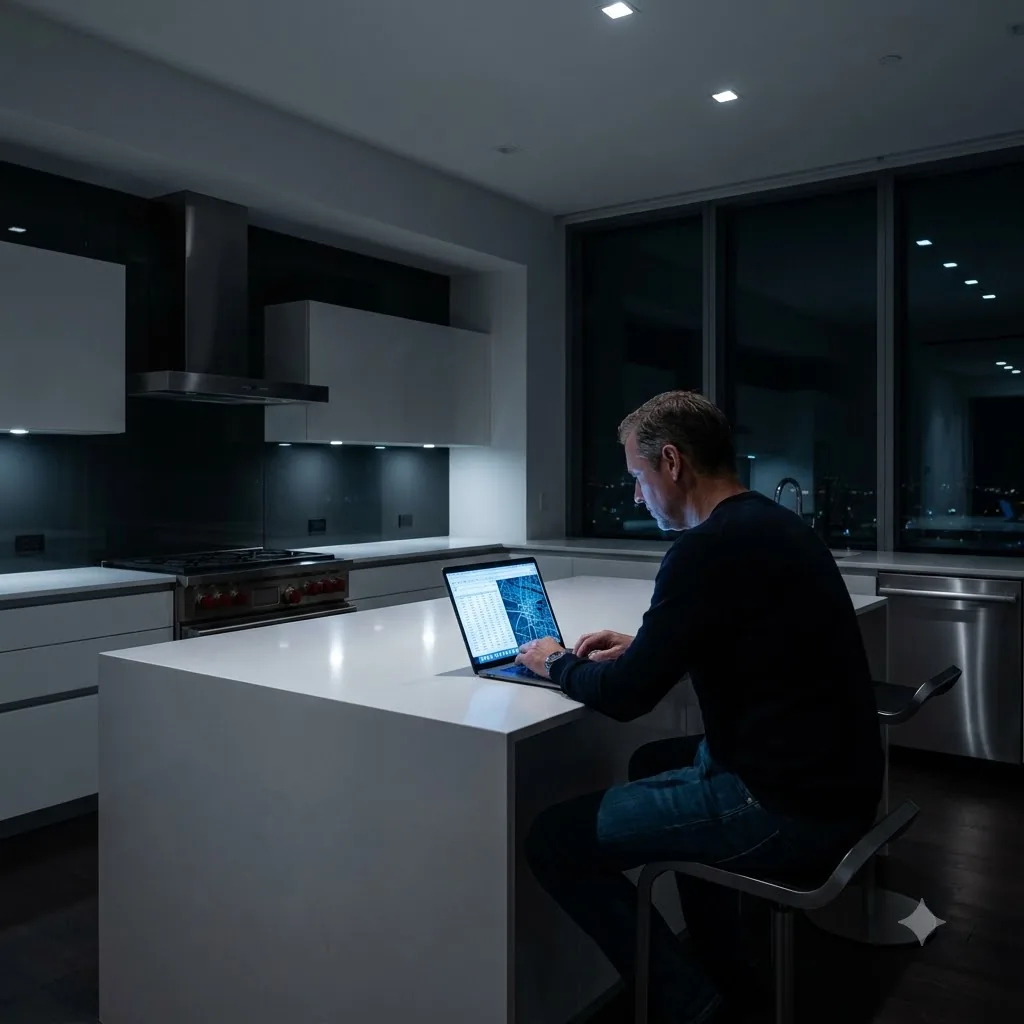
Richard turned toward the colossal Calcutta marble island. The dual monitors of his workstation still glowed with the red and orange clusters of his tracking software, mocking him. Beside the workstation sat his prized Waterford crystal decanter, filled to the brim with amber scotch, resting on a polished silver tray. It was a flawless object. Symmetrical. Expensive. Perfectly controlled.
A sudden, violent surge of impotence clawed its way up Richard’s throat. The realization that he had absolutely zero control over the people living inside his meticulously curated fortress shattered his composure. With a sharp, guttural sound that tore from his lungs, Richard swung his arm in a wide, desperate arc.
His open palm slammed into the heavy crystal decanter.
The impact sent a shockwave up his forearm. The decanter launched off the marble island and crashed onto the hardwood floor with a deafening, explosive shatter. Shards of thick, faceted glass sprayed across the kitchen, raining against the stainless steel appliances and skittering under the sub-zero refrigerator. A pool of expensive liquor immediately began to bleed across the pristine floorboards, the sharp, pungent scent of alcohol masking the usual smell of lemon surface cleaner.
Richard stood over the wreckage, his chest heaving, his hand throbbing with a dull, pulsing ache. He stared at the shattered glass, the adrenaline spiking in his veins. He waited for the fallout. He waited for Leo to flinch, to yell, to show any sign of fear or submission to the sudden outburst.
Slowly, Richard turned his head back toward the mudroom.
Leo hadn’t moved. He hadn’t flinched. He simply stood in the doorway, looking past the shattered glass and the spilled scotch, directly into Richard’s eyes. There was no anger in the boy’s expression. There was only a profound, devastating pity. It was the exact same look Maya had given him at the neighborhood gates.
“You’re empty, Dad,” Leo said softly.
Without another word, Leo turned back to the marble console table. He calmly gathered the remaining, intact manila envelopes and the decommissioned library books, stacking them against his chest. He didn’t look back at Richard. He didn’t ask for permission. He just turned and walked into the shadowed hallway leading to the east wing.
Richard stood completely paralyzed, the air trapped in his lungs. He listened to the soft, rhythmic padding of his son’s bare feet ascending the carpeted stairs. Each step felt like a heavy, final punctuation mark on a ledger he could no longer balance.
He waited, staring at the empty hallway, listening to the sprawling silence of the five-thousand-square-foot house.
From the second floor, a sharp, metallic click echoed down the stairwell. The sound of Leo’s bedroom door locking from the inside.
Then, nothing.
Richard was entirely alone. The adrenaline faded, leaving behind a cold, creeping numbness. He looked down at the ruined decanter, the glittering shards of glass reflecting the sterile blue light of his computer monitors. The tracking map was still open, the red epicenters glowing pointlessly on the screen. He knelt down slowly, his expensive dress pants soaking up the spilled scotch, and reached out with a trembling hand toward the wreckage, surrounded by the deafening hum of the refrigerator and the absolute, crushing emptiness of his perfectly ordered life.