Story code: ST-000537
Part 2: The Digital Ghost
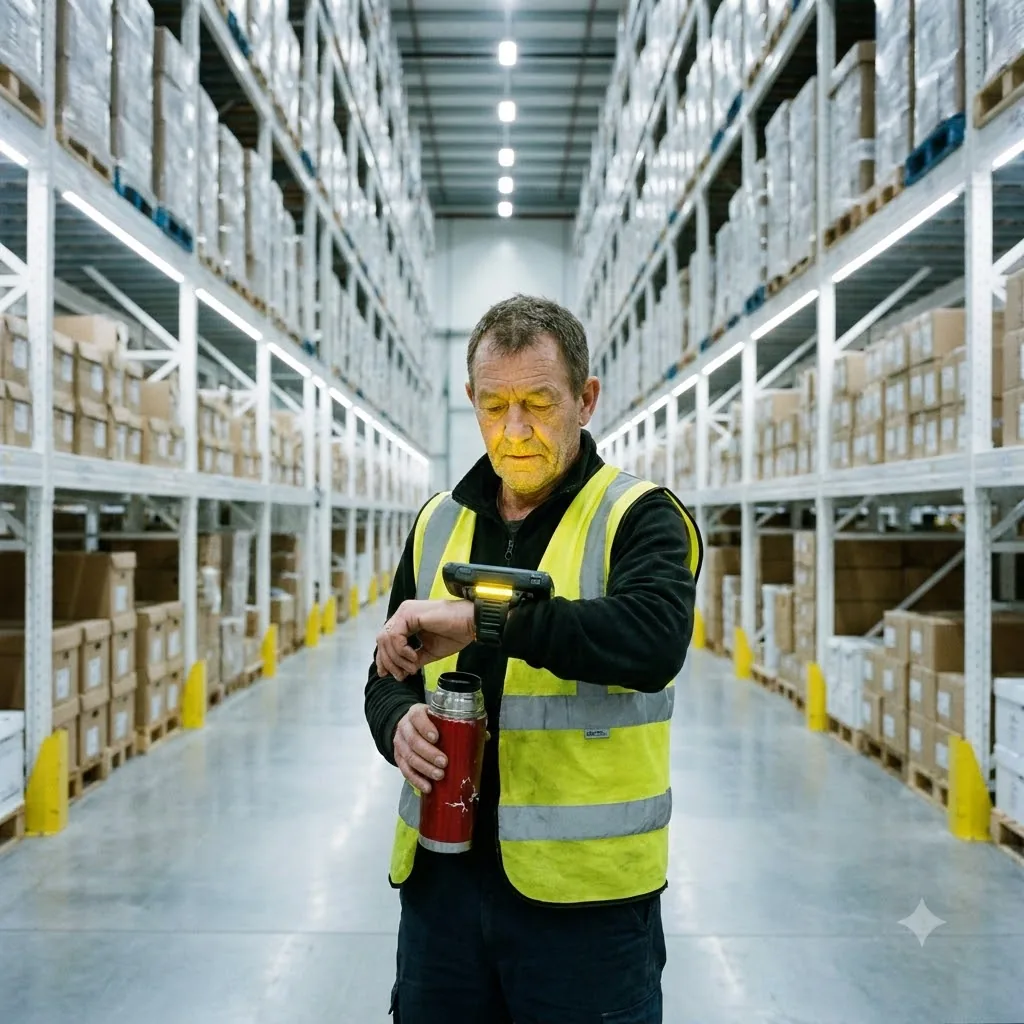
Arthur stared at the bright red block of text. *Termination with Prejudice.* The letters seemed to vibrate against the sterile white paper. The hissing sound of the sliding folder still echoed in the small, soundproofed cube, masking the faint, rhythmic hum of the ventilation system overhead that pumped chilled, recycled air into the room. He didn’t reach for the document. Instead, he maintained his vice-like grip on the capless aluminum thermos, letting the cold metal ground him. He focused intently on keeping his breathing shallow and even, acutely aware that the wrist scanner strapped to his forearm was continuously feeding his heart rate directly to the glowing tablet resting on Director Chloe’s lap.
“Look at it, Arthur,” Chloe said. Her voice was exactly like the room itself-flat, climate-controlled, and entirely devoid of warmth. “Your efficiency metrics have been degrading for six consecutive months. Your pathing is increasingly erratic. You are currently costing the company exactly four point two credits per hour in wasted kinetic energy.”
Arthur kept his eyes locked on the paper, refusing to give her the satisfaction of meeting her gaze. The pain in his left knee flared, a sharp, grinding sensation that shot up his thigh like a spark of electricity. He shifted his weight imperceptibly to relieve the pressure, but the heavy hinges of his metal brace clinked softly against the steel leg of his chair.
Chloe sighed, a perfectly measured exhalation of corporate disappointment. She tapped the glass screen of her tablet with a manicured fingernail. “I reviewed your employment file personally before calling you in. It’s a very thin file. You’ve been working on this floor for twelve years, yet you have zero emergency contacts listed. Your next-of-kin field is completely blank. Your off-shift communication logs indicate you haven’t sent a single digital message to anyone outside the facility network in over three years.”
She leaned forward, her elbows resting lightly on the pristine white table, bringing the scent of expensive floral perfume into his personal space. “You have no one, Arthur. No family. No friends. You live alone in a company-subsidized hab-unit in Sector 4. You eat company-subsidized nutrient packs. This warehouse isn’t just your employer; it is your entire ecosystem. If I finalize this termination clause right now, your hab-unit door code will be wiped from the registry before you even reach the bus stop outside. You will have nowhere to go, no savings to access, and absolutely no one to call for help.”
The deliberate cruelty of her words hung heavily in the freezing air. She was using the hollow shell of his life as a bludgeon, trying to crush whatever meager resistance he might offer. She wanted him to feel the immense, suffocating weight of the company pressing down on his solitary shoulders. She needed him terrified, pliant, and entirely dependent on her next directive. And she was right about his isolation-he was completely alone. But she was dangerously wrong to assume that meant he was defenseless.
Beneath the table, Arthur traced the exposed rim of his thermos with his thumb, his mind drifting back to the heavy wooden pallets in Aisle 44. He wasn’t just hiding a piece of dented red plastic in that dusty blind spot. Pressed firmly inside the hollowed-out top of the thermos cap was a scavenged biometric spoofer. He had cobbled it together during stolen bathroom breaks over three agonizing months, using a discarded picking-drone logic board and a stolen proximity badge, soldering the micro-wires together with the heated tip of a paperclip.
Right now, that little red cap was broadcasting a continuous, low-frequency loop of Arthur’s own vital signs directly into the warehouse’s local sub-network. To the facility’s central routing algorithm, it looked exactly like a biological worker was permanently stationed behind the obsolete printer paper, performing a slow, endless inventory audit. It was a digital ghost. As long as the cap remained in that specific blind spot, generating a phantom heat-signature, Arthur could periodically slip his actual wrist scanner into ‘sleep mode’ without triggering a facility-wide alarm. He desperately needed that ghost. It was the only way he could safely access the restricted medical-disposal bins near the loading docks to scavenge the discarded lidocaine patches that kept him walking. If he didn’t get those patches, his knee would fail entirely, and the automated drones would sweep his immobilized body off the floor like broken pallet wood.
“I haven’t committed any infractions,” Arthur said, his voice raspy from hours of silence on the warehouse floor. He carefully monitored his tone, keeping the rising panic out of his throat.
“Biometric data does not lie,” Chloe countered smoothly, her mask of concern hardening into something sharper. “Your heart rate spikes inexplicably during transit. You take wildly inefficient routes. You are hiding something from the company, Arthur. And in a closed ecosystem like ours, secrets are a form of theft.”
She pushed a sleek black pen across the table, laying it parallel to the termination clause.
“Here is your reality,” Chloe continued, her eyes locking onto his worn face. “If you walk out of here without signing a full confession of time-theft and willful inefficiency, I will activate this termination immediately. You will be escorted off the property by security, destitute and blacklisted. However, if you sign the confession, I am authorized to offer you a demotion to the hazardous waste sorting sector. The pay is halved, and the ambient corrosive dust will significantly shorten your lifespan, but you will keep your hab-unit. You will keep your access to the cafeteria. You will survive.”
It was a forced choice designed to break him. Hazardous sorting was a death sentence, just a slower, far more agonizing one. But if she terminated him right now, he would never make it back onto the warehouse floor. He would never retrieve the cap. By the end of the shift, the system would notice the phantom worker in Aisle 44 hadn’t moved. A manual drone sweep would be ordered, the illegal spoofer would be discovered, and they would trace its unauthorized broadcast right back to his biometric profile. Corporate espionage carried a mandatory federal prison sentence. He had to get back to Aisle 44. He needed more time.
Arthur looked down at the black pen. He reached out with a trembling, calloused hand, his stiff fingers hovering just millimeters over the smooth plastic barrel.
Before he could touch it, Chloe tapped her tablet again. A high-resolution image flashed onto the large monitor mounted on the wall directly behind her. Arthur’s blood ran completely cold. It was a still frame captured from a ceiling fisheye lens, heavily zoomed in on the intersection of Sector J and Aisle 44.
“Before you sign,” Chloe said softly, a dangerous, triumphant edge creeping into her corporate monotone, “perhaps you can explain to me why your pathing data shows you entering a designated overstock aisle today, and why your left hand was exactly three ounces lighter when you walked out of it.”