Story code: ST-001150
Part 2: The Ordinance
Mateo’s fist hit the wood again, the sound cracking like a gunshot in the dead, silent heat of the afternoon. The pain shot up his forearm, but he barely registered it. He raised his hand for a third strike, drawing a heavy breath of the stagnant, ozone-scented air, but the heavy dark door pulled inward before his knuckles could connect.
A wall of crisp, refrigerated air spilled out onto the front porch, washing over Mateo’s sweat-drenched clothes.
Arthur Pendelton stood in the foyer. He wasn’t startled. He didn’t jump or step back. He stood perfectly still, wearing a pressed linen shirt completely free of wrinkles, his thin, silver hair combed flat against his scalp. He looked at Mateo’s raised fist, then lowered his gaze to the crumpled ball of heavy bond paper in Mateo’s hand, and finally looked up to Mateo’s face. His expression was not angry or fearful. It was a mask of placid, terrifying patience.
“You are damaging my property,” Arthur said. His voice was thin, dry, and entirely devoid of emotion, like old parchment rubbing together.
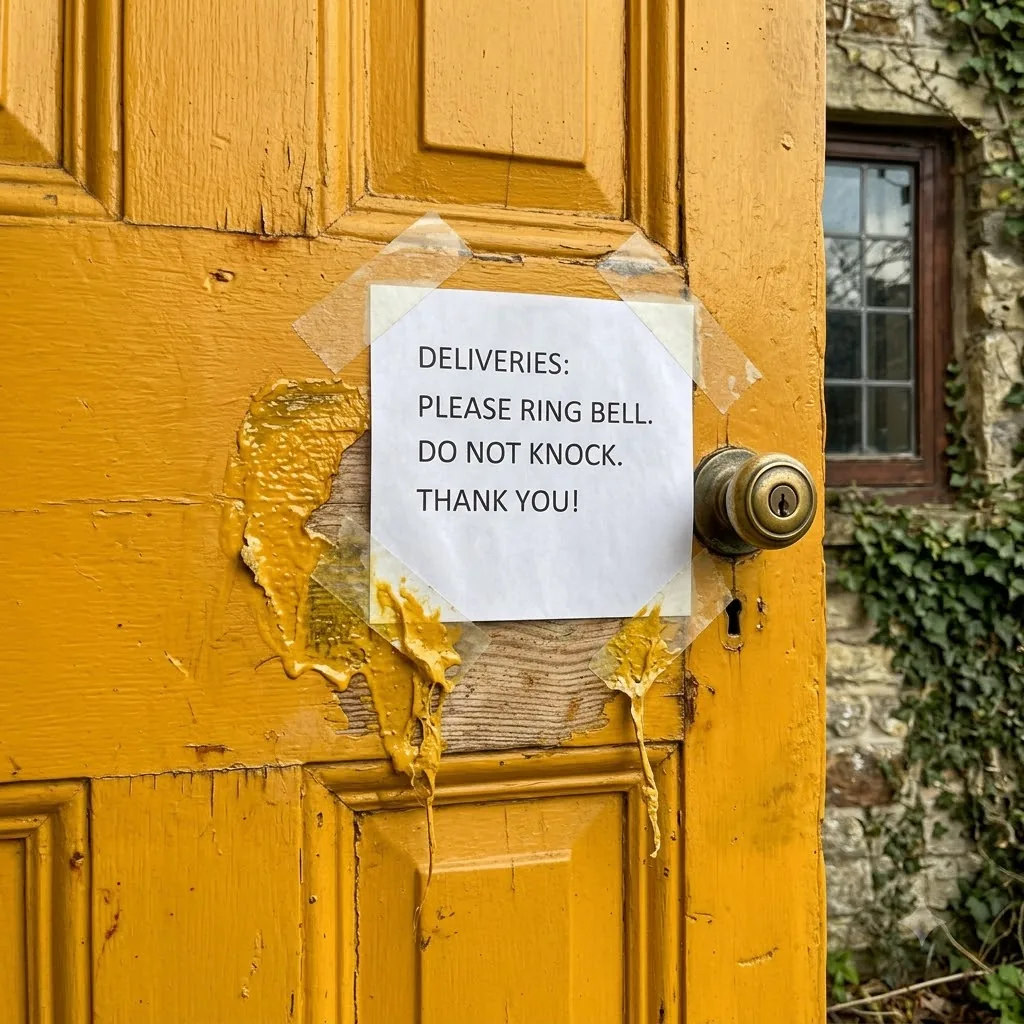
“You damaged mine,” Mateo said, his voice trembling with a raw, panicked rage he was trying desperately to leash. He shoved his fist forward, opening his fingers to reveal the crumpled citation and the jagged, marigold yellow paint chip still hopelessly bonded to the clear packing tape. “You came onto my porch while the paint was wet. You slapped industrial adhesive onto a fresh finish. You ruined it on purpose.”
Arthur calmly adjusted his wire-rimmed glasses. He didn’t even look at the vibrant paint chip. “I attached a formal notification of a covenant violation to the offending structure. The method of attachment is irrelevant. The structural integrity of your… modification… is your own responsibility. If cheap paint fails to adhere, that is a matter for you and your hardware store.”
“There is no covenant,” Mateo snapped, stepping half an inch closer. The cold, sterile air from the house chilled the sweat on his neck. “I checked the deed before I signed the mortgage. I checked the city zoning. I own that house. There is no Homeowners Association here. There is no architectural committee. There is only you.”
Arthur offered a small, bloodless smile. It didn’t reach his eyes. He reached out to a small, polished mahogany table beside his door, picking up a manila folder that had clearly been sitting there, waiting for this exact confrontation. He opened it with practiced slowness, withdrawing a stiff, yellowed photocopy covered in dense, typewritten text.
“City Ordinance 4B, Section 12, ratified in 1968,” Arthur read, his pale blue eyes never leaving Mateo’s face. “Pertaining to historical sightlines and neighborhood aesthetic preservation in unincorporated subdivisions. It allows any resident within a two-hundred-foot radius to petition the city for an immediate injunction against exterior modifications deemed visually disruptive to the established character of the street.”
Mateo stared at the old man, his mind struggling to process the legalistic trap springing shut around him. The heat of the concrete porch radiated up through his sneakers, making him feel suddenly lightheaded. “Visually disruptive? It’s yellow paint, Arthur. It’s a front door. It’s not a toxic waste dump.”
“It is a blight,” Arthur corrected smoothly, lowering the paper. “It is an aggressive, neon eyesore that depreciates the value of every single home on this block. We have maintained a standard here for forty years. Neutral tones. Dignity. Order. Your door is a loud, unacceptable declaration of disrespect.”
“Disrespect?” Mateo let out a harsh, disbelieving laugh, his chest tightening. “I spent everything I had to buy that house. I spent weeks fixing the rot you let sit there for years while the previous owner let it decay into a neighborhood hazard. The marigold is for my grandmother. It’s the color of the altars she used to build. It means something to my family. It means we made it.”
“Your family’s sentimental attachments are not my concern,” Arthur said, the temperature in his voice dropping even further, freezing over completely. “The law is my concern. And the law, under this specific municipal ordinance, allows me to place a lien on your property if the injunction is ignored.”
Mateo froze. The blood drained from his face. The word *lien* hung in the sweltering air between them, heavier and far more dangerous than the summer humidity. He had just emptied his entire savings account for the down payment and closing costs. His credit cards were maxed out from the emergency plumbing repairs and the moving truck rental. He barely had enough cash left in his checking account to cover groceries and gas until his next paycheck. A legal battle, a lien on the deed-it could trigger a breach in his mortgage agreement. The bank could intervene.
“You’re bluffing,” Mateo said, though the absolute certainty in his chest was already cracking, replaced by a cold, creeping dread. “You can’t steal my house over a paint color.”
“Am I bluffing?” Arthur held out the photocopy, tapping the bottom of the page with a perfectly manicured fingernail. “My lawyer drafted the injunction this morning. It is ready to be filed at the county courthouse tomorrow at eight o’clock sharp. I will sue for aesthetic damages, property devaluation, and my own legal fees. You will spend tens of thousands of dollars defending a piece of wood, Mateo. You will lose your home over a bucket of yellow paint.”
Mateo looked past Arthur, peering into the immaculate, silent house. There were no pictures on the walls. No signs of life, of family, of messy, vibrant joy. Just pristine, sterile control. The old man wasn’t just defending a color palette. He was defending his absolute, tyrannical authority over the world outside his window. He was willing to financially ruin a young, first-time homeowner just to maintain the unbroken gray monotony of his view.
Mateo looked down at the bright yellow flake in his trembling hand. The color of marigolds. The color of celebration, of survival, of his grandmother’s enduring spirit. Sacrificing it meant bowing to a bully, painting over his heritage and his pride with dull, lifeless gray. But fighting it meant risking the very roof over his head, the security he had worked his entire adult life to achieve.
Before Mateo could form a reply, before he could decide whether to fold or fight, a low, mechanical hum broke the heavy silence of the neighborhood. He turned his head slowly.
A white city police cruiser was rolling slowly down the street, its tires crunching softly against the hot, cracked asphalt. It didn’t have its sirens on, but its roof-mounted lightbar flashed a blinding, rhythmic blue and red, slicing through the afternoon glare and painting Arthur’s gray house with violent strokes of color.
The cruiser drifted past Mateo’s house, past the scarred, ruined yellow door, and came to a smooth, deliberate stop right at the end of Arthur’s immaculate driveway.
Mateo turned back to Arthur. The old man was already holding a small, silver cell phone in his left hand, his thumb resting over the keypad.
“As I said,” Arthur murmured, stepping back into the refrigerated safety of his foyer and preparing to close the door. “I require order. And I anticipated you might become violently hostile when presented with the consequences of your actions.”
The heavy oak door clicked shut, the deadbolt sliding loudly into place, leaving Mateo standing completely alone on the porch, his fist still raised like a weapon, as the heavy car door of the police cruiser slammed shut behind him.