Story code: ST-000183
Part 2: The Crestview Bypass
Leo stumbled backward, his heavy leather tool belt shifting awkwardly on his waist as the rubberized grip of the DeWalt reciprocating saw struck his sternum. He caught the heavy tool before it could fall to the unfinished decking, the cold metal casing heavy and foreign in his calloused hands.
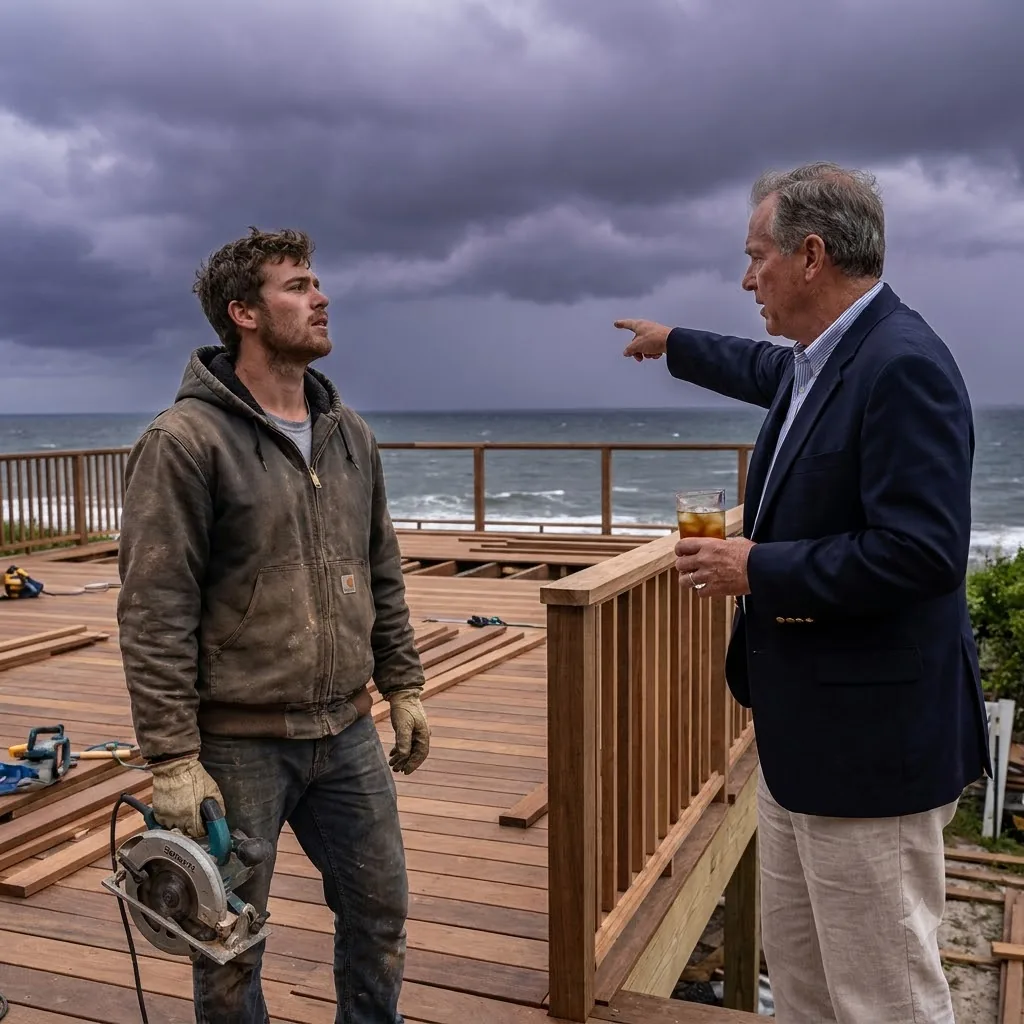
Vance stood his ground, crossing his arms over his expensive cashmere sweater. He looked entirely unfazed by the physical altercation, wearing the expression of a man who was used to treating contractors like disobedient children.
The siren on Leo’s phone finally timed out, leaving only the sound of the rising wind whipping off the Pacific Ocean. Down in the valley, the sky had turned a bruised, sickly greenish-black. The first distant rumbles of thunder vibrated through the soles of Leo’s work boots. He needed to be in his truck right now. He needed to be stacking those heavy sandbags against his basement windows.
“Mr. Vance, I am leaving,” Leo said, his voice dropping into a low, dangerous register. He lowered the saw, refusing to hand it back, and instead set it carefully on the nearest stack of lumber. “My neighborhood is under a flash flood warning. I have to secure my property.”
“If your truck tires touch that asphalt driveway before this railing is lowered, I am holding back your final draw,” Vance warned, stepping directly into Leo’s path. “Eighteen thousand dollars, Leo. You walk off this job site, I void the contract for abandonment. Good luck paying your crew.”
Leo froze, his hand hovering over his canvas tool pouch. Eighteen thousand dollars. It was the exact amount the bank had quoted him for the emergency home repair loan. His insurance had outright denied his claim from the last flood, citing a loophole about “groundwater seepage.” He was personally on the hook for a new water heater, a new furnace, and the extensive mold remediation that was currently tearing his home down to the studs. If he left now, he would lose the money entirely, and his house would flood anyway. He was trapped on this cliff, financially chained to a man who cared more about an ocean view than human safety.
Before Leo could formulate a response, Vance’s cell phone began to ring, a bright, cheerful marimba melody that clashed violently with the booming thunder. Vance held up a finger, signaling Leo to wait, and pulled the phone from his pocket. He answered it, pressing the device tightly against his ear to block the roaring wind.
“Mark, finally,” Vance shouted into the receiver. “Yes, I’m standing out on the cantilever right now. The storm is hitting fast.”
Leo knelt down, pretending to wrap his pneumatic air hose, but his focus remained locked on Vance. He recognized the name Mark-it was the lead civil engineer Vance had hired for the massive retaining wall project completed earlier that month.
“The bypass is holding perfectly,” Vance yelled over a sudden gust of wind, laughing into the phone. “I’m looking right down at the valley. The runoff is funneling straight down the mountain, completely missing the retaining wall.”
Leo stopped moving. He stayed crouched over his compressor, his heart hammering a frantic rhythm against his ribs.
“I know the municipal system is too small for a squall like this,” Vance said, rolling his eyes as if the engineer on the other end was being utterly unreasonable. “But if we hadn’t bypassed the county reservoir, this whole cliffside pool project would have washed out last month. I am not letting my infinity pool slide into the ocean just to protect a bunch of swamp land.”
Leo felt a cold, prickling sweat break out across the back of his neck, completely unrelated to the dropping temperature.
“The city approved the permit-well, I expedited the permit,” Vance continued, pacing along the edge of the expensive deck. “It’s not my fault they built those cheap tract homes in a natural drainage basin. All our runoff is going straight into the Crestview storm drains, just like you designed. If the lower basin floods, let them buy sump pumps. The city will never trace the overflow back to my property.”
Leo slowly stood up. The damp, mildewed smell of his flannel shirt suddenly took on a sickening new context. His address was 442 Crestview Drive.
The massive retaining wall holding up Vance’s new swimming pool had been finished exactly a month ago. Three weeks ago, the first freak flood had hit Leo’s street. It wasn’t just heavy rain. It wasn’t a natural disaster. It was Vance. The millionaire had illegally routed thousands of gallons of mountain watershed directly into the aging Crestview sewers to save his own landscaping.
The water that had destroyed Leo’s furnace, ruined his family’s belongings, and forced his wife to take their children to a motel-it had all come from this exact cliff.
Vance pocketed his phone and turned back around, looking annoyed that Leo was still standing there. “The storm is making landfall, Leo. You have maybe twenty minutes before the rain makes these power tools a shock hazard. Cut the posts. Thirty inches. I won’t ask again.”
Leo looked down at his neighborhood. The rain was already starting to obscure the valley in a gray, hazy sheet. Even if he ran to his truck right now, he wouldn’t make it down the winding mountain roads in time. The Crestview basin was already filling up with Vance’s diverted runoff. His basement was a lost cause.
He couldn’t save his house today.
Leo turned his gaze away from the valley and looked at the magnificent, eighty-thousand-dollar deck beneath his boots. The imported Ipe wood was pristine, incredibly dense, and flawlessly installed. It was a masterpiece of structural engineering, relying on absolute tension and perfectly measured load-bearing joists.
“You want them at thirty inches?” Leo asked, his voice deadened, entirely stripped of its previous urgency.
“Exactly thirty inches,” Vance said, gesturing impatiently at the tools. “And I don’t want to see any ragged edges. Make it perfectly level.”
Leo didn’t grab his tape measure. He didn’t bother pulling out a speed square to mark his lines. He simply reached into his tool bag and pulled out a fresh, heavy-duty demolition blade-the kind forged with carbide teeth, designed specifically to tear through embedded nails, thick bolts, and structural timber.
He locked the aggressive blade into the DeWalt reciprocating saw and plugged the thick orange extension cord into the wall outlet.
Walking over to the first massive corner post, Leo squeezed the trigger. The 15-amp motor screamed to life, a deafening mechanical roar that momentarily drowned out the thunder. He pressed the spinning carbide teeth into the ironwood. He didn’t aim for thirty inches. He aimed low, right near the base, and shoved the blade forward.
The saw bit violently into the dense teak, sending up a thick, acrid plume of burning woodsmoke. Sparks showered over Leo’s boots as the aggressive teeth chewed effortlessly through a half-inch galvanized carriage bolt hidden inside the joint.
He pushed harder. The thick post snapped. The heavy, four-foot block of solid Ipe wood tumbled backward, crashing violently onto the finished deck boards. Its sharp corner gouged a deep, jagged, unrepairable trench across three separate planks, instantly ruining hundreds of dollars of imported material.
“Hey! Watch the decking!” Vance yelled, taking a step forward, his eyes wide with sudden alarm.
Leo ignored him. He stepped to the second post. But this time, he didn’t just aim for the upright lumber. He angled the heavy saw downward, bracing the metal shoe of the tool directly against the rim joist-the primary load-bearing beam holding the entire cantilevered structure suspended over the sixty-foot drop.
He squeezed the trigger, burying the demolition blade deep into the structural frame.