Story code: ST-000245
Part 2: Protocol Four-B
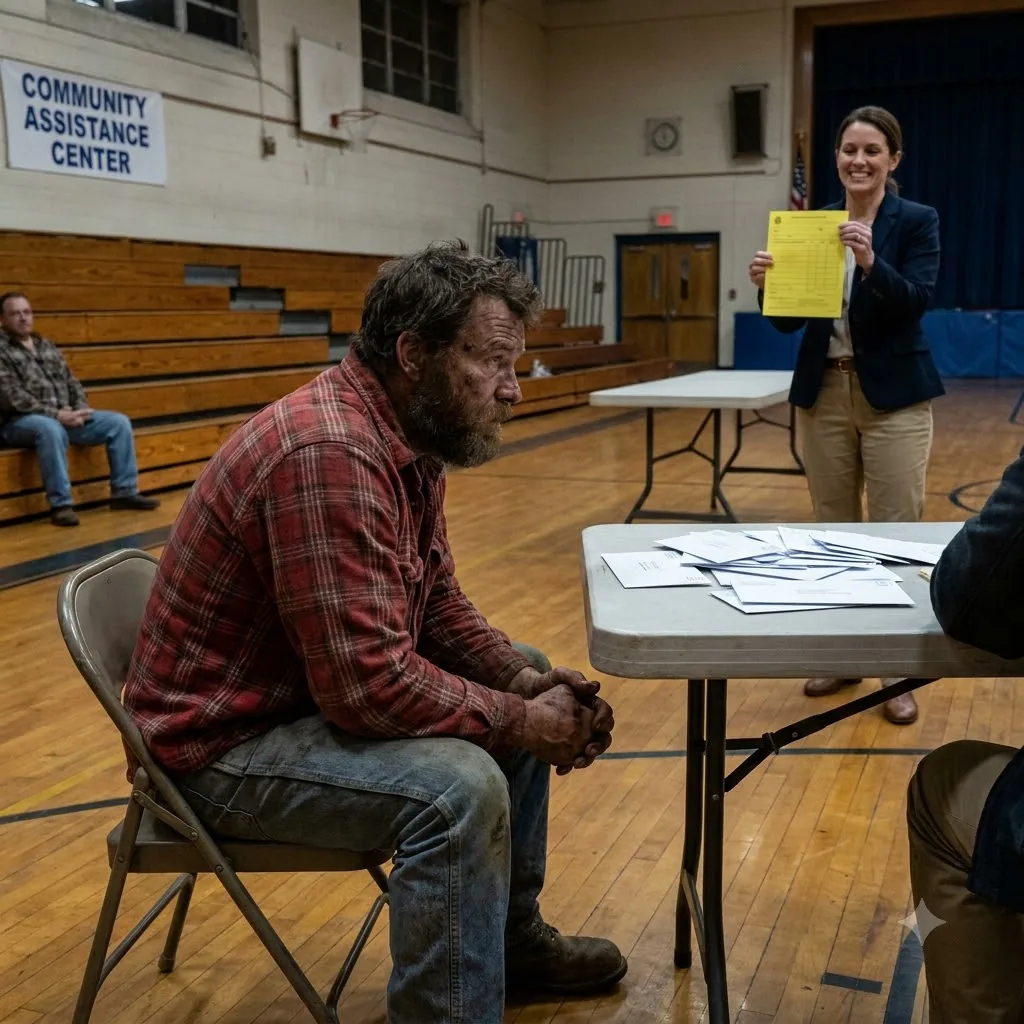
The two tactical men stopped exactly two feet away from Coley. Up close, the high school gym’s humid air carried the smell of their aggressive spearmint chewing gum and the heavy starch of their black uniforms. Their chest rigs lacked any identifiable agency patches or police insignia. Their nameplates were blank, replaced entirely by alphanumeric identification numbers stamped in white. More importantly, Coley noted the square black boxes mounted dead center on their tactical vests. A tiny red LED blinked steadily on each device, a stark contrast against the dark fabric.
Active recording.
They wanted a viral video. They wanted a high-definition clip of an irate, irrational Appalachian coal miner lunging at peaceful NGO workers, ready to be broadcast across their donor network to justify their presence and their methods.
Coley’s heart hammered against his ribs, a heavy, primal rhythm demanding immediate action, but he forced his hands to remain perfectly open, his palms facing outward. He did not clench his jaw. He did not narrow his eyes. He took a single, deliberate step backward, keeping his boots light on the polished hardwood.
“I am complying,” Coley said. He pitched his voice to carry across the quiet gymnasium, ensuring it sounded flat, even, and entirely devoid of aggression. “I am stepping away from the table. I am not a threat to anyone.”
Maya picked up her wireless microphone. “Mr. Vance, your refusal to accept the behavioral parameters of your transition is creating an unsafe environment for our staff.” Her voice echoed through the PA system, loud and tragically sympathetic, drowning out his calm compliance. “We are only here to help you heal from a violent industry.”
The guard on the right, a heavy-set man with a shaved head and a thick neck, stepped into Coley’s newly vacated space, intentionally closing the distance. “Keep moving toward the exit, buddy,” the guard muttered under his breath, his voice barely a rasp, his lips moving just enough to form the words. “Give me a reason. Just twitch.”
Coley didn’t twitch. He kept his eyes locked on the blinking red light of the body camera. He took another smooth, measured step backward. “I am moving toward the exit,” he announced clearly.
He glanced over his shoulder at the long line of men behind him. His friends. His former crew. Men he had pulled double shifts with in the stifling dark of the Number Four shaft.
The atmosphere in the gym had drastically changed. The initial flicker of solidarity and sympathy was evaporating rapidly into desperate anxiety. These men had underwater mortgages, hungry children, and mounting winter utility bills. They had swallowed their pride to sit through an agonizingly condescending seminar, and now, Coley was the only thing standing between them and their survival.
“Come on, Coley,” Higgins called out from the middle of the pack. The older miner shifted his weight from one worn boot to the other, his weathered face tight with stress. “Just go, man. Don’t mess this up for the rest of us.”
“Yeah, just walk away,” another voice muttered from the back of the line.
Maya sighed heavily into the microphone, a sharp intake of breath engineered to convey deep, burdened sorrow. “I am so sorry, everyone. But due to this sudden escalation, Protocol Four-B requires us to reassess the emotional volatility of the entire group. We will need everyone to step back. We are pausing all distributions until the facility is completely secure.”
A low, collective groan of panic rolled through the wooden bleachers. At the table, the nervous assistant rapidly gathered the manila envelopes, stacking them out of reach behind a plastic storage tub.
The betrayal hit Coley like a physical blow to the sternum. Maya wasn’t just isolating him; she was expertly weaponizing his own community against him. She was transforming him into the villain in a room full of victims.
“He’s leaving!” Higgins yelled, stepping out of line and pointing a calloused finger at Coley. “He’s not with us! Just give us our checks!”
Coley kept walking backward, refusing to turn around completely. If he turned his back, the guards might grab him to initiate a scuffle. If he resisted, the cameras would catch the struggle. He analyzed the folding table as he retreated. The assistant with the laptop had shifted the device outward to clear space for the envelopes. The glowing screen was now momentarily angled toward Coley.
He stopped his retreat for a fraction of a second.
It wasn’t a list of names. It was a digital spreadsheet dashboard. At the top, in large red text, it read: *Targeted Withholdings: 12 / 20.* Below that, it listed the total monetary value of the frozen severance packages.
They had a quota.
This wasn’t about his psychological profile or his supposed “ideological rigidity.” The NGO was deliberately failing a specific percentage of the miners to claw back the transition funds. They were keeping the money, using the behavioral audits as a legally unassailable excuse to withhold the largest payouts. They had profiled him because he was calm enough to endure it without starting a riot, and because his severance as a former shift foreman was larger than most.
“Keep moving,” the shaved-headed guard warned, suddenly reaching out to shove Coley’s shoulder.
Coley sidestepped the heavy hand smoothly, letting the guard stumble slightly forward into empty air. “Do not touch me,” Coley said, speaking clearly for the benefit of the cameras and the crowd. “I am exiting voluntarily.”
“Mr. Vance,” Maya said over the speakers, her voice cutting through the rising tension. “If you leave the premises now without signing the incident report, your severance will be permanently revoked. However, if you sign the acknowledgment of your aggressive behavior, we can clear the room, restore order, and process your fellow workers.”
She held up a single sheet of paper attached to a new clipboard.
It was a masterful, suffocating trap. If he signed it, he legally confessed to being a violent threat, giving them the ironclad grounds to keep his money and justifying their entire narrative. If he walked out the double doors, he lost his daughter’s asthma money by default. But if he stayed and argued, the guards would arrest him for trespassing, he would go to jail, and the other miners would lose their checks because of his ongoing “disruption.”
He looked at the men in line. Higgins, old man Miller, and thirty others were glaring at him with raw, desperate hostility. They needed him to submit. They were begging him with their eyes to take the fall so they could feed their families.
The two tactical guards spread out, cutting off his direct path to the exit. The taller one rested his hand ominously on the black handle of a collapsible baton. The red recording lights on their chests stared at Coley like unblinking eyes. Maya held the pen out across the folding table, her face a mask of manufactured empathy, waiting for him to surrender.