Story code: ST-001891
Part 2: The Convenience Fee
The text message on the shattered screen was agonizingly brief: *Manager said 4:00 PM sharp. If you don’t have the full 300, they pack her things. No partials.*
Silas stared at the glowing white letters until they blurred. Four o’clock. The digital clock in the corner of his screen mocked him: 1:14 PM. He had two hours and forty-six minutes to bridge a gap that was widening by the second. The thick manila envelope resting against his ribs suddenly felt like an iron anchor, dragging him beneath the surface. He wasn’t just panicking over a fifty-dollar municipal citation. He was panicking because every dollar diverted to the city clerk was a dollar stolen from the envelope. And if that envelope wasn’t full by four, the most important person in his life was out on the street.
He couldn’t leave Elm and Maple. The thought clawed at his mind, a desperate urge to flee the watching camera, but he shoved it down. Any other corner in the district was a ghost town at this hour. This specific intersection, where the towering glass of the financial district met the historic brick of the tourist quarter, was the only artery in the city with enough dense foot traffic to generate a miracle. If he packed up his gear and walked ten blocks to the waterfront, he would lose an hour of prime daylight. He would lose his established momentum. He had to stand his ground right here.
Silas shoved the phone back into his jacket pocket. The immediate obstacle was the pink carbon copy of the noise citation sitting on the velvet lining of his guitar case. The responding officers had been clear: pay the fifty dollars through the city’s mobile portal, or lose the street performer’s medallion and the equipment entirely. He couldn’t even touch his amplifier’s power switch until the citation was cleared.
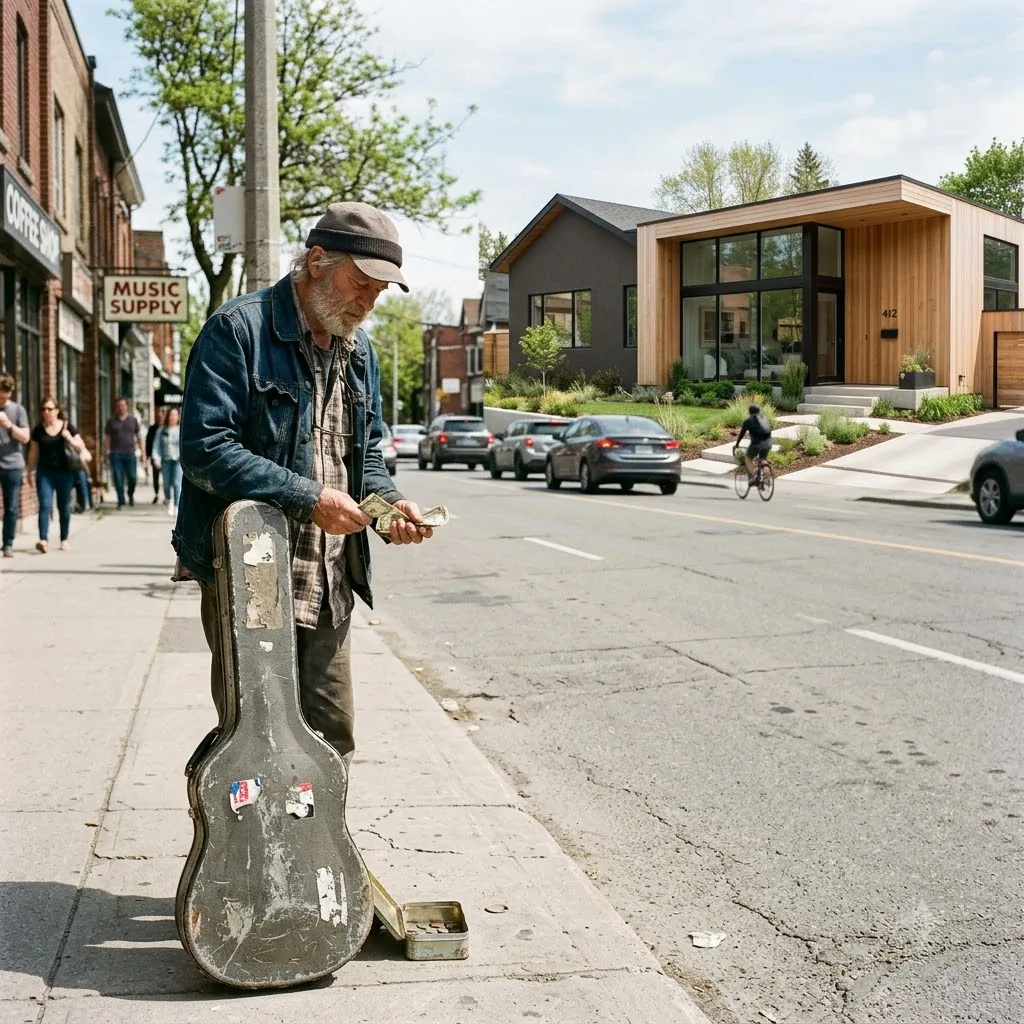
He looked at his dented plastic bucket. Thirty-two in wrinkled bills, maybe eight in scattered coins. Forty dollars cash.
He pulled his phone back out and navigated to his banking app with a numb, trembling thumb. His checking account balance sat at exactly $52.14. It was supposed to be the final safety net, the digital money he would withdraw at three-thirty to push the envelope over the finish line.
If he paid the fine online now, his checking account would be drained. He would have to earn the fifty dollars all over again, entirely from scratch, relying on the goodwill of strangers who were currently avoiding his gaze. But without the amplifier, he was completely invisible. His raw acoustic guitar could not compete with the roar of city buses, the hiss of pneumatic brakes, and the relentless hum of urban life.
He had to spend the money to make the money. It was the oldest, cruelest trap in the world.
Silas clicked the link on the pink slip. The city clerk’s portal loaded with agonizing slowness, the spinning wheel stuttering on his phone’s weak cellular connection.
Across the street, the heavy oak door of the renovated bungalow swung open.
Silas froze, his thumb hovering over the payment screen.
A man stepped onto the pristine porch. He wore a crisp, charcoal-gray turtleneck and held a sleek silver coffee mug. He didn’t look angry; he looked profoundly inconvenienced. The man took a sip of his coffee, his eyes locking onto Silas. He pointed a manicured finger at the unplugged amplifier sitting on the cobblestones.
“I thought the officers told you to move along,” the man called out. His voice was conversational, effortlessly carrying across the narrow street, entirely devoid of empathy.
“They told me to turn off the amp,” Silas called back, his voice tight, fighting the violent urge to scream. “I have a medallion to be on this corner. I’ve been on this corner every day for four years.”
“And I bought this house last week,” the man replied, leaning against a wooden porch pillar. “I work from home. My office faces the street. Your noise is vibrating through my floorboards. If you start playing again, even without that box, I’m calling them back. The ticket clearly states you’re creating a public nuisance.”
Silas’s grip tightened on the neck of his guitar until his knuckles turned white. The man wasn’t just demanding quiet; he was claiming the airspace of the entire block. “It’s an acoustic guitar, man. It’s a public sidewalk. The city ordinance doesn’t apply to unamplified music.”
“Do you really want to test that with the police?” the man asked, offering a thin, patronizing smile. “I have them on speed dial. Save yourself the trouble. Go find a park.”
The man turned and walked back inside, the heavy oak door clicking shut with a definitive, expensive-sounding thud. The blue light on the smart camera blinked, a digital watchman ensuring Silas remained silenced.
A wave of profound, suffocating isolation washed over Silas. The lunchtime crowd flowed around him like a river around a stone, entirely indifferent to his existence. Marcus, a mid-level accountant who normally stopped every Tuesday to drop a ten-dollar bill and request a blues riff, walked past. Marcus glanced at the unplugged equipment, then at Silas’s strained expression, gave a pitying grimace, and tossed a single quarter into the bucket without breaking his stride.
The silver coin hit the plastic with a hollow *clack*.
Silas couldn’t breathe. The clock was ticking. 1:22 PM. He needed to plug in. He needed to drown out the bungalow, the traffic, and the rising panic. He looked down at his phone, the city clerk’s payment portal finally loading on the cracked screen.
He entered his debit card information, his calloused fingers slipping on the shattered glass. He authorized the $50.00 payment to clear the citation.
The screen refreshed. A bright red banner appeared at the top.
*Transaction Declined. Insufficient Funds.*
Silas stared at it, uncomprehending. He checked his memory. He had $52.14. The fine was exactly fifty.
He scrolled down the payment page, his blood turning to ice. There, nestled beneath the fifty-dollar charge in small, pale gray text, was a municipal add-on.
*Subtotal: $50.00. Convenience Fee: $4.95. Total Due: $54.95.*
He was two dollars and eighty-one cents short. He couldn’t pay the ticket digitally. He couldn’t legally turn on the amp. And a white police cruiser had just turned onto Elm Street, its tires rolling slowly over the cobblestones, heading straight toward his corner.