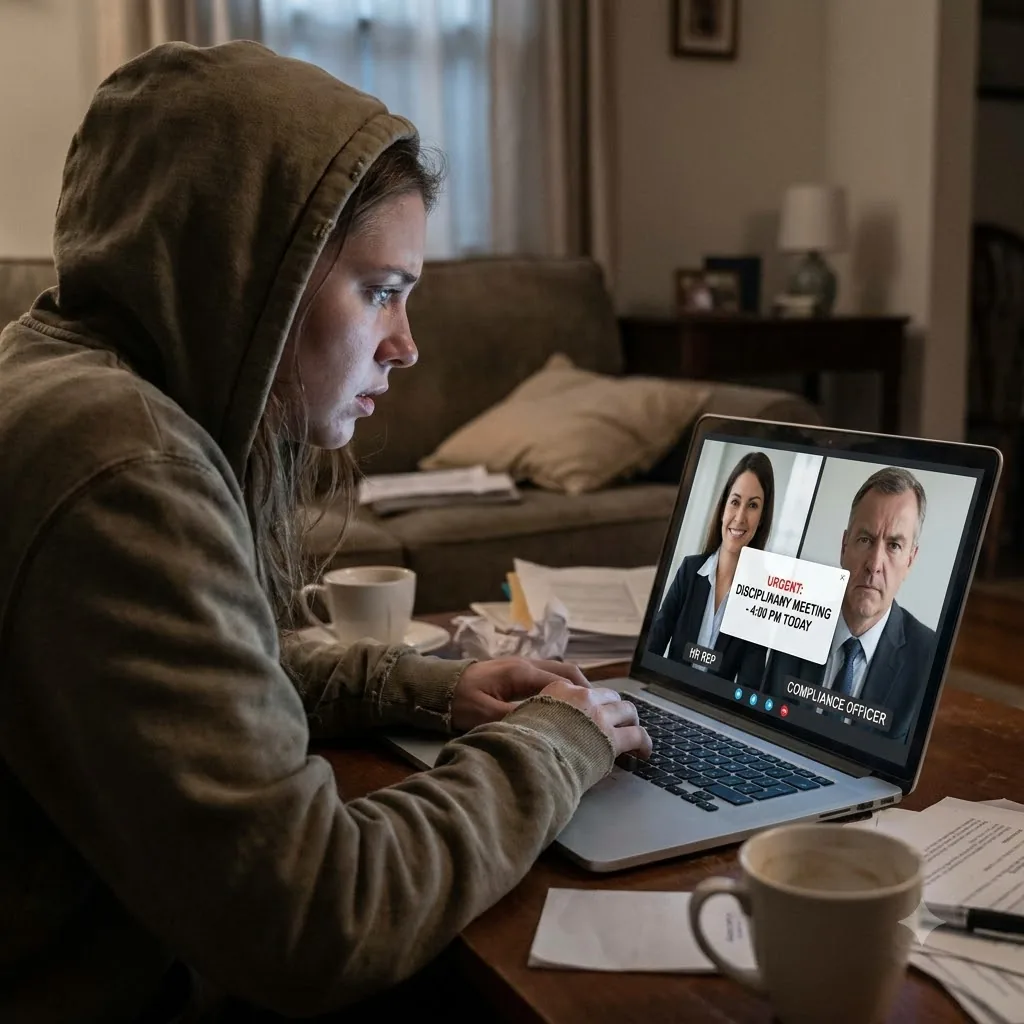
Story code: ST-000341
Part 2: Weaponized Empathy
Maya dragged her mouse back and forth across her mousepad, watching the cursor flit across the bottom of the video application. There was no microphone icon. There was no camera toggle. She pressed the spacebar, the standard keyboard shortcut to temporarily unmute her audio. A dull Windows error chime echoed in her headset. She pressed `Alt+A`. Another hollow chime.
“We really appreciate you holding this space with us today, Maya,” Julian said. He steepled his fingers, leaning toward his webcam so his beige sweater filled the frame. “We know sudden pivots can feel deeply dysregulating. That’s exactly why Chloe and I are here to co-create a safe container for your next steps.”
Maya’s heart rate spiked, a heavy thud against her ribs. She moved her cursor to the chat icon at the bottom of the control bar. The panel expanded on the right side of her screen. She rapidly typed: *I can’t unmute. My controls are gone. What is this meeting about?*
She hit enter. The text flashed for a fraction of a second before vanishing. In its place, a system notification appeared in muted gray font: *Participant messaging has been restricted by the host to ensure a focused, trauma-informed environment.*
“I want to validate the stillness I’m seeing from you right now,” Chloe chimed in. Her smile remained frozen, her eyes unblinking behind thick, blue-light-blocking glasses. “Silence is a perfectly valid response to growth. It tells us you’re actively receiving this narrative, and we honor that.”
Maya stared at Chloe’s video feed. *They disabled my microphone,* she realized, a cold knot tightening in her stomach. They had deliberately stripped away her voice, and now they were actively documenting her silence as peaceful, uncontested acceptance.
“Exactly,” Julian nodded, his tone dropping to a sympathetic register. “As you know, the company is moving toward a more agile, decentralized energy. We are shedding legacy paradigms. And unfortunately, that means certain roles are undergoing an evolution.”
Maya opened a new window on her browser. She tried to navigate to her personal email to forward whatever evidence she could salvage, but the browser returned a DNS error. A corporate firewall overlay appeared, stating external access was paused for her wellness. Her company VPN had locked her out of the wider internet. She was digitally quarantined.
“We want to empower you during this season of change,” Chloe said, tilting her head to the side. “We’ve curated an Alignment Pathway specifically tailored for your journey.”
Julian clicked something on his end, and Maya’s view shrank as a screen share overtook her monitor. A pristine PDF filled her screen. The pastel header read: *Voluntary Alignment & Synergistic Transition Acknowledgment*.
Maya leaned closer, scanning the dense block of corporate-therapy jargon. The document didn’t use the word ‘termination.’ It never mentioned a ‘layoff.’ Instead, it relied on phrases like ‘opt-in sabbatical,’ ‘mutual realignment,’ and ‘knowledge democratization.’
Under a section labeled *Immediate Action Items*, she saw a bulleted list. The first item was her backend architecture review. But the text beside it didn’t say she was presenting it. It read: *Transfer of architectural assets to global asynchronous partner.*
“We want this to be a collaborative off-ramp,” Julian explained, his voice oozing with unyielding empathy. “By clicking the link Chloe is about to drop in the chat, you’ll take ownership of your pivot. You’ll agree to a two-week transition sprint, where you’ll shadow our external support vendor to ensure a seamless transfer of your institutional energy.”
A notification pinged. Chloe had posted a hyperlink to a digital signature platform.
*Action Required: Alignment Confirmation,* the message read.
Maya read the PDF again. The language was meticulously crafted to legally insulate the company. If she signed, she wasn’t just agreeing to train her offshore replacement; she was legally acknowledging the transition was completely voluntary. They were forcing her resignation and calling it a wellness initiative.
“We’re asking you to lean into this closure, Maya,” Chloe whispered, as if guiding a morning meditation. “We want you to exit with grace. Declining to sign the alignment document will be recorded as a choice to abandon your commitment to our culture, meaning you forfeit your transition stipend.”
Maya moved her mouse toward the red *Leave Meeting* button. If she closed the application, she could run to her phone, disconnect from the Wi-Fi, and call an employment lawyer.
But as her cursor hovered over the button, she noticed something shift in the participant panel.
The meeting had started with three people. Now, the counter at the top of the participant list read *four*.
Maya scrolled down. Below Chloe’s and Julian’s names, a new user sat silently in the digital room, their camera and microphone firmly disabled. The display name was *Recording_Bot_Legal_Archiver_04*.
“Maya, we need a physical sign that you are processing this,” Julian prodded gently. “Just click the link, read through the affirmations, and provide your signature. It’s the healthiest way to step into your new truth.”
She couldn’t leave. The bot was capturing her every move. If she clicked the red button, the video would show her silently staring at a transition agreement before abruptly hanging up-perfect documentation of job abandonment. If she stayed and didn’t sign, they would sit there, recording her refusal to cooperate with their empathy.
Maya moved her cursor to the digital signature link in the chat, but she didn’t click. She hovered over it, waiting for the tooltip to display the full destination URL. The web address popped up in a small yellow box. Embedded deep in the hyperlink’s tracking parameters was a string of text that made the blood drain from her face: `&template=waiver_of_litigation&cause=voluntary_departure`.