Story code: ST-000802
Part 2: Asset Logged
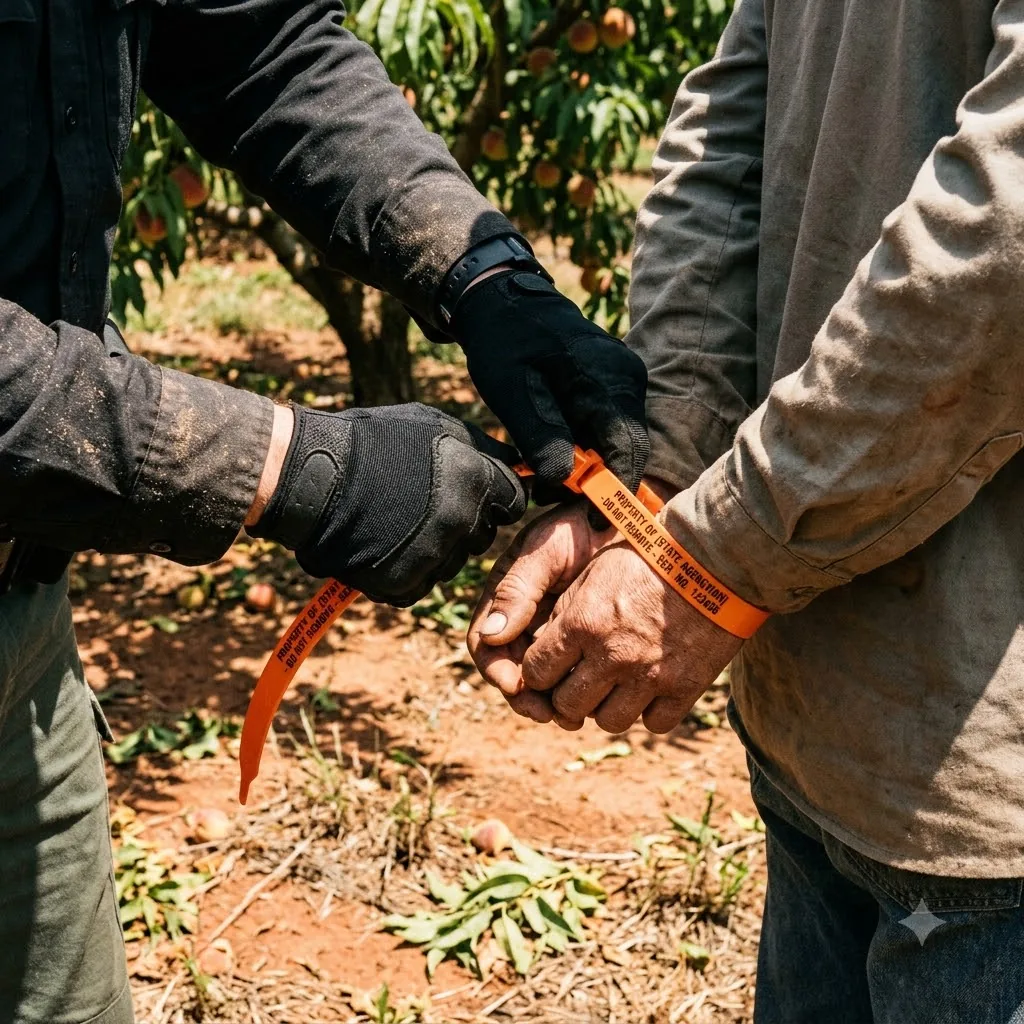
The ratcheting sound stopped, leaving only the oppressive drone of the cicadas in the heavy Georgia heat. Julian let his thumb slide off the sharp, interlocking edges of the corporate brand. He took a slow breath, forcing his face to remain completely passive. He was a federal agent. He had spent seven years eating dirt at the southern border, navigating endless bureaucratic reviews, and swallowing his pride to secure his place in this agency. He had a mortgage on a neat suburban house in Marietta. He had the premium federal health insurance that covered his mother’s expensive dialysis treatments. He was exactly three years away from his pension vesting. He had built a fortress of stability around his life, and the foundation of that fortress was following orders.
He gave the young worker a firm but measured push on the shoulder. “Walk,” Julian commanded, his voice deliberately flat, betraying none of the cold spike of adrenaline currently shooting through his chest.
The worker stumbled forward in the loose, dry soil, catching his balance clumsily with his arms pinned behind his back. “Por favor, jefe,” the young man whispered, casting a desperate glance over his shoulder. “No a la planta. Deportarme. Por favor.”
Julian frowned, keeping his pace steady a step behind the man. *Not the plant. Deport me. Please.* Detainees always begged. It was the hardest part of the job. They begged for a phone call, they begged for their children, they begged for just one more chance. They pleaded with God and with Julian not to be deported. They never begged *to* be deported.
They reached the edge of the tree line where the three white vans idled. The exhaust fumes mixed with the smell of rotting peaches, creating a hazy, toxic soup that clung to the back of Julian’s throat. Up close, the absence of government markings on the vehicles was glaring. There were no Department of Homeland Security placards on the doors. There were no blue federal stripes. There were not even standard-issue government fleet license plates. There was just a plain, glossy white exterior and a small, square QR code decaled onto the rear bumper of each van.
Miller stood by the open rear doors of the lead vehicle, holding a heavy-duty, ruggedized tablet. He wasn’t holding a standard intake clipboard. He wasn’t calling dispatch to run names through the National Crime Information Center database. He was just tapping a screen that glowed brightly in the shade of the canopy.
“Next,” Miller said, not bothering to look up from the glass.
Julian guided his worker forward. The young man’s thin shoulders shook violently. As they approached the bumper, Miller stepped forward with a handheld barcode scanner wired directly to his tablet. He didn’t ask the detainee for a name. He didn’t ask for a country of origin or an age. He simply reached out, grabbed the young man’s bound wrists with a meaty hand, and pointed the scanner directly at the heavy black plastic of the zip-tie.
A sharp, synthetic beep cut through the rumble of the idling engines.
“Asset logged,” Miller muttered to himself, swiping a thick finger across his screen. “Load him up.”
Julian froze. His grip tightened slightly on the worker’s arm. *Asset.* Not detainee. Not subject. Not undocumented migrant. Asset.
He looked down at the tablet screen as Miller shifted his weight to point the scanner at the next worker in line. In the top corner of the glowing display, spinning slowly in a crisp digital animation, was the exact same geometric, interlocking corporate logo that was stamped deep into the plastic restraints biting into the worker’s wrists.
“Hey, Miller,” Julian said, keeping his tone carefully casual. He needed to sound bored, just another badge punching the clock and doing the paperwork. “Which processing center are we routing these guys to? Stewart or Atlanta? I need to get the destination code for my shift report.”
Miller stopped tapping. He slowly lowered the tablet, turning his thick, sunburned neck to look at Julian. The older man’s eyes were completely hidden behind cheap, polarized tactical sunglasses, making his face an unreadable wall. “You don’t need a shift report for a direct transfer, Julian.”
“Direct transfer?” Julian asked, letting a hint of genuine confusion slip through his carefully maintained mask. “We’re bypassing federal processing?”
“It’s a new pilot program,” Miller said, his voice dropping an octave, carrying a subtle but distinct edge of warning. “Private sector efficiency. We’re taking this batch straight to the new automated agricultural processing facility in Dalton. The contractor takes over housing, medical, and labor assignment from here. Cuts out the bureaucratic middleman. Saves the taxpayers a fortune. You got a problem with saving taxpayer money, Julian?”
*Labor assignment.* The phrase hit Julian like a physical blow to the ribs. The United States government deported people, or it detained them pending a hearing. It absolutely did not bypass federal courts to assign human beings to labor camps run by private corporations.
The worker beside Julian suddenly dropped to his knees in the dust, hyperventilating. “¡No!” he cried out, the previous quiet compliance shattering into raw panic. “¡Prefiero la cárcel! ¡No me vendan!”
*I prefer jail! Don’t sell me!*
“Get him up,” Miller snapped, his hand dropping instinctively toward the yellow Taser strapped to his thigh. “Get him in the damn van, Julian. Right now.”
Julian’s heart hammered a frantic rhythm against his sternum. He grabbed the young man by the bicep, hauling him upward. The worker’s skin was hot and slick with sweat. He looked directly into Julian’s eyes, his dark pupils blown wide with terror. It wasn’t the look of a man afraid of the law. It was the look of a man staring into an abyss.
Julian had built his entire life on being on the right side of the law. The rules protected him. The rules provided his family’s survival. But there were no rules here. The federal government had seemingly outsourced a raid to a corporation that was explicitly tagging human beings as permanent inventory.
“I said get him in,” Miller repeated, taking a heavy step closer.
Two other agents, both recent private-sector transfers like Miller, paused their loading at the second van. They turned to watch, resting their hands casually on their duty belts. The isolation closed in on Julian instantly. He was the only legacy ICE agent on this specific squad. The rest were all Miller’s guys, brought in under the new regional directive.
If Julian drew his weapon or keyed his radio for help, he would be a lone, rogue agent assaulting his own team. He’d lose the badge, the pension, the house, and his freedom. He’d be facing federal charges by sundown, unable to help his mother or himself. If he did nothing, he was personally delivering this man-and dozens of others-into unrecorded, inescapable servitude.
Julian shoved the worker forward, guiding him up the step into the open back of the van. The dark interior was already packed with ten other men, sitting shoulder-to-shoulder on bare metal benches, their hands bound with the same black, branded plastic.
“Good,” Miller said, his tone softening back to a chilling indifference. “You ride in the back with this batch, Julian. Make sure the inventory stays quiet on the highway.”
Julian climbed into the stifling, exhaust-choked heat of the transport van. Behind him, Miller slammed the heavy metal doors shut, engaging the exterior deadbolt with a heavy clack, plunging Julian into the dark with a dozen men who no longer legally existed.