Story code: ST-000802
Part 3: The Occupancy Mandate
The heavy metal doors of the transport van swung open, violently breaking the suffocating darkness with blinding industrial halogen light. Julian squinted, his lungs burning from an hour of inhaling trapped diesel exhaust and the panicked, unwashed sweat of a dozen zip-tied men. During the agonizing ride, he had mentally recited federal transport protocols, clinging to the familiar bureaucracy of his seven-year career to suppress his rising panic. But as his vision cleared, the last of his bureaucratic comfort evaporated.
They hadn’t pulled into the secure sally port of the Stewart Detention Center. There were no reinforced cinderblock walls, no armed federal marshals, no sterile intake corridors lined with blue plastic chairs. They were parked inside a cavernous loading bay that vibrated with the deafening, rhythmic roar of heavy machinery. Beyond the bay, sprawling conveyor belts snaked through a massive facility, carrying endless cascades of agricultural produce under glaring fluorescent strips. It smelled of industrial bleach, rotting peaches, and hot metal.
“Out. Move,” Miller barked, striking the side of the van with a heavy open palm.
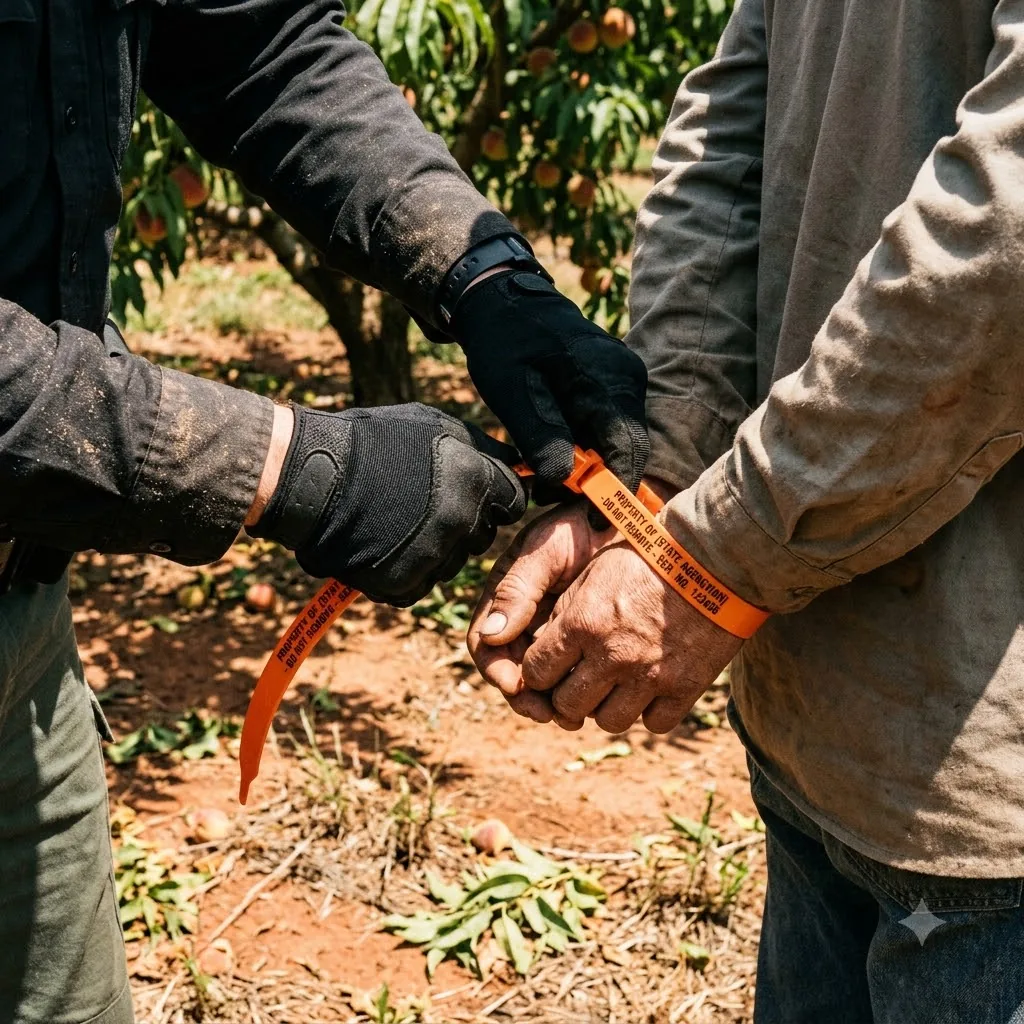
The workers shuffled forward, blinded and trembling, their wrists still bound by the black, corporate-branded plastic. Julian stepped down onto the slick concrete, his legs stiff from the cramped ride. He bypassed Miller entirely, unvelcroing his tactical vest just enough to let his sweat-soaked uniform shirt breathe. He needed answers, and he needed them on paper. His entire life-his mortgage, his mother’s dialysis, his impending pension-was shielded by strict adherence to federal law. If this was a rogue operation, he needed the paper trail to save himself.
“Where is the site director?” Julian shouted over the mechanical din, stepping directly into Miller’s personal space.
Miller smirked, casually adjusting his polarized tactical sunglasses despite the indoor lighting. He pointed a thick finger toward a suspended, glass-walled office overlooking the factory floor. “Up the stairs. Try not to embarrass yourself, Julian. You’re in the private sector now.”
Julian didn’t look back. He took the metal-grated stairs two at a time, his heavy boots clanging over the roar of the sorting machines. Through the glass, he saw a man in a crisp white shirt and a dark, expensive tie, standing over a broad mahogany desk. He was tapping at a ruggedized tablet identical to the one Miller had used in the orchard.
Julian pushed the door open. The immediate silence of the soundproofed office made his ears ring. The air conditioning was freezing, a sharp, sterile contrast to the humid, suffocating loading dock below.
The man looked up. He wore a silver magnetic nametag that read *Vance – Warden / Site Operations*. He didn’t carry the weary, hardened look of a federal prison warden. He looked like a corporate logistics manager optimizing a supply chain.
“Agent Julian, I presume,” Vance said, his voice smooth and entirely unbothered. “Miller texted that you were having some assimilation issues with the new workflow.”
“I need the A-files for the twenty-two men we just transported,” Julian said, planting his boots firmly on the plush carpet. “I need the Form I-862 Notice to Appear documents countersigned, and I need the EOIR docket numbers. These men are entitled to an immigration judge within forty-eight hours of apprehension.”
Vance sighed, setting the tablet down gently on his desk. “We don’t use A-files here, Julian. We use inventory tracking barcodes. You saw the bands on their wrists.”
“You cannot hold federal detainees without a deportation hearing schedule,” Julian countered, taking a hard step closer to the desk. “It’s a direct violation of the Immigration and Nationality Act. If you don’t have a federal judge assigned to this facility, this is illegal detention. Where is the EOIR docket?”
Vance offered a patronizing, thin smile. He reached across his desk, picked up a thick, leather-bound portfolio, and flipped it open. He spun it around, sliding it across the polished wood toward Julian. “We don’t need a docket, because they aren’t waiting for deportation. You’re a legacy ICE guy, Julian. You’re stuck in the old math. The government pays fifty thousand dollars a year to house one detainee in a federal facility while they sit around waiting for a backlog judge. It’s a waste of capital.”
Julian looked down at the document. It bore the official seal of the local municipality, stamped right alongside the sharp, geometric corporate logo he had traced on the zip-ties back in the orchard.
“Read clause four, sub-section B,” Vance instructed softly.
Julian’s eyes scanned the dense, single-spaced legal text. *…the Federal Agency shall be contractually bound to maintain a minimum 95% occupancy rate at the Dalton Agricultural Processing Facility at all times, to be audited quarterly.*
“A bed mandate,” Julian muttered, his brow furrowing. “ICE has had local quota mandates before. It just guarantees the private prison gets paid for empty beds.”
“Keep reading,” Vance said, tapping a manicured fingernail against the parchment.
Julian traced his finger down the page. *…Said occupancy shall be strictly utilized to satisfy the manual labor demands of the Facility in lieu of monetary tax compensation to the municipality, classifying all detained individuals as active operational assets until the termination of this contract.*
Julian’s breath hitched in his throat. He read the words again. *In lieu of monetary tax compensation.* *Active operational assets.*
“This is a municipal contract to supply free labor,” Julian said, his voice dropping as the sheer, terrifying scale of the document crystallized in his mind. “You aren’t holding them for processing. You’re processing the peaches. You’re running a slave ship with a federal stamp on it.”
“We’re keeping the supply chain moving,” Vance corrected, leaning his knuckles on the desk. “The municipality gets a cut of the agricultural profits instead of property taxes. The private sector gets a highly reliable workforce that doesn’t unionize, doesn’t call in sick, and doesn’t complain about minimum wage. And your agency gets to clear its apprehension quotas without asking Congress for more funding. It’s a perfect, closed loop.”
Julian stared through the glass wall behind Vance. Down on the factory floor, the terrified men from the van were already being shoved toward a massive, stainless-steel sorting line. Their branded zip-ties were being snipped off, only to be immediately replaced by heavy rubber aprons and steel-toed boots. Guards with yellow tasers stood at the end of every row.
“They have a constitutional right to a hearing,” Julian said, gripping the edge of the mahogany desk so hard his knuckles turned white. “If they see a judge, they eventually get deported. If they get deported, they leave the facility.” He looked up from the factory floor, locking onto Vance’s cold, calculating eyes. “You can’t maintain a ninety-five percent occupancy rate for the assembly line if you deport them.”
Vance’s patronizing smile slowly vanished, replaced by a flat, unblinking stare.
“How long is their sentence, Vance?” Julian asked, the ice in his own voice surprising him. The suffocating heat of the orchard suddenly felt very far away. “If there are no federal hearings, and you’re legally bound to keep this factory ninety-five percent full just to keep the municipal profits flowing… when do they go home?”
Vance didn’t answer. The silence in the freezing office stretched out, heavy and absolute. Down below, the industrial machinery roared, deafening and endless, but up here, Vance just stared at Julian. The polite corporate facade had completely stripped away, leaving only the chilling reality of a question the warden had no intention of ever answering.