Story code: ST-001366
Part 3: The Wreckage of the Myth
The Chamber of Commerce Winter Mixer was held in the glass-walled atrium of the new municipal center, a towering monument to the town’s aggressive gentrification. I stood near the carved ice sculpture, wearing a starched white chef’s coat, presenting silver trays of my black truffle gougères to people who owned summer homes and wintered in St. Barts. The air inside the room was thick, smelling of expensive botanical gin and arrogant, heavy perfumes.
Every time I smiled and offered a napkin, the phantom itch in my left arm flared. It hadn’t stopped burning since the morning.
Greg wasn’t in the freezing alley. I had smuggled him up the back stairwell to my tiny apartment above the bakery, wrapped him in my heaviest winter quilt, and left him with a bucket and a bottle of water to sweat through the worst of his withdrawal. While he shook in the dark, fighting for his life against a biology that wanted to tear him apart, I was down here, performing for the very people who had stepped over him.
Eleanor Vance glided by, her daytime cashmere swapped for a sequined cocktail dress. She patted my arm with manicured fingers. “The gougères are absolutely divine, David. We are so, so lucky to have you in our town.”
I nodded, the muscles in my neck screaming with the physical effort of keeping my head attached to my shoulders. “Thank you, Eleanor.”
Then Silas took the center of the room. He didn’t need a microphone; his booming, self-assured voice naturally commanded the space, trained by years of telling people exactly what they wanted to hear. He held a crystal tumbler of scotch, his heavy gold Rolex catching the ambient light of the chandelier as he raised his hand for attention.
“Friends, colleagues,” Silas announced, waiting with practiced patience for the murmurs to die down. “If we’re talking about the future of Main Street, we need to look at the man standing right by the ice sculpture. David.”
Heads turned toward me. Applause rippled through the wealthy crowd. I felt a cold, prickling sweat break out on the back of my neck.
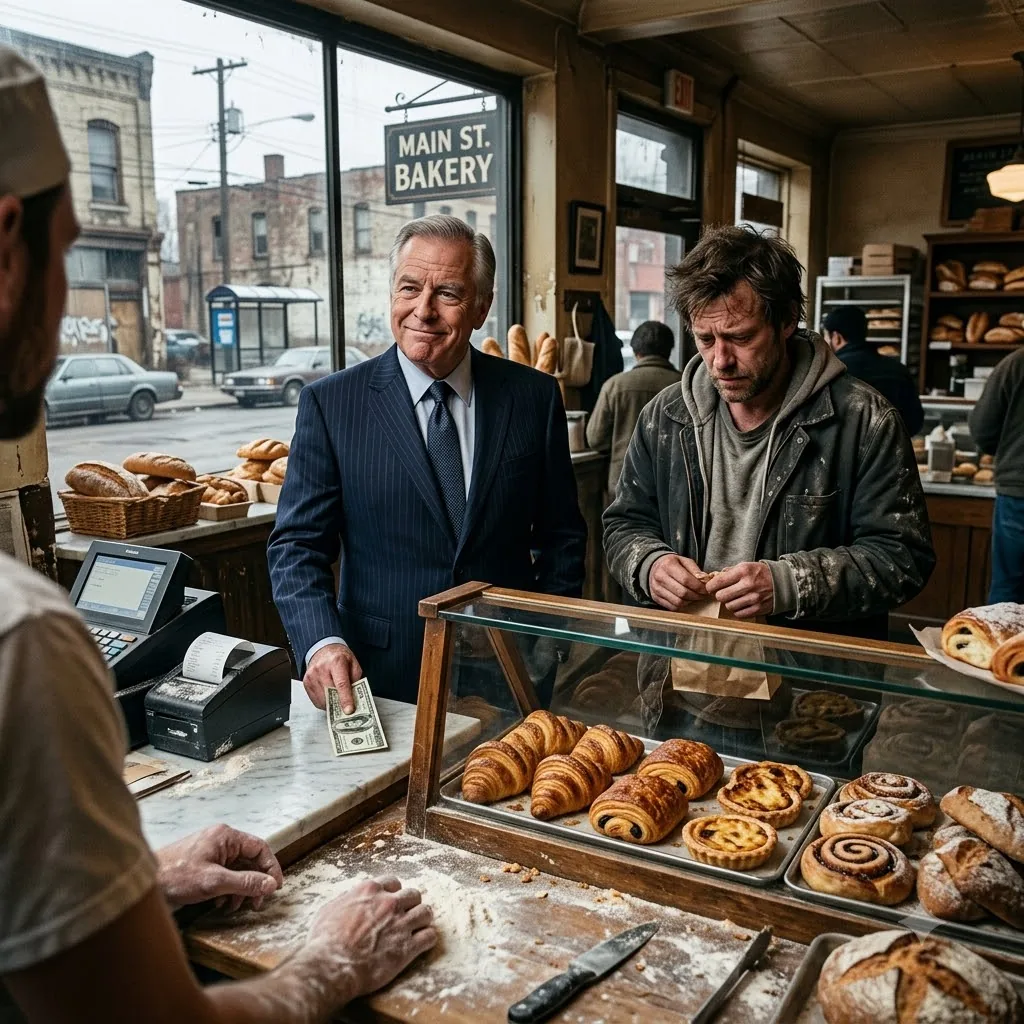
“David represents the gold standard,” Silas continued, pacing slowly like a predator showing off its territory. “Just this morning, I was in his shop. A local junkie stumbled in. A real piece of work. Dirty, shaking, knocking over expensive merchandise. Did David call social services? Did he coddle the leech? No. He grabbed him by the collar and threw him out into the alley where he belonged.”
Soft laughter and murmuring approval echoed off the tall glass walls. Eleanor smiled warmly and raised her champagne flute to me.
“That is the uncompromising discipline we need,” Silas preached, his eyes gleaming with righteous authority. “I see the same dregs every single day at my pawn shop on 4th Street. They come in crying, begging for cash advances, bringing me stolen power tools and their grandmother’s tarnished rings, acting like the world owes them a living. It’s pathetic. We need to stop subsidizing their weakness and start protecting our investments. We need more people with David’s cultural work ethic, and fewer local parasites.”
The itch in my arm turned into a searing, white-hot spike. My vision tunneled. I looked at Silas, standing there in his two-thousand-dollar suit, bloated on the misery of a town he was systematically bleeding dry. He didn’t just hate Greg; he profited off him. Silas’s pawn shop and payday loan fronts were the financial bear traps that caught desperate people, stripping them of everything before the drugs finally finished them off.
And Silas was using me as the moral justification for his cruelty.
I looked down at the heavy silver tray in my hands. I thought about the steel ice mallet from the morning. I thought about the crushing, suffocating weight of the pedestal they had built for me.
I dropped the tray.
The crash of heavy silver and scattering truffle gougères against the marble floor rang out like a bomb. The room instantly fell dead silent. The polite applause choked off in throats. The string quartet in the corner abruptly dragged their bows to a halt.
Dozens of wealthy eyes stared at me in profound shock.
I stepped over the spilled pastries. The stiff starch of my chef’s coat suddenly felt like armor instead of a straitjacket. I walked right into the center of the room, stopping ten feet from Silas.
“I didn’t throw him in the alley,” I said. My voice was no longer the soft, subservient tone I used to sell artisan sourdough. It was the harsh, jagged voice of a man who had survived county holding block D.
Silas blinked, his confident smile faltering. “What?”
“Greg. The man you humiliated this morning,” I said loudly, projecting my voice so every single person in the atrium could hear the echo. “He’s upstairs in my apartment. Sleeping in my bed. Trying to survive the withdrawal.”
Eleanor gasped, taking a stumbling step back, her hand flying to her chest. “David, what are you saying? You let that… that person into your home?”
“He’s not a ‘that person,’ Eleanor,” I snapped, turning to face the zoning board chair. “And I am not your perfect little success story. You all love my Italian tile floors and my imported espresso machines. You love my ‘work ethic.’ You know what my work ethic actually is? It’s absolute terror. I am over six hundred thousand dollars in debt. I took predatory loans from three different shadow lenders just to build the patio you’ve been extorting me over. I am bleeding out every single month, drowning to keep up this pristine facade so you don’t realize I’m exactly as desperate as the people you step on.”
I turned back to Silas. His face had gone rigid, a dangerous, ugly red creeping up from his collar.
“You don’t get to use me as a weapon against them anymore,” I told him, closing the distance between us. “You run a predatory pawn shop that charges four hundred percent interest on title loans. Greg didn’t start shaking because he’s weak. He’s on the street because you foreclosed on his mother’s house when she got sick, and your shop stripped every single asset he had left. You manufacture the misery in this town, Silas, and then you stand here drinking top-shelf scotch, complaining about the smell of the corpses.”
“Watch your mouth, you ungrateful little-” Silas snarled, dropping the polite, civic facade entirely.
“Or what?” I interrupted, my voice dropping to a low, lethal register. The phantom itch in my arm was completely gone, replaced by a terrifying, absolute clarity. “You’ll ruin my reputation? You’ll tell everyone I’m not the model immigrant you paraded around?”
I unbuttoned the cuffs of my chef’s coat and aggressively rolled up my left sleeve. The scars were faint, faded by ten years of sobriety and relentless kitchen burns, but the old, collapsed track marks were still visible if you knew exactly what you were looking at. I held my arm up high under the harsh glare of the crystal chandelier.
“Look at it,” I demanded.
Silas stared at my forearm, his sneer freezing into absolute horror as he recognized the scarred, ruined flesh.
“Ten years ago, I was Greg,” I said, my voice cutting through the total silence of the atrium. “I slept on wet cardboard behind the industrial park. I pawned the boots off my own feet to buy a fix. I shook exactly the way he shook this morning. I am a junkie. I’m just a junkie who learned how to bake bread and smile while you insulted my people.”
Nobody moved. Eleanor looked as if she were going to faint against the ice sculpture. The town council members were completely paralyzed, staring at me as if a monster had just ripped off its human skin in the middle of their gala.
Silas opened his mouth to speak, to regain control, to spin the narrative back into his favor, but there were no words left for him to steal. He just stood there, clutching his scotch, suffocating in the absolute wreckage of his own myth.