Story code: ST-001366
Part 4: The Next Hour
The brass chime above the door didn’t scream anymore. It barely whispered. It had been exactly two weeks since the Chamber of Commerce mixer, and the silence in my bakery was absolute. I stood behind the Italian pastry case, watching the dry January snow drift past the large front window. The racks behind me were still full of artisan sourdough, dark chocolate croissants, and delicate pear tarts, but there was no one left to buy them.
Eleanor Vance had been swift. The permit for my spring patio expansion was officially revoked forty-eight hours after the gala, citing “unforeseen zoning irregularities.” The real irregularity, of course, was me. I had broken the cardinal rule of their town: I had forced them to look at the ugly, grinding machinery running just beneath their pristine streets.
The country club crowd vanished overnight. There were no more wives in cashmere scarves buying boxes of hand-painted macarons for their book clubs. No more Silas coming in to loudly order his expensive coffees while lecturing the room on inherent work ethic. I was radioactive. I had taken a sledgehammer to my own pedestal, and the resulting debris had completely buried my bottom line.
I opened the heavy leather ledger on the counter. The math was brutal, printed in sharp, unforgiving red ink. The shadow lenders didn’t care about my moral epiphanies. The six hundred thousand dollars in debt was a living, breathing monster in the room with me. Without the daily influx of wealthy tourists and town council members, I had maybe two months before the bank seized the building, the commercial ovens, and the Italian tile I had scrubbed with my own blood.
I ran my fingers over the faded, collapsed track marks on my left forearm. The sleeve of my plain grey t-shirt was rolled up. I hadn’t worn the starched, suffocating white chef’s coat since the night at the atrium.
And yet, as I stared at the red numbers spelling out my inevitable ruin, I realized the phantom itch in my arm was entirely gone. For the first time in three years, I wasn’t vibrating with the exhausting effort of holding up a lie. I wasn’t terrified of slipping, because I had already hit the ground. The worst had happened. The facade was shattered, the town knew exactly what I used to be, and I was still breathing. The air in the bakery smelled of browned butter and caramelized sugar, and for once, it didn’t smell like a cage.
The brass chime rang.
I looked up, expecting the postman or perhaps a process server. Instead, Greg stood in the doorway.
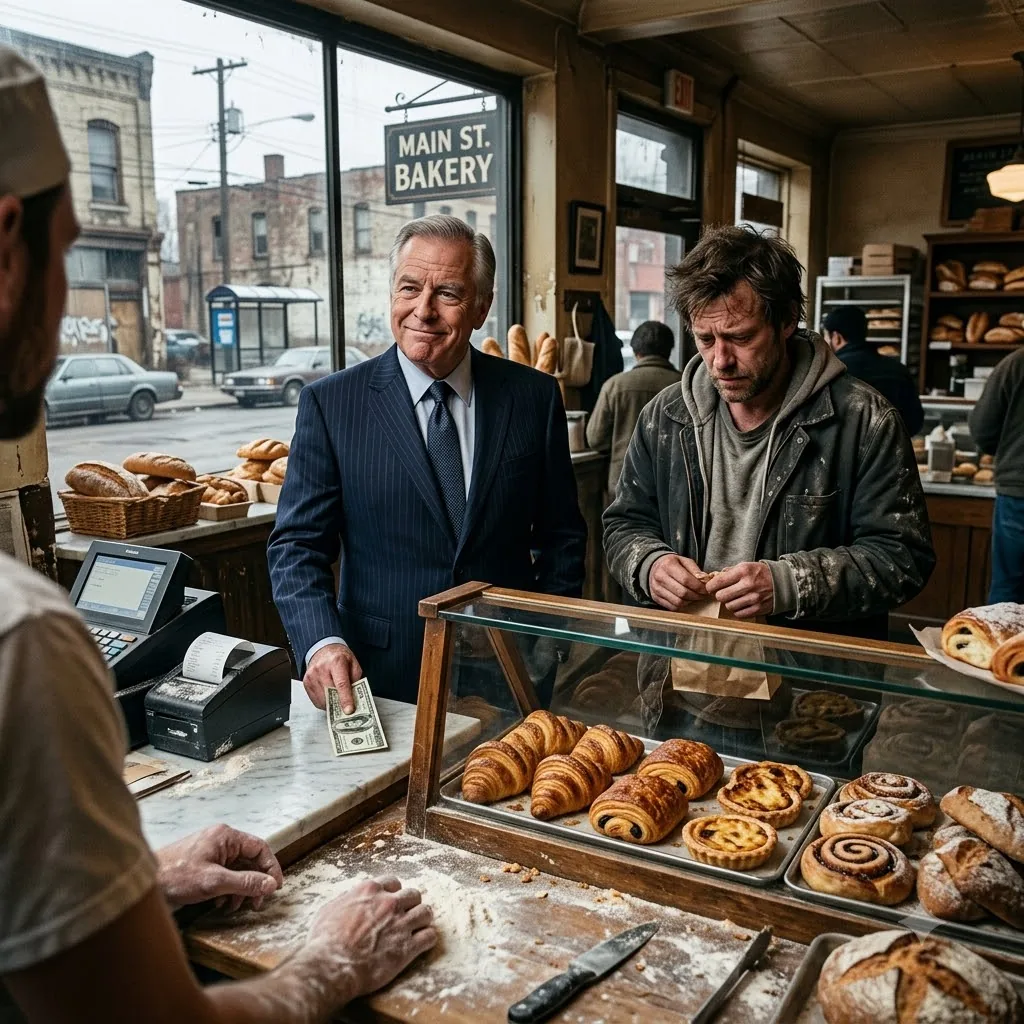
He didn’t stumble this time. He closed the door carefully behind him, shutting out the biting wind. He looked hollowed out, his cheekbones sharp and bruised purple underneath his eyes, but the bone-rattling tremor that had consumed him two weeks ago was gone. He was wearing a faded, oversized thermal shirt, washed clean, and his salt-stained sneakers were tied tight. He was sober for the day. In our world, that was a monumental victory.
Greg walked slowly to the counter. He didn’t look at his muddy shoelaces. He met my eyes.
“It’s quiet in here,” Greg said. His voice was gravelly, rough from disuse and the violent sickness he had sweated out on the floor of my apartment upstairs.
“It usually is, these days,” I replied, closing the ledger.
Greg looked at the pristine rows of eclairs under the glass. “I heard what happened. At the fancy municipal building. Word travels fast at the shelter. They said you told Silas to rot, right in front of the whole town.”
“Something like that,” I said.
“You blew up your whole spot for me,” Greg said, his brow furrowing with a heavy guilt. “You’re going to lose this place.”
“I didn’t do it just for you, Greg. I did it because I was suffocating.” I leaned against the stainless steel counter, crossing my arms. “And I’m probably going to lose it, yeah. The debt is real.”
Greg nodded slowly. He didn’t offer a hollow apology or an empty promise that things would magically work out. Addicts know better than to sell false hope. We know exactly what ruins look like.
He jammed his hands deep into the pockets of his jeans. “I don’t have a hundred-dollar bill to slap on the glass,” he said softly. “I don’t even have three bucks for a black coffee.”
“I’m not selling coffee today,” I said.
“But I need to get out of the cold,” Greg continued, his jaw tightening with quiet, desperate resolve. “And I need to keep my hands moving. If I don’t keep my hands moving today, I’m going to go find my guy on 4th Street. I can feel it in my teeth.”
I recognized the edge in his voice. It was the exact same edge I used to have when I first started scrubbing baking sheets ten years ago, praying the physical exhaustion would drown out the screaming in my blood.
“I’ve got three days’ worth of mixing bowls and heavy sheet pans piled up by the industrial sink,” I told him. “The grease is baked on. It’s miserable work.”
“I don’t care,” Greg said.
I walked around the counter. I didn’t grab his sleeve this time. I didn’t drag him out of sight to appease an audience. I just pushed the heavy wooden swinging doors open and held one back.
“The aprons are on the hook to the left,” I said. “Hot water takes a minute to kick in.”
Greg walked past me into the kitchen. The oppressive scrutiny of the storefront was dead and gone. I followed him in, letting the doors swing shut behind us. Greg tied a stained canvas apron around his waist, turned on the massive faucet, and plunged his hands into the scalding water. I walked over to the wooden butcher block, pulled out a massive mound of proofed dough, and slammed it down onto the flour-dusted surface.
We didn’t speak. We didn’t need to. The bakery was going to die, the money was gone, and the town had turned its back on us. But as the rhythmic scraping of the steel wool joined the heavy thud of my hands kneading the dough, the space finally belonged to me. We worked side by side in the wreckage, two ghosts keeping our hands moving, building nothing but the next hour.