Story code: ST-000226
Part 2: The Subsidiary
Elias shoved the iron handle forward, the rusted gears grinding in protest as the heavy steel awning finally rolled upward. Sunlight spilled across the dusty glass of the storefront, catching the faded gold-leaf lettering of his grandfather’s name. Elias’s breath came in shallow, ragged gasps. He couldn’t stop looking at the dark tinted windows of the SUV idling at the curb, where Sarah had disappeared just moments ago.
The executive did not look back at the vehicle. She stepped past Elias, her polished leather heels clicking sharply against the cracked pavement, and waited by the front door.
Elias fumbled his ring of keys from his apron pocket. His hands shook violently as he tried to slide the brass key into the lock. It took him three attempts before the cylinder turned. He pushed the heavy glass door open, immediately hit by the familiar, comforting scent of gun oil, aged walnut stock, and settled dust. For the first time in his life, his grandfather’s shop did not feel like a sanctuary. It felt like a trap.
The executive walked inside, ignoring the racks of vintage hunting rifles and the glass display cases filled with revolvers. She set her leather portfolio down on the main counter, sweeping a layer of dust away with the edge of her manicured hand. The two massive tactical guards stepped inside directly behind her, taking up positions by the entrance. They crossed their thick arms, completely blocking the only exit to the street.
“What are you going to do to her?” Elias asked, his voice cracking. He stayed on the customer side of the counter, suddenly too afraid to step behind his own register. “Sarah’s not dangerous. She’s just a grieving mother. You can’t just throw a bag over her head and kidnap her in broad daylight.”
The executive calmly unclasped her portfolio. “Ms. Miller was not kidnapped, Elias. She was processed.” She drew out a thick stack of documents printed on heavy, watermarked paper. “As of midnight last Tuesday, the city council officially declared bankruptcy. Vanguard Corrections purchased the municipal debt, and by extension, the zoning and enforcement rights for this district. This entire commercial block is now classified as a Vanguard Priority Enforcement Zone. By chaining herself to a structural fixture in a priority zone, she engaged in corporate sabotage. She is currently in transit to a Vanguard labor facility to work off the fines associated with her breach of contract.”
Elias stared at the woman, his stomach twisting into a cold, hard knot. “Breach of contract? She didn’t sign anything.”
“Citizenship in a Vanguard district implies consent to Vanguard security protocols,” the executive replied, her tone as casual as if she were explaining a weather forecast. “Our control over the local enforcement grid is absolute. Your neighborhood police precinct was officially decommissioned at four o’clock this morning. We are the sole authority here now.”
As if on cue, Elias looked through the front window and saw a familiar blue-and-white city police cruiser rolling slowly down the avenue. His heart leaped with a sudden, desperate hope. He took a half-step toward the glass, raising his hand. The officer in the driver’s seat looked directly at the storefront, locked eyes with Elias, and then saw the black armored Vanguard SUV parked out front. The cruiser immediately braked, threw itself into a tight, illegal U-turn, and sped away in the opposite direction.
Elias let his hand drop to his side. The street was completely empty. No one was coming to help.
“Now,” the executive said, tapping a heavy, silver pen against the documents on the counter. “Let us discuss the survival of your grandfather’s legacy.”
Elias forced himself to approach the glass case. He looked down at the first page of the contract. The Vanguard logo, a stylized iron shield, was stamped across the top. Below it, the terms detailed a massive, immediate purchase order: tactical shotguns, specialized riot munitions, body armor, and chemical deterrents. It was enough money to pay off all his suppliers, clear the shop’s debts, and keep the doors open for another decade.
But as his eyes scanned down to the bold print in the third section, the blood drained from his face.
“This isn’t just a supply order,” Elias whispered, tracing his calloused finger over the clauses. “You want the deed to the building. You want to reclassify the shop as a Vanguard Forward Logistics Hub.”
“A necessary security measure,” the executive stated smoothly. “Given the volatile nature of the civilian population-as demonstrated by Ms. Miller this morning-we cannot risk our supply chains being disrupted by local unrest. By transferring the deed to Vanguard, your shop becomes corporate sovereign territory. You will be appointed as the authorized quartermaster. You will be paid exceptionally well. But Vanguard will control who enters, who leaves, and how the inventory is distributed. You will answer only to us.”
Elias looked up, meeting the woman’s hollow, unblinking eyes. “And if I refuse? If I tell you to take your contract and get out of my shop?”
The executive offered a small, terrifying smile. “Vanguard’s parent corporation acquired the commercial bank holding your mortgage three days ago. Your payments are ninety days in arrears. If you refuse to sign, I will leave. My guards will leave. And tomorrow morning, a Vanguard eviction team will arrive to seize the property, confiscate your inventory, and process you for trespassing on corporate land.”
She clicked the silver pen and laid it carefully on top of the signature line.
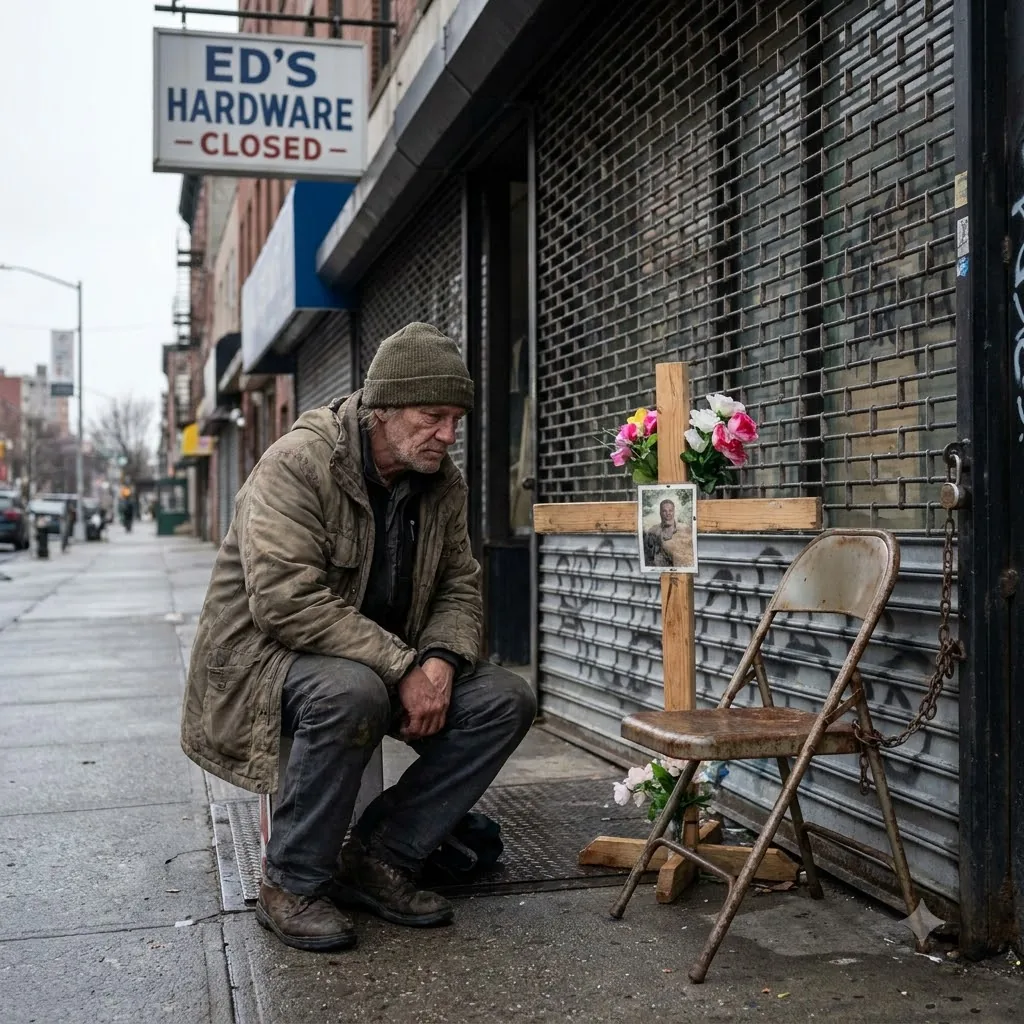
Elias looked from the pen, to the imposing guards blocking the door, and out to the spot on the sidewalk where Sarah’s broken wooden cross still lay in the gutter. He was entirely surrounded, the walls of his family’s history closing in on him.