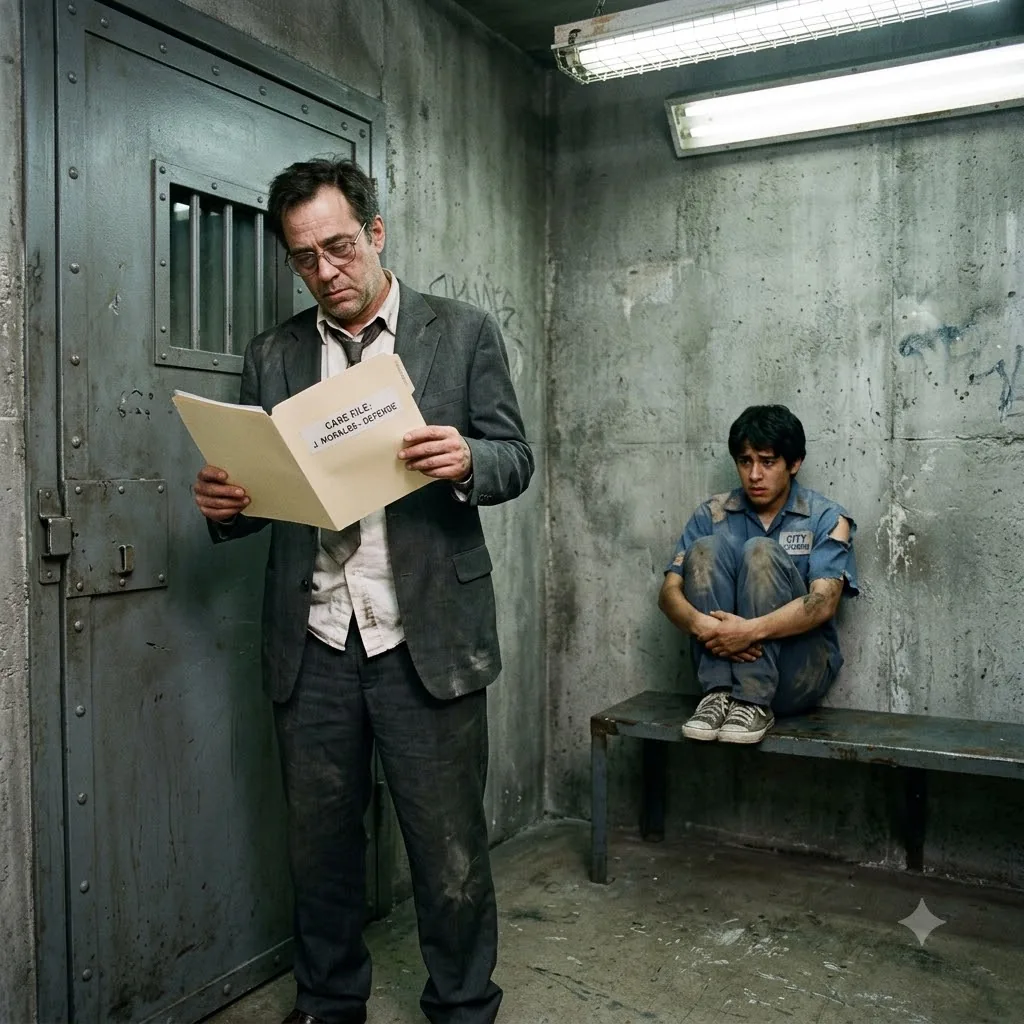
Story code: ST-001393
Part 2: The Biohazard Addendum
“Let’s go, counsel. Arraignments are moving.” The bailiff’s voice boomed over the low murmur of the holding cell, accompanied by the heavy jingle of brass keys.
Marcus instantly shifted his shoulders, blocking the guard’s line of sight. He reached up and sharply yanked the collar of Leo’s delivery jacket, hiding the scorched polyester and the terrifying pattern of bloody stippling beneath it.
*Stippling.* Unburnt gunpowder and molten metal fused into the skin. It only happened at extreme close range. The homeowner hadn’t just been angry about a missed delivery instruction. He had leveled a shotgun at a nineteen-year-old through a car window and pulled the trigger. Leo hadn’t weaponized his vehicle in a rage; he had slammed it into reverse in a blind panic, desperately trying to escape a man actively trying to murder him.
“Marcus,” the bailiff barked, slapping his palm against the doorframe. “Judge is clearing the docket. Bring him out.”
“Give us sixty seconds, Miller,” Marcus called back, keeping his voice carefully bored.
He turned back to his client. Leo’s chest hitched, his breath shallow and frantic. The boy was staring at the legal pad in Marcus’s hands, specifically at the plea agreement the prosecutor had drafted.
“Leo, listen to me,” Marcus whispered, his voice dropping to a harsh rasp. “Did the man at the house have a gun?”
Leo flinched as if struck by a physical blow. His eyes darted to the open cell door, then down to the scuffed concrete floor. He wrapped his arms around his own ribs, violently shaking his head. It wasn’t a denial; it was a desperate plea for Marcus to stop asking.
“I need you to tell me,” Marcus pushed, keeping his hands flat on his knees to appear unthreatening. “Because if you sign this paper, you admit to a felony property crime you didn’t commit. We have evidence right on your shoulder that changes everything.”
Leo’s jaw trembled. A thin, reedy sound escaped his throat. “He… he said…”
“What did he say?”
“He said if I talk… his friends in the department… they know where my little sister goes to school.”
The stale air in the holding cell seemed to freeze in Marcus’s lungs. The pristine police report suddenly made horrific sense. The missing shattered glass in the vehicle inventory. The total lack of an ambulance call or crime scene technicians. The homeowner wasn’t just a rich guy with a temper; he had enough leverage with the local precinct to get a midnight shift to orchestrate a massive cover-up, burying an attempted murder under a falsified vandalism charge.
“Counsel! Now! Or he misses his slot!”
Marcus grabbed his legal pad. He hoisted Leo by the elbow, keeping his own body positioned between the boy’s injured shoulder and the bailiff as they shuffled out of the holding cell and into the harsh fluorescent glare of the courthouse corridor.
Assistant District Attorney Vance was waiting by the double doors of Courtroom 3B. Vance was wearing a three-thousand-dollar suit that had no business being in a miserable Tuesday morning arraignment session. He checked a heavy gold wristwatch, his expression tightening into a mask of aggressive impatience.
“Tell me you have the signature, Marcus,” Vance said, stepping forward to block their path to the courtroom. “Judge Hollis is taking the bench. If we don’t present the plea right now, the offer vanishes.”
“I need another ten minutes to confer with my client,” Marcus said.
“You don’t have ten minutes. You have right now,” Vance snapped. He looked at Leo, his eyes narrowing with practiced intimidation. “This is a gift, kid. You tore up a prominent citizen’s estate. You’re looking at five years in a state facility. I’m offering you probation and a fine. Don’t be stupid.”
Leo shrank back against the cinderblock wall, his breathing turning ragged. He reached out a trembling hand toward the cheap ballpoint pen clipped to Marcus’s breast pocket. “I’ll sign,” he choked out. “Just… please, let me sign.”
“No,” Marcus said, stepping between Leo and Vance. “The narrative in your police report is a work of fiction, Vance. It mentions rear-end damage to the vehicle but conveniently leaves out how the driver’s side window got blown out.”
Vance’s face hardened. The slick, transactional demeanor vanished, replaced by something cold and exceedingly dangerous. “The report is exactly what it needs to be. Do not play crusader today, Marcus. You do not have the capital for it.”
“A man fired a shotgun at a teenager over a delivery dispute.”
“A vandal reversed his car into a heavy wrought-iron gate, causing localized shrapnel damage to his own vehicle,” Vance countered flawlessly, his voice dropping to a dead whisper. “That is the official, corroborated fact. That is what the responding officers swore to. That is what the medical intake screening confirmed.”
Marcus gripped the legal pad. “And the physical evidence on my client?”
Vance didn’t miss a beat. “What physical evidence? The kid was combative during the arrest. He scraped his shoulder on the asphalt. The holding cell nurses already cleared him.”
They had erased it. The medical screening had deliberately ignored the gunshot residue and the stippling. If Marcus pointed it out right now, Vance would simply direct the bailiffs to confiscate Leo’s shirt as “evidence” of the resisting arrest charge. It would go into a plastic bag, enter the precinct’s evidence locker, and conveniently disappear before a forensic expert could ever examine the burn marks.
Marcus was trapped. If he let Leo sign, the boy became a convicted felon, forever silenced by the threat to his family, while a violent man walked free. If he refused the plea, Vance would immediately upgrade the charges, throw Leo in county jail with an impossible bail, and strip the only piece of physical evidence right off the kid’s back.
“You have sixty seconds until Judge Hollis calls the docket,” Vance said, tapping the heavy wooden door of the courtroom. He pulled a secondary document from his briefcase and shoved it against Marcus’s chest. “Oh, and we added a standard addendum to the probation terms. Defendant agrees to surrender the clothing worn during the incident for routine biohazard disposal, given the minor abrasions sustained during his arrest.”
Marcus stared at the addendum. The trap was absolute. They knew exactly what was on that shirt, and they were legally mandating its destruction as a condition of the boy’s freedom.
Leo’s trembling hand grabbed Marcus’s sleeve again, his grip desperate. “Please,” the boy begged, tears finally spilling over his bruised cheeks. “I need to go home to my sister. Give me the pen.”