Story code: ST-000399
Part 4: The Price of Progress
The silence over the muddy lawn broke when the producer practically lunged forward, clapping a hand over the camera lens. “Cut! Cut it, turn it off!” he shouted, shoving the operator backward.
Chloe did not look down at the pink and yellow envelopes soaking in the freezing mud around her designer boots. Her jaw tightened, the mask of benevolent philanthropy entirely wiped from her face. She held Arthur’s gaze for one long, suffocating second. There was no apology in her eyes, no sudden wave of familial guilt. There was only the cold, calculating glare of an executive who had just endured a minor logistical setback.
Without a word to her father, Chloe pivoted on her heel, her ruined cream-colored boots leaving muddy tracks across the broken concrete. She climbed back into the jet-black SUV. The tinted window slid up, sealing her away, and the vehicle immediately reversed out of the demolition zone, leaving the camera crew to scramble after it.
Arthur stood over the scattered medical bills, his chest heaving, his hands empty. He had humiliated her, but the roaring diesel engine of the backhoe behind him proved how little that mattered.
The site manager stepped over a muddy pile of chemotherapy receipts, checking his silver watch. “Your forty-five minutes are up, Arthur,” the man said, his voice entirely devoid of the previous mocking cheer. He signaled to the private security guards. “Escort him inside. He gets whatever fits in three boxes. Then we tear it down.”
The security contractors gripped Arthur by the arms and marched him up his own front steps. The rest was a blur of frantic, devastating motion. Under the silent, heavy watch of the guards, Arthur threw a few changes of clothes, a framed photograph of his late wife, and a small lockbox of vital documents into the cardboard boxes they provided. He had no time to unbolt the kitchen table he had built. He couldn’t salvage the antique mantle clock.
When they marched him back out to the street, the destruction began before he even cleared his property line.
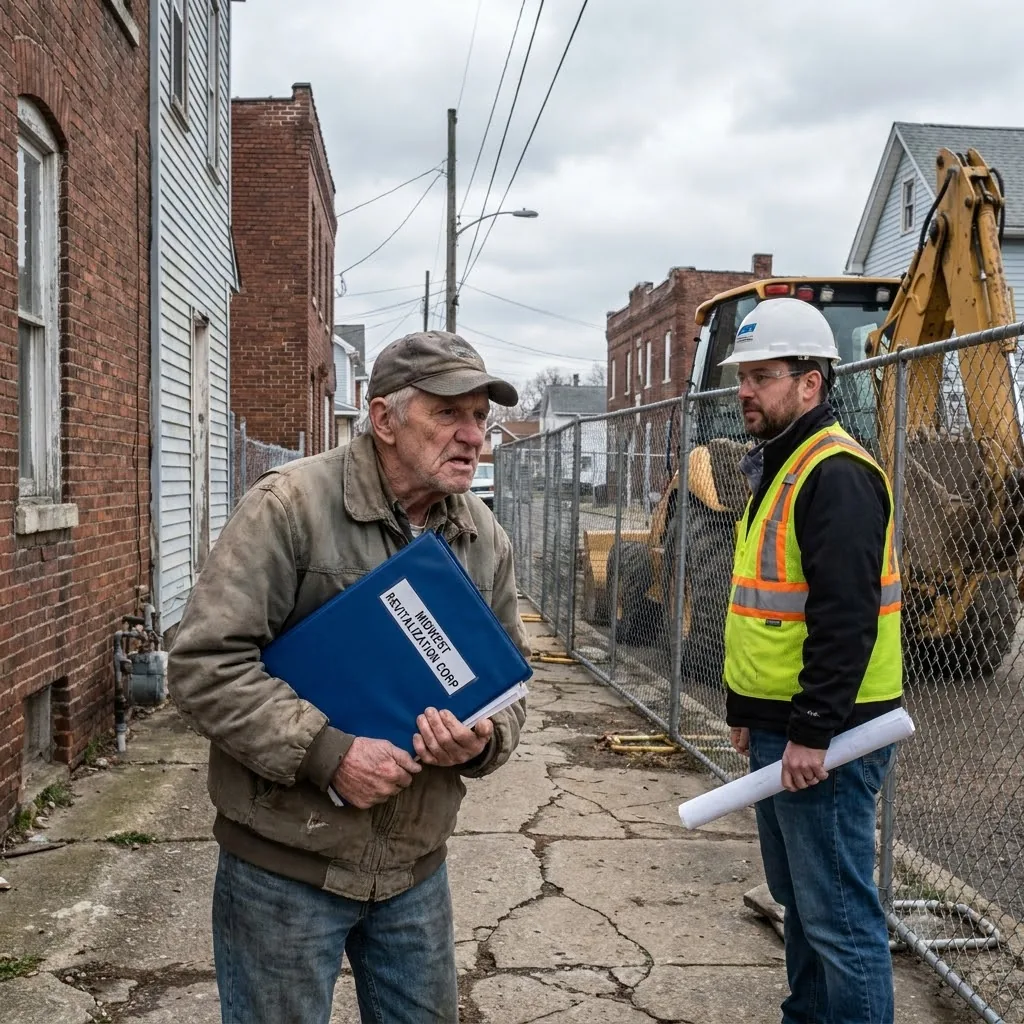
Arthur stood on the shattered asphalt and watched the yellow backhoe raise its massive steel bucket. With a sickening crunch of wood and fiberglass, the machine tore straight through the roof of his front porch. The structure collapsed instantly, burying the spot where he used to wait for Julian to come home from school in a cloud of freezing plaster dust. Down the block, Dave Miller was being physically restrained by security as a second backhoe ripped through his garage. The eminent domain order was absolute. No moral victory could stop the steel treads.
By six o’clock that evening, Arthur was sitting alone in absolute silence.
Vanguard Holdings had deposited him in one of their “fully furnished relocation units”-a sterile, fourth-floor apartment in a massive concrete high-rise on the outskirts of the city. The walls were painted a blinding, institutional white. The furniture smelled of industrial factory glue. Arthur sat on the edge of a stiff gray sofa in the center of the living room, staring at the three cardboard boxes sitting unopened on the beige carpet. His entire life had been reduced to a half-packed pile in a room that didn’t belong to him.
He reached for the television remote resting on the cheap laminate coffee table and turned on the wall-mounted screen. He needed to know if the city had intervened, if his neighbors had found somewhere safe to go, or if anyone had seen the truth he had shoved into Chloe’s chest.
The local news anchor appeared on the screen, sitting beside a glossy graphic of the Vanguard Holdings corporate campus rendering.
“…a tense morning in the East District as the Midwest Revitalization Initiative broke ground,” the anchor announced, his tone light and optimistic. “Despite Vanguard Holdings’ generous relocation packages, demolition crews faced staunch resistance from local residents clinging to the blighted properties.”
The broadcast cut to footage from Chloe’s camera crew. Arthur leaned forward, his heart pounding against his ribs.
The footage had been masterfully edited. It showed Arthur marching aggressively onto the porch, his face red and furious. But the audio was muted, overlaid with the anchor’s voiceover. The camera angle was cropped tight, completely hiding the massive stack of unpaid medical bills Arthur had been holding. Instead, the frame focused on Chloe. She was standing in the mud, looking heartbroken, holding her hands up in a gesture of profound, tragic patience while an angry old man screamed silently in her face.
“CEO Chloe Vance, seen here attempting to personally comfort displaced residents, issued a statement reiterating her commitment to bringing modern salvation to forgotten communities,” the anchor continued seamlessly. “Vanguard insists this temporary friction from rural backwardness is a small price to pay for regional progress.”
The screen transitioned to an aerial drone shot of Arthur’s street. The houses were gone. The oak trees were gone. There was nothing left but a vast, flattened expanse of frozen dirt and heavy machinery.
Arthur pressed the power button on the remote. The screen snapped black, plunging the sterile apartment back into perfect stillness. The eminent domain had taken his home. His daughter had taken his neighborhood. And the world outside was already applauding her for it. He lowered the remote to the cushion, surrounded by his cardboard boxes, entirely alone in the dark.