Story code: ST-000915
Part 3: The Severance – Part 3
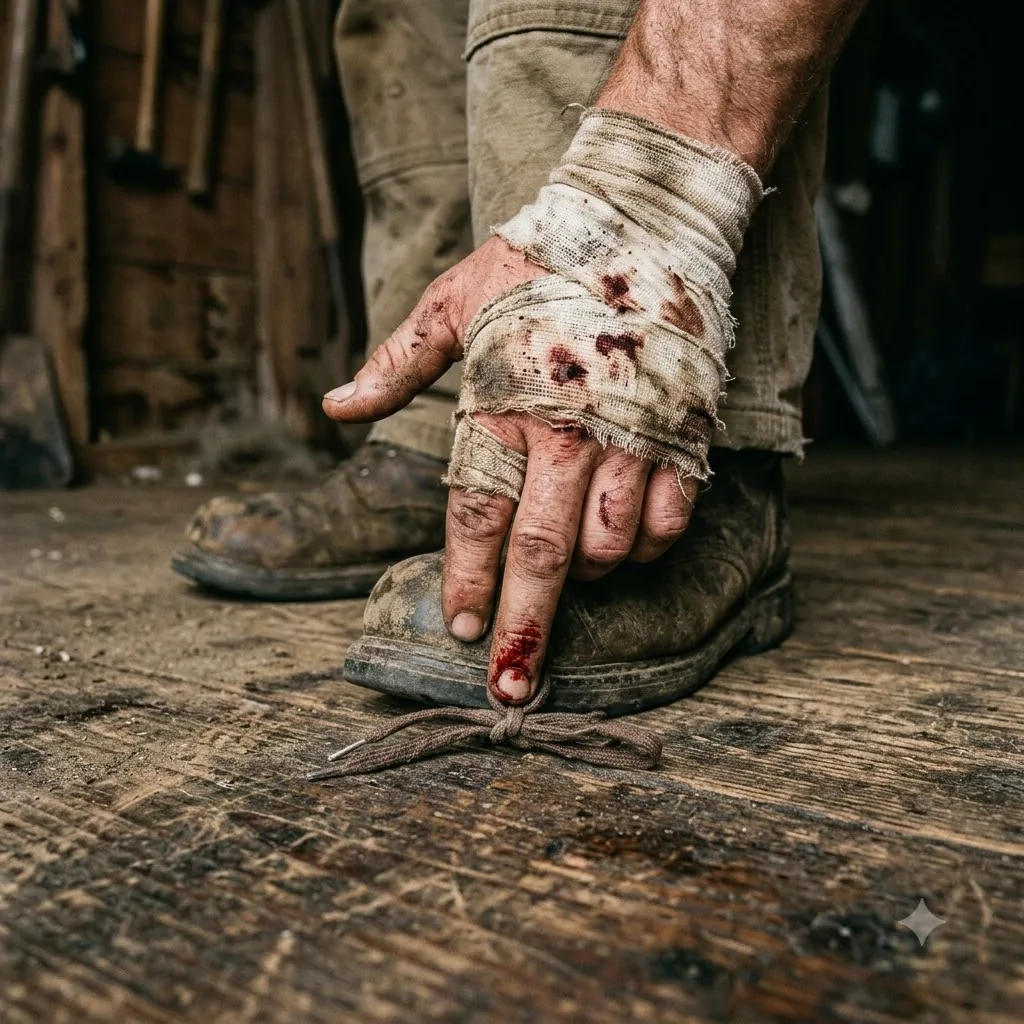
Mateo waited in the freezing mud, his breath slipping through his teeth in thin, controlled plumes. The pain in his right hand had shifted from a sharp, localized stabbing to a deep, nauseating throb that pulsed violently in time with his heartbeat. The muddy shoelace he had used to bind his shattered knuckles was cutting off his circulation, turning his exposed fingertips a dull, mottled purple. He kept his good left hand wrapped tightly around the rusted plastic handle of the flathead screwdriver. Ten minutes passed. Then fifteen. The damp cold seeped through his canvas jacket, but he welcomed it. It anchored him, forcing away the panicked image of the pink eviction notice and resurrecting a cold, calculated stillness he hadn’t touched in years.
Above him, the trailer’s thin floorboards groaned under a sudden weight. Heavy footsteps approached the rear exit. The metal latch of the back door clicked sharply, and the rusted hinges whined as it swung outward into the morning air.
Mr. Henderson stepped out onto the small aluminum landing, a freshly lit cigarette trapped between his lips. He exhaled a long, thick cloud of gray smoke, looking out over the muddy strawberry fields with the satisfied, lazy posture of a lord surveying his conquered land. He reached down to adjust the heavy gold watch on his left wrist, completely unaware of the shadow detaching from the corrugated skirting below him.
Mateo moved. The hesitation and subservience that had bound him since he crossed the border vanished instantly, replaced by the lethal, fluid muscle memory of his former life in Sinaloa. He didn’t slip or stumble in the wet clay. He surged up the metal steps, grabbing the front of Henderson’s tailored wool trousers and heavy leather belt with his good left hand. He yanked the manager violently forward while simultaneously sweeping his heavy work boot behind Henderson’s ankles.
Henderson let out a wet, choking gasp as his feet flew out from under him. He slammed backward onto the cheap linoleum floor of the trailer’s narrow rear hallway. The cigarette flew from his mouth, bouncing off the faux-wood paneling.
Mateo stepped over the threshold, his mud-caked boots leaving dark smears on the pristine floor. He grabbed the heavy steel door, pulled it shut against the biting wind, and drove the deadbolt home with a sharp, echoing snap. The heavy metallic clack finalized the trap.
Henderson scrambled backward, his expensive wingtip shoes slipping frantically for purchase on the slick floor. The lit cigarette burned a black, smoldering hole into the hallway runner. “Are you out of your mind?” Henderson gasped, his pale face suddenly slick with sweat. His corporate arrogance faltered, replaced by genuine alarm. He reached frantically for his breast pocket. “I’m calling the police. I’m calling ICE. You’re dead, you hear me? You’re going to rot in federal lockup.”
Mateo didn’t rush. He didn’t raise his voice, and he didn’t raise his fists. He simply stood over the manager, his posture completely transformed. The hunched, deferential slouch of the invisible, broken migrant worker evaporated. He squared his shoulders, standing at his full height, his dark eyes entirely devoid of fear, anger, or desperation. It was the dead, empty stare of a professional executioner evaluating a target.
He spat the screwdriver handle into his left palm. The thick steel shaft glinted dull and heavy under the harsh fluorescent lights.
“Call them,” Mateo said, his voice dropping an octave, slipping into a cold, flat cadence that echoed off the narrow walls. “Call the federal dispatch line. They will take two hours to process the paperwork and send a county cruiser to my empty duplex. I will not be there.”
Henderson froze, his manicured fingers trembling just inside his jacket pocket. The absolute lack of emotion in Mateo’s voice paralyzed him. This wasn’t the blind panic of a cornered animal. This was a clinical assessment.
Mateo took one slow, deliberate step forward, towering over the manager. “You drive the silver Audi Q7 parked by the front administrative steps. License plate ELK-814. You have a blue parking sticker on the lower left rear bumper for the Oakridge Private Day School. There is a gate access transponder clipped to your sun visor for the Whispering Pines subdivision on the north side of town.”
Henderson’s mouth opened, but no sound came out. The blood rapidly drained from his cheeks, leaving his face the color of spoiled milk.
“Your wife drives the white Lexus SUV,” Mateo continued, his tone as casual as a man reading a weather report. “She brought you lunch on Tuesday. She has blonde hair and wears designer sunglasses. She parked in the fire lane because she felt entirely safe doing so.”
“How…” Henderson whispered, his hand slowly slipping out of his pocket, leaving the phone behind.
“I have spent the last eight months picking your strawberries in the dirt,” Mateo said. “But before I came to this country, I worked for the Gulf Cartel in Matamoros. My job was collections. I collected from wealthy, arrogant men who thought a locked door and a private security patrol made them invincible.”
Mateo crouched down, bringing his face inches from Henderson’s. He kept his ruined, tightly bound right fist pressed securely against his thigh, ready to use as a blunt instrument if forced, but his left hand casually twirled the rusted screwdriver.
“Whispering Pines is a very quiet neighborhood,” Mateo stated, his dark gaze boring directly into Henderson’s terrified eyes. “Large properties. Lots of old oak trees. The houses are set far back from the street, which means the neighbors cannot hear a window breaking at the rear of the property. The master bedrooms in those custom builds are always on the second floor, usually directly above the garage. The sliding glass doors on the ground-floor patios are just standard double-pane glass. A heavy rock wrapped in a shirt, or a steel tool, bypasses the magnetic alarm sensors on the doorframe entirely.”
Henderson was trembling uncontrollably now, his breath coming in short, ragged gasps that rattled in his chest. His eyes darted from the screwdriver to Mateo’s face, searching for a bluff, for a crack in the facade. He found only an abyss.
“If you press that call button,” Mateo whispered, the quiet intensity of his voice filling the hallway, “or if the sheriff locks my little brother out of our home at five o’clock today, I will not come back to this trailer. I will not look for a labor lawyer. I will take the last city bus to the north side of town tonight. I will walk through the dark woods behind Whispering Pines. I will shatter your patio glass. And I will show you, your blonde wife, and the children who go to Oakridge Day School exactly why I had to leave Matamoros.”
The silence in the cramped hallway was absolute, broken only by the steady, mechanical hum of the air conditioning unit overhead. Henderson stared up at the man he had just dismissed as a nameless, disposable peasant. The manager’s corporate shield-his job title, his tailored suit, his threats of immigration enforcement-shattered into useless dust. He realized with suffocating, paralyzing clarity that he had just invited an apex predator into his life, and the government dispatch line could not save him tonight.
Mateo stood up smoothly. He gestured with the flathead screwdriver toward the cherrywood desk in the main office. “The settlement check for four thousand dollars is in the steel lockbox on your credenza. You are going to stand up, walk in there, and open it.”