Story code: ST-000915
Part 4: The Ghost of Matamoros
Henderson pushed himself up from the linoleum, using the narrow hallway wall for support. His tailored suit was smeared with muddy boot prints, but he didn’t attempt to brush them off. He kept his back pressed against the faux-wood paneling, terrified to turn away from Mateo as he staggered toward the front office. Mateo followed at a measured, unhurried pace, the rusted flathead screwdriver resting casually against his thigh.
When Henderson reached the cherrywood desk, he leaned heavily against the side credenza. His hands shook so violently that his manicured fingers slipped off the small brass dial of the lockbox twice.
“Four pins,” Mateo reminded him softly.
Henderson swallowed hard, his breath wheezing as he steadied his wrist with his opposite hand. He managed to turn the dial, inputting the combination. With a hollow click, the heavy steel lid popped open. Inside sat a thick stack of banded hundred-dollar bills. The company always kept off-the-books cash to quickly pay out undocumented injuries, avoiding the paper trails required by federal insurance auditors.
Henderson grabbed the stack and held it out, his pale eyes averted, staring fixedly at the pristine beige carpet.
Mateo took the money with his left hand. He thumbed the edge of the paper bands, feeling the rough texture of the currency. Forty bills. Four thousand dollars. Exactly what the insurance representative had promised in writing.
“Do not cancel my employee number,” Mateo instructed, slipping the heavy bundle of cash into his canvas jacket. “Do not file a termination report. If anyone asks, I quit this morning and moved out of state to find construction work. You will never see me on this property again.”
Henderson nodded frantically, a desperate, jerky motion. “Just go. Please. I won’t say a word. I swear to God.”
“If you do,” Mateo said, turning toward the door, “I won’t need to ask God for permission.”
Mateo walked out of the double-wide trailer and down the metal steps. The biting morning wind felt entirely different now. It didn’t chill him; it cooled the hot sweat on the back of his neck. He walked steadily past the muddy fields, past the harvest crews hunched over the endless strawberry rows. None of them looked up. They remained completely invisible. For a brief, intoxicating moment, Mateo felt the familiar surge of absolute power he had once known in Sinaloa-the electric thrill of dictating reality through unapologetic fear.
Then he reached the edge of the county road, and the adrenaline finally began to recede.
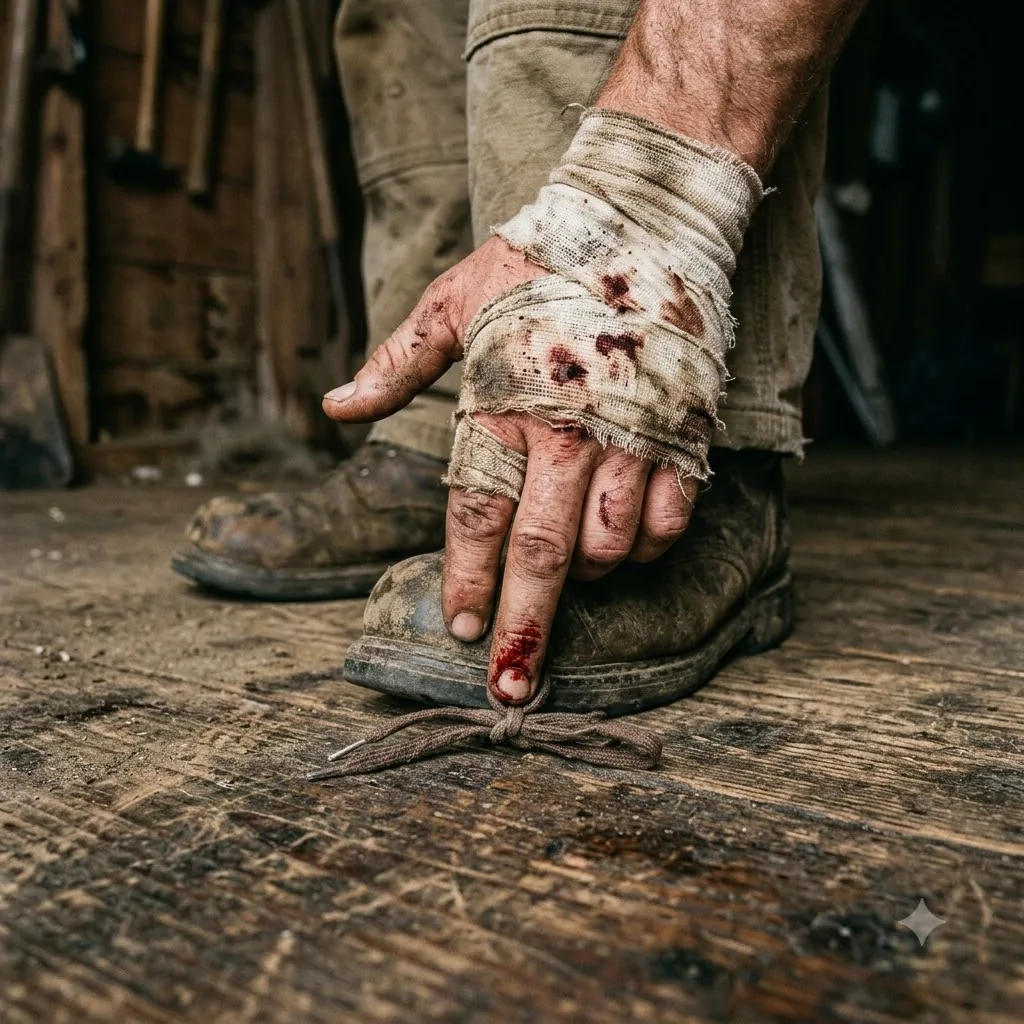
The pain hit him like a physical blow. It didn’t just throb; it screamed. Mateo stumbled behind a rusted bus stop enclosure and collapsed onto the damp wooden bench. He placed the screwdriver on the slats and brought his right hand to his chest. The muddy shoelace he had used to bind his knuckles was practically embedded in his swollen flesh. The fingertips protruding from the gauze were entirely black and blue, completely numb and cold to the touch.
Using his teeth and his left hand, he painstakingly unpicked the tight, muddy knot. As the pressure released, a wave of nausea washed over him so intensely he had to lean forward and spit bile into the wet weeds. He stared at his unwrapped, misshapen hand. The metacarpals were visibly displaced beneath the skin, the jagged bone fragments having shifted under the extreme pressure of his makeshift binding. The clinic doctor’s warning echoed loudly in his ears. The tendons were severed. He would never hold a wrench, a steering wheel, or a heavy harvest basket with that hand again. He had permanently traded his physical future for forty hundred-dollar bills.
By three o’clock that afternoon, the pink eviction notice was gone. The property manager, a weary man who didn’t ask questions as long as the currency was valid, had gladly accepted nine hundred dollars to clear the rent debt and the late fees. The duplex was secure.
At six o’clock, Mateo sat in a corner booth at a brightly lit strip-mall pizzeria. Across the red-checkered tablecloth, Leo was enthusiastically tearing into a large slice of pepperoni pizza, completely oblivious to the morning’s violence. The boy’s face was smeared with grease, his eyes bright and entirely devoid of the fear that had shadowed him in their freezing kitchen at dawn.
“Eat slow,” Mateo murmured, pushing a plastic cup of soda toward his brother with his left hand. His ruined right arm rested heavily in a makeshift sling he had fashioned from an old t-shirt, hidden carefully beneath his jacket.
“Are we really okay now?” Leo asked, pausing with the crust halfway to his mouth. “The sheriff isn’t coming?”
“He isn’t coming,” Mateo said, forcing a gentle smile he did not feel. “We are safe.”
Leo grinned and took another massive bite.
Mateo leaned back against the cracked vinyl booth. The remaining thirty-one hundred dollars formed a thick, heavy block inside his interior coat pocket. It was enough to keep them fed, clothed, and housed for months while he figured out how to find work as a one-handed man. He had won. He had protected his little brother and secured their immediate survival.
But as he watched Leo eat, a dark, suffocating weight settled over Mateo’s chest. He looked at his hidden right hand, then out the rain-streaked restaurant window into the darkening parking lot.
He had walked thousands of miles through deserts and rivers, starved, bled, and accepted daily humiliation just to escape the cartel’s gravity. He had wanted Leo to grow up in a world where men didn’t solve their problems by threatening to shatter glass and murder families in the dark.
Yet, when pushed to the absolute edge, the civilized world of administrative offices and federal tip lines had offered him no salvation. To survive it, he had been forced to reach back into the darkest corner of his soul and pull out the exact monster he had fled. Henderson wasn’t quiet tonight because of the law, or justice, or morality. He was quiet because Mateo had terrorized him.
Mateo closed his eyes, listening to the upbeat pop music playing over the restaurant’s cheap speakers. He had kept his brother safe, but the bitter realization tasted like ash in his mouth. The violence hadn’t stayed in Matamoros. It had traveled with him, sleeping in his blood, waiting for a reason to wake up. He had not escaped his past at all. He had simply transplanted it into his new life.