Story code: ST-001387
Part 2: The Weight of the Glass
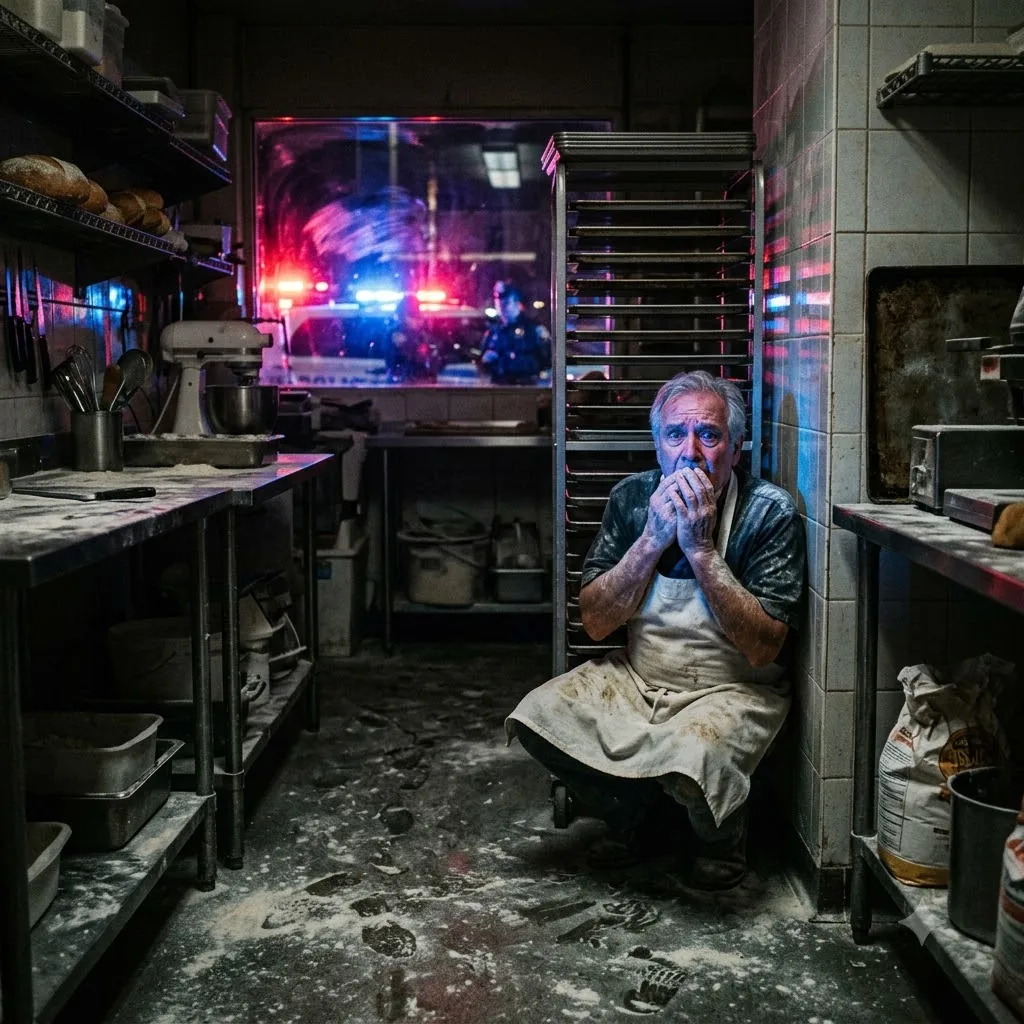
Glass rained down in a jagged curtain, the shards glittering violently in the sweep of the red and blue police strobes. Elias threw his arms over his head, dropping hard to the linoleum floor behind the front counter. The impact of the masonry brick against the reinforced glass of the display case sent a dull, echoing vibration through the floorboards. For a split second, the bakery was completely silent, the air sucked out of the room by the shock of the violence.
Then, the crowd erupted.
It was not a collective gasp of horror. It was a deafening roar of approval.
Elias stayed pressed against the baseboards, his heart hammering against his ribs. Cold night air immediately surged through the jagged hole in the storefront, carrying with it the harsh smell of exhaust fumes and adrenaline. He crawled forward on his elbows, ignoring the sharp sting of a glass splinter biting through the fabric of his apron. Peering around the edge of the mahogany counter, he watched the tactical officers swarm the barricade. Three heavily armored men tackled the shadow who had thrown the brick, pinning the struggling figure to the hood of a cruiser. The crowd surged forward in response, chanting, “Let them go! Let them go!”
The police line bowed inward, the metal barricades scraping horribly against the pavement as hundreds of bodies pressed their weight against the steel.
Elias looked past the chaos, his eyes drawn through the violently opened sightline of his shattered window. Across Elm Street, the elementary school sat in absolute darkness. Without the distraction of his gold-leaf logo on the glass, Elias had a direct, unobstructed view of the second-floor classrooms. In the pale wash of the streetlamps and sweeping strobes, he saw a slight movement. A tiny, pale face was pressed against the bottom corner of a classroom window, barely visible above the sill. A small hand rested flat against the glass.
Elias’s breath hitched. It was a child, trapped in a dark room for hours, watching a volatile mob tear apart their quiet neighborhood. How many of them were crying? How many thought the men with rifles and armor outside were there because a shooter was roaming the halls? The psychological damage being inflicted on those children in the name of a righteous protest was unfathomable.
He pulled his phone from his pocket. The breaking of the glass had apparently cleared whatever localized interference was blocking his signal, or perhaps a mobile cell tower had finally been deployed. He had two bars. He dialed the non-emergency dispatch number, his trembling fingers leaving smeared flour on the glowing screen.
It rang four times before a harried voice answered. “Dispatch, hold.”
“Wait, please!” Elias shouted over the roar of the crowd outside. “This is Elias Vance. From the bakery. You have to tell the school it’s just a protest. You have to let those kids go home.”
“Mr. Vance,” the dispatcher’s voice came back, strained and breathless. “We cannot lift the lockdown. The crowd has completely blocked the intersection of Elm and Maple. There is no safe egress route for the buses, and we absolutely cannot have children walking through an active riot zone. We just had a heavy projectile thrown through your window. It is not secure.”
“But they’re terrified,” Elias pleaded, watching the small face in the window suddenly disappear, replaced by the dark silhouette of a teacher frantically pulling the child back down to the floor. “They have nothing to do with this. The protest is about me. Can’t the police just push the crowd down toward the town square? Clear a safe path?”
“We do not have the manpower to move over a thousand people right now, sir,” the dispatcher snapped, the chaotic sound of multiple radios blaring in the background. “The state police are still forty minutes out. The crowd’s primary demand is a public apology and a reversal of your service refusal. Until they disperse, or we get enough tactical units to forcefully clear the street, that school remains locked down for their own safety.”
The line went dead.
Elias lowered the phone, the cold wind whipping his apron strings. He crouched behind the counter, staring at the masonry brick resting atop the crushed remnants of his signature lemon tarts.
Outside, the megaphone crackled again. The voice was distorted but piercingly loud, cutting easily through the wail of the sirens.
“Look at what his hatred has caused!” the voice boomed, the amplified sound bouncing off the brick facade of the bakery. “The police are protecting a bigot while our community suffers! He sits in there in silence while children are locked in their schools! His intolerance is holding this entire town hostage! End the hate, Elias!”
Elias closed his eyes, his back sliding down the wooden cabinets. The sheer manipulation of it took his breath away. The activists had descended on his town, gridlocked the streets, forced the massive police response, and incited the riot. Yet, they had seamlessly pivoted the narrative. The mob was not responsible for the terrified children across the street; Elias was. If he just abandoned his beliefs, if he just walked out the front door, took a knee, and agreed to bake the cake, the mob would cheer. They would pack up their neon signs, the police would stand down, and the children would be released to their frantic parents.
He was being asked to ransom his own conscience for the psychological well-being of the elementary school.
A loud pop echoed from the street, followed by the distinctive hiss of compressed gas. Plumes of thick, white smoke began to billow from the asphalt between the police line and the rioters. Tear gas. The wind, funneling down Elm Street, picked up the chemical cloud and dragged it directly toward the shattered bakery window-and across the street, drifting up toward the school’s second-floor intake vents.
Elias choked as the first tendrils of gas crept over the windowsill, immediately burning his eyes and searing his throat. He dropped flat to the floor, pulling the collar of his shirt up over his nose. He could hear the crowd screaming, coughing, and scattering, but the sheer volume of bodies meant the crush against the barricades only intensified.
Then, his phone buzzed against the linoleum. It wasn’t the police dispatcher calling back.
It was an unknown number, but the caller ID text simply read: *Elm Street Elementary – Principal’s Office.*
Elias stared at the glowing screen through watering eyes. The gas was thickening, filling his beloved retail space with toxic smoke. The mob was not going to stop. They believed their cause was absolute, righteous, and completely justified, regardless of who got hurt in the crossfire. They would never abandon their moral high ground.
The phone kept vibrating against the floor, demanding an answer. If he picked it up, he knew exactly what the voice on the other end would beg him to do.