Story code: ST-000378
Part 2: The Code Red
“Wait! What are you doing?” Marcus lunged toward the glass, nearly knocking over a stack of custom-printed linen menus.
The inspector didn’t flinch. He ran a heavy, calloused hand over the neon orange sticker, ensuring the adhesive was perfectly flush against the pristine glass.
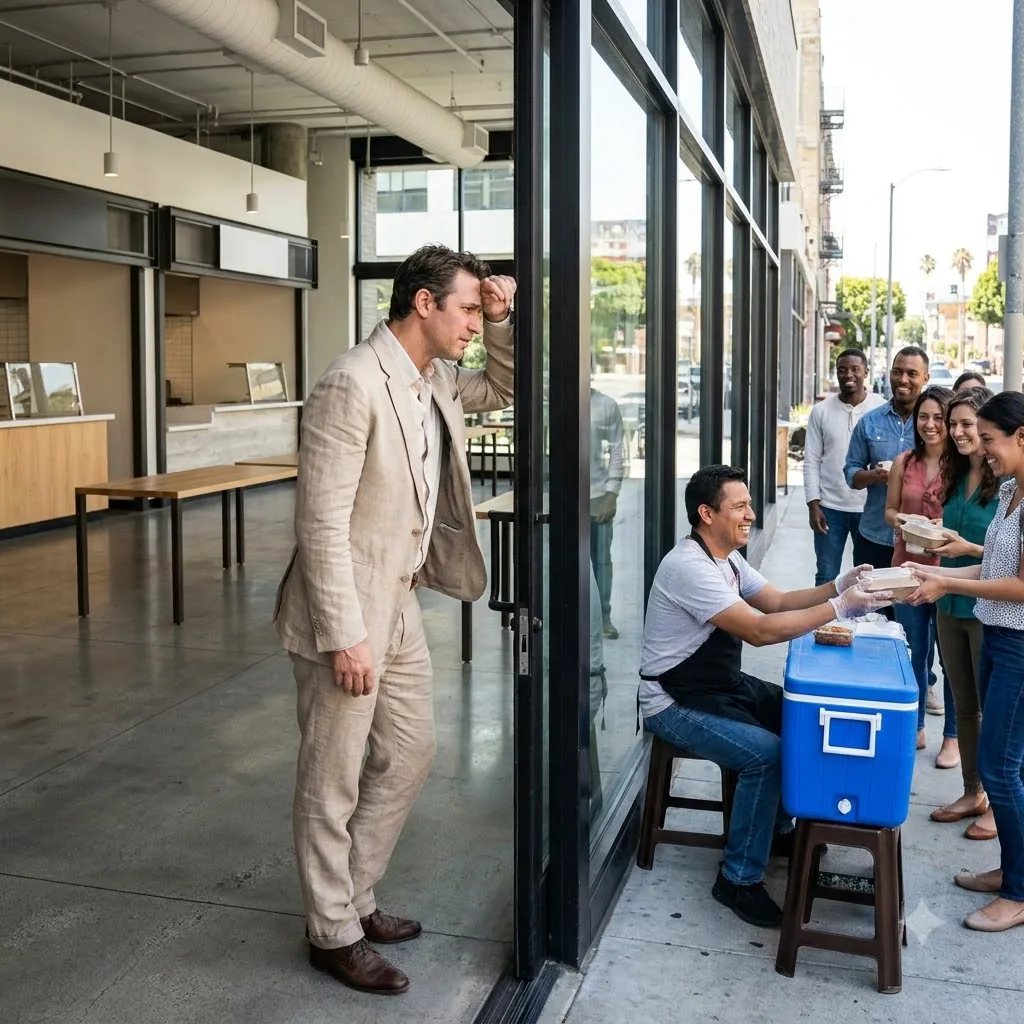
“This is a mistake,” Marcus said, his voice echoing off the vaulted ceiling of the empty food hall as he pulled the door open. “I’m the one who reported the violations. The illegal vendor is right out there!” He pointed a shaking finger toward the damp sidewalk, where Mateo was currently handing a stack of thin napkins to a pair of construction workers.
The inspector finally looked up, his expression a mask of absolute bureaucratic exhaustion. He tapped the thick rubber casing of his tablet with a stylus. “I don’t manually review tickets. The automated system flagged this commercial parcel with a Code Red hazard protocol. Five hundred and twelve severe health and safety violations logged in the last forty minutes.”
Marcus felt the blood drain from his face, a cold prickle of dread washing over his scalp. “Those complaints aren’t for my business. They’re for the sidewalk!”
“The municipal system aggregates by commercial zone and registered footprint,” the inspector recited monotonously, not even glancing at Mateo or the battered blue cooler. “The sidewalk is a public right-of-way. The geo-tags are nested inside your registered property lines. Five hundred unique violations trigger an automatic administrative lockdown.” The man clipped the portable printer back to his heavy leather belt. “Do not remove the sticker. Do not serve food. You can appeal at City Hall. The next available review board hearing is in forty-five days.”
“Forty-five days?” Marcus grabbed the inspector’s sleeve, but the man pulled away smoothly, turning his back and walking toward his idling white hybrid SUV. The heavy glass door swung shut on its hydraulic hinges, locking automatically. The entry chime echoed mockingly through the empty hall.
Marcus sprinted back to the reclaimed-wood host stand, his expensive leather shoes slipping on the freshly buffed concrete. He slammed his hands down next to his open laptop. The terminal window was still running. A waterfall of green text blurred across the dark screen.
*Complaint generated for unsafe grease disposal. Processing…*
*Complaint generated for vermin presence. Processing…*
Because he had spoofed the IP addresses and used dynamic syntax to bypass the spam filters, the city’s automated defense network hadn’t just logged the complaints; it had classified the Artisan Mercado as the epicenter of a localized public health catastrophe. The enforcement algorithm couldn’t penalize a man with a plastic cooler who didn’t exist in the tax database. So it penalized the multi-million dollar corporate entity sharing the exact same GPS coordinates.
Marcus hammered the escape key, frantically typing the abort commands to kill the script. The terminal window vanished, but the damage was already institutionalized. His phone vibrated violently against his thigh. Then it buzzed again. And again.
He pulled it out to see a cascading wall of automated emails from the city’s licensing portal. His health permit: Suspended. His certificate of occupancy: Revoked pending inspection. His merchant processing account, which was tied to his municipal standing in the city’s smart-grid: Temporarily frozen to prevent fraudulent transactions during a closure.
“No, no, no,” Marcus muttered, swiping wildly through the notifications. He had maxed out two personal credit lines just to float the first month’s overhead. He had an eighty-thousand-dollar payroll scheduled for Friday, and a massive delivery of imported burrata, dry-aged steaks, and highly perishable micro-greens arriving in less than an hour. Without the commercial refrigerators running-which the city grid would remotely cut power to under a Code Red-he would lose tens of thousands of dollars in inventory by sunset.
He looked up through the triple-paned glass. Outside, the world continued completely unaware of his sudden financial ruin. Mateo was still there. The morning rush had dwindled, but the blue cooler remained open. Mateo was calmly reorganizing his remaining foil-wrapped bundles, licking his thumb as he counted a thick stack of crumpled bills.
A hot, blinding wave of irrational anger washed over Marcus. This was Mateo’s fault. If the vendor hadn’t been standing there, openly mocking the system and stealing his foot traffic, Marcus would never have written the code. The city was a blind, idiot machine, and Mateo was ruthlessly exploiting it while Marcus, who had played by every rule, paid every tax, and secured every permit, was being crushed in its gears.
Marcus paced behind the glass like a trapped animal, watching the street vendor. Mateo didn’t look like a calculated saboteur. He looked deeply tired. He wore scuffed, mud-caked boots and a faded jacket that was far too thin for the morning chill. But to Marcus’s spiraling mind, that battered blue cooler was a deliberate weapon of mass destruction.
A massive, refrigerated delivery box truck hissed to a stop at the curb, its hazard lights flashing rhythmically against the gray sky. Marcus’s heart leaped. It was his supplier. If he could just get the inventory inside and pack it into the walk-ins before the automated power shut-off triggered, he could salvage something.
Marcus pushed through his front doors, stepping out into the biting wind. The sudden, rich smell of roasted chiles and steamed masa hit him, but he ignored it, rushing toward the truck. The delivery driver had already hopped down from the cab, holding a digital clipboard.
“Hey!” Marcus waved, forcing a desperate, breathless smile. “Just pull around to the alley, I’ll unlock the loading dock.”
The driver paused. His eyes drifted past Marcus’s shoulder, fixing on the pristine glass facade of the Mercado. He stared directly at the neon orange sticker. The driver’s expression flattened into absolute apathy. He looked down at his clipboard, swiped the screen, and sighed.
“Notice of Immediate Closure?” the driver asked, tapping his stylus against the plastic casing.
“It’s a clerical error,” Marcus pleaded, stepping laterally to block the driver’s view of the sticker. “An algorithm glitch. I’m sorting it out right now. Just back the truck in.”
“Can’t do it, buddy,” the driver said, already turning back toward the cab. “Corporate policy. If the destination has an active health closure, we don’t break the seal on the truck. Liability issue. If I drop fifty pounds of wagyu into a quarantined site, my boss fires me.”
“I already paid for it!” Marcus shouted, his professional veneer shattering completely. “It’s my food! Leave the boxes on the sidewalk!”
“Can’t drop perishables on a public right-of-way,” the driver called back, climbing up into the cab and slamming the heavy door. “Read your contract.” The diesel engine roared as the truck pulled away from the curb, taking Marcus’s last remaining shred of capital with it.
Marcus stood frozen on the sidewalk, the cold wind slicing through his thin designer shirt. He was completely exposed, utterly helpless. He turned slowly, his hands balling into tight fists.
Ten feet away, Mateo was dragging the blue cooler a few inches to the left, trying to keep it out of a growing puddle. The vendor paused, looking up. For the first time all morning, Mateo made direct eye contact with Marcus. The older man’s face was unreadable, worn down by years of invisible labor, but his dark eyes dropped to the orange sticker on the door, then back to Marcus’s frantic, sweating face.
Before Marcus could scream at him, before he could march over and kick the blue cooler into the gutter, a heavy municipal utility truck rounded the corner. Its amber lights painted the street in sweeping flashes as it pulled aggressively onto the sidewalk, directly between Marcus and Mateo. Two city workers in hardhats stepped out, carrying heavy steel chains and a thick brass padlock.