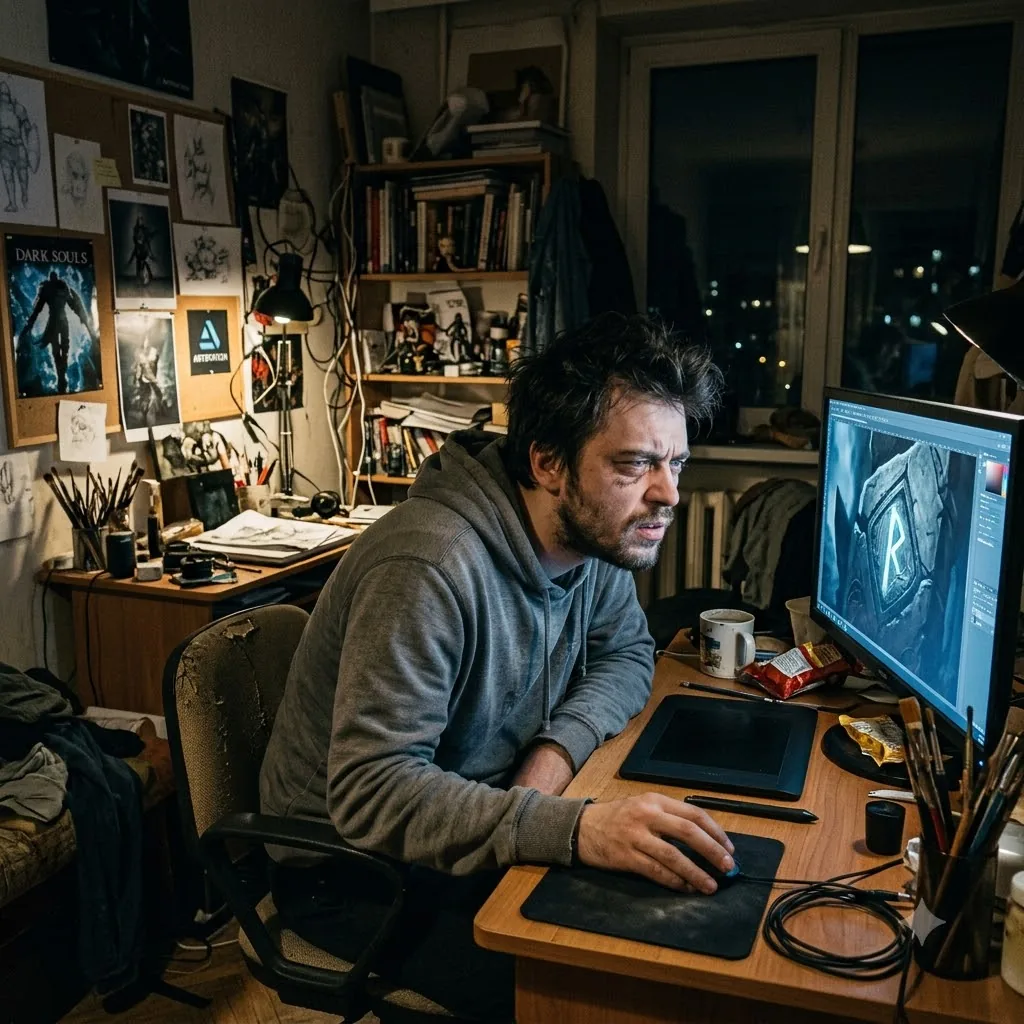
Story code: ST-000570
Part 2: The Compliance Audit
Elias slammed his hand down on the power strip beneath his desk, killing the electricity to his entire workstation. The dual monitors snapped black. The screaming cooling fan died instantly, leaving the tiny studio apartment swimming in a sudden, ringing silence.
He sat in the dark, his heart hammering against his ribs. The glowing white signature-E.L.A.I.S.-was burned into his retinas, hovering in the pitch-black room like an afterimage.
He couldn’t leave the machine off. If he wanted to prove anything, he needed evidence, and the evidence was currently sitting on a platter drive that the massive tech conglomerate, Apex Dynamics, had just flagrantly violated.
Elias knelt on the cracked linoleum, his fingers trembling as he traced the tangle of cables. He unplugged the ethernet cord from the wall router. He severed his computer from the internet completely. Only then did he reach down and flip the power strip back on.
The boot sequence felt like it took hours. When the operating system finally loaded, Elias ignored the offline warnings and immediately opened the Apex desktop client. He had been forced to install it to access his final pay stubs and the meager severance agreement six months ago. The UI was still the same sleek, unassuming gray.
He dug into the application files, bypassing the user-friendly menus to open the raw diagnostic logs in a text editor. Line after line of dense, timestamped code scrolled past his tired eyes. He used the search function for his external drive’s designation label: Volume_E.
The results populated instantly. Thousands of them.
Elias felt a cold sweat break out across the back of his neck. The logs detailed a systematic, throttled extraction. For six months, whenever his CPU usage dropped below ten percent-whenever he stepped away to sleep or eat-the Apex client had been silently copying his local files, compressing them, and sending them back to the company’s servers. It wasn’t a backup. It was an ingestion engine. They had swallowed his unfinished sketches, his layered project files, his high-resolution texture libraries, and the deeply buried, self-deprecating doodle with the misspelled signature.
He opened the PDF of his severance contract, using the find tool to search the dense legalese. He hit on Section 17, Clause 4, buried fifty pages deep: *To ensure the complete removal of proprietary corporate intellectual property post-termination, Employee authorizes the Apex Compliance Client to scan, audit, and synchronize local directories. Apex retains the right to ingest telemetric and file-structure data to train internal security algorithms.*
They had framed the largest data heist of his life as a routine security measure. They hadn’t just scraped the public internet. They had Trojan-horsed their black-box AI right into the homes of every artist they laid off.
Elias needed the original sketch. He needed the raw file with its creation date stamped three years prior, proving he originated the strokes the AI was now mimicking. He grabbed a cheap, plastic thumb drive from his drawer and shoved it into an empty USB port.
He opened the external drive directory. He clicked through the nested folders-Archive, 2020, Scraps, Trash. There it was. ‘study_fail_04.psd’.
He clicked and dragged the file toward the thumb drive window.
A red loading bar appeared on his screen. *Calculating time remaining.*
Then, a secondary window violently stole focus. It was the Apex client. The gray UI had turned a harsh, warning yellow. A prompt rendered in the center of the screen, completely locking out his mouse movements.
*Offline status detected. Compliance Audit interrupted. Initiating local file quarantine to protect proprietary assets.*
“No,” Elias said aloud, his voice cracking in the quiet room. “No, no, no.”
He mashed the escape key. He tried to force-close the window. The Apex client possessed kernel-level permissions; it ignored his inputs entirely.
Behind the warning prompt, he watched the file explorer window. The icons for his artwork, thousands of hours of painstaking digital painting, began to change. The familiar blue icons shifted into blank, white pages. The file extensions were rewriting themselves in real-time. ‘.psd’ became ‘.apx_lock’. ‘.png’ became ‘.apx_lock’.
The client was encrypting his local hard drive.
He looked at the transfer bar for the misspelled sketch. It was stuck at ninety-nine percent. The encryption script was tearing through the directory alphabetically. It chewed through the A folders, the B folders, moving with terrifying speed.
Elias gripped the plastic casing of the thumb drive. If he pulled it too early, the file would corrupt. If he waited for the encryption script to reach the ‘S’ folder, he would lose the original file forever.
The script hit the ‘R’ folder. The ‘S’ folder vanished, replaced by a locked archive.
The transfer bar flashed green for a fraction of a second.
Elias ripped the thumb drive out of the port with enough force to scrape the metal against the chassis.
He sat back, breathing heavily, staring at the destroyed directories on his monitor. Six years of his life, locked behind a corporate firewall on his own offline machine. He looked down at the tiny plastic drive in his palm. He had the file. He had the proof.
His phone buzzed on the desk.
It was a message through the gig-economy app from the fifteen-dollar client who had sent him the AI reference image.
Elias tapped the screen to open the notification.
*Hey man,* the message read. *I don’t know what’s going on, but I just got a massive legal warning from Apex Dynamics. They deleted the reference image I sent you from my generation gallery and locked my account. The email said the image contained a “Classified Internal Watermark” and threatened to sue me for corporate espionage if I distributed it. Are you messing with me? I’m cancelling the gig.*
Elias stared at the glowing phone screen. The tech giant’s algorithm hadn’t just hallucinated his signature; it had flagged it as an unauthorized leak of their own stolen property. Apex wasn’t just insulated; they were actively hunting down the generated outputs to cover their tracks. He was sitting alone in a sweltering apartment with a fifteen-dollar thumb drive, entirely cut off from the industry, and the most powerful legal team on the planet now knew the exact watermark was out in the wild.