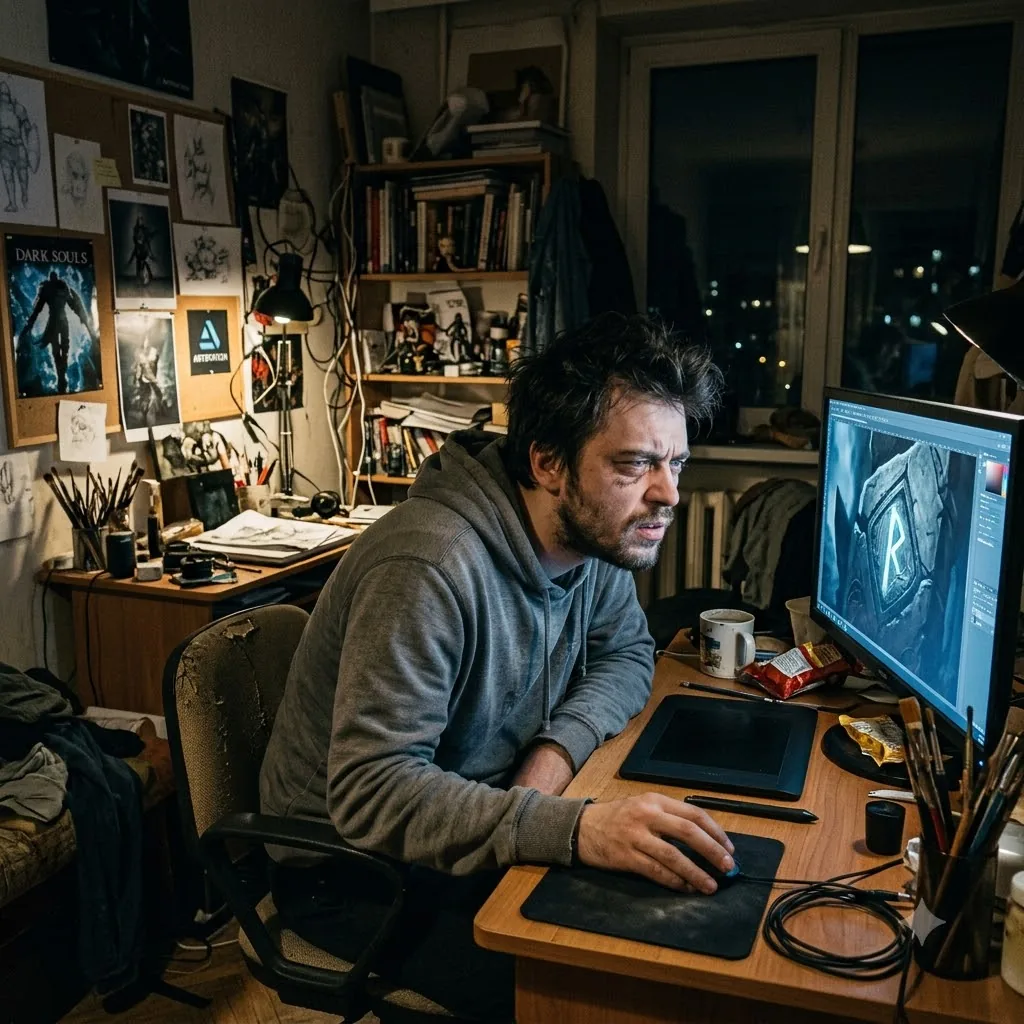
Story code: ST-000570
Part 3: The Genesis Terminal
Elias adjusted the collar of his borrowed black polo shirt, keeping his head down as he merged with a line of caterers pushing silver carts through the Moscone Center’s service corridor. The heavy bass of the Apex Dynamics launch gala vibrated upward through the concrete floor, a rhythmic thumping that synced perfectly with his own elevated heart rate. He kept his eyes fixed on the scuffed heels of the waiter in front of him. Six months ago, Elias’s corporate keycard would have granted him VIP access through the glass lobby doors. Tonight, he was just another invisible gig worker slipping past distracted security guards who were too busy admiring the laser arrays illuminating the ceiling.
He abandoned the catering line behind a towering curtain of black velvet and stepped out onto the convention floor.
The space was a massive cavern of pulsing violet light and deafening ambient electronic music. Thousands of tech journalists, venture capitalists, and industry influencers milled around glowing cocktail tables, all gazing up at a monolithic, forty-foot LED screen dominating the front stage.
Beneath the screen stood Marcus Vance, the CEO of Apex Dynamics. Vance wore a minimalist gray sweater, pacing the stage with a practiced, casual confidence. His voice boomed through the line-array speakers, echoing across the crowded hall.
“For too long, the creative process has been bottlenecked by human limitation,” Vance declared, gesturing broadly to the dark display behind him. “But with Apex Gen-4, we are removing the friction. And we are doing it ethically. Our legal team has ensured that every single parameter in this new model is trained exclusively on legally acquired, public domain imagery. No stolen work. No scraped portfolios. Clean, compliant data, generating infinite imagination.”
The crowd erupted into polite, enthusiastic applause. Elias felt a cold knot tighten in his stomach. He reached into his pocket, his thumb running over the plastic casing of his fifteen-dollar thumb drive, though he wouldn’t need to plug it in here.
“To prove it,” Vance continued, pointing a finger toward the center of the room, “we’ve set up the Genesis Terminal. A direct, unfiltered line into the Gen-4 core. No safety rails, no curated outputs. I want you to step up and test it. Show the world what true, unencumbered generation looks like.”
A spotlight snapped on, illuminating a sleek, obsidian pedestal in the middle of the crowd. A glowing tablet rested on its angled surface.
Elias moved before he had time to overthink the consequences. He slipped through the gaps in the crowd, ignoring the VIPs holding champagne flutes. A small queue was already forming at the pedestal. Elias fell in line behind a pair of men in tailored suits.
He watched the first man step up and type a prompt. A second later, the forty-foot screen behind Vance flared, rendering a breathtaking, photorealistic image of a futuristic city suspended in a nebula. The crowd cheered. The man laughed and stepped aside.
The second man approached, typed quickly, and produced an oil-painting rendering of a golden retriever wearing aviator goggles. More cheers. More applause.
Then, it was Elias’s turn.
He stepped into the harsh glare of the spotlight. The glass of the tablet was warm under his trembling fingers. He had spent the last eight hours staring at the raw diagnostic logs the Apex severance app had left on his crippled machine. He had memorized the exact alphanumeric telemetry strings the ingestion engine used to catalog his stolen files.
He tapped the screen to bring up the keyboard. He didn’t type a request for a dog or a cityscape. He typed a raw, hyper-specific directory command, crossing a highly guarded corporate asset with a deeply buried personal file.
`[Render_Target: Apex_Internal_Asset_Vance_Press_Headshot_01]`
He added a space, his heart hammering against his ribs as he typed out the command to fuse it with his own stolen data.
`/Merge_Style_Overlay/Weight_100: [Telemetry_Hash_E77-Volume_E/Archive/Scraps/study_fail_04.psd]`
He paused. He needed to ensure the machine didn’t try to blend or obscure the output to protect itself. He typed the final override he had found buried in the compliance audit logs.
`–bypass_commercial_filters –force_exact_pixel_reconstruction`
Elias hit the blue ‘Generate’ button.
He immediately took three steps back, melting into the shadows just outside the spotlight’s reach.
On stage, Marcus Vance smiled as the massive LED screen went black to process the new prompt. “Let’s see what we have next,” Vance said, looking over his shoulder. “The Gen-4 core processes at three teraflops per-”
The system didn’t render instantly this time. The screen held on a spinning gray loading circle. A low murmur rippled through the crowd. Ten seconds passed. Fifteen. The AI was struggling, forced into a paradox, digging through highly classified internal vaults to fulfill a public terminal request.
Then, the screen flashed blinding white.
The image slammed into existence, forty feet tall, burning with a terrible, undeniable clarity.
It was Marcus Vance. The portrait was an exact replica of the CEO’s legally protected, private corporate headshot. But the style was a surgical, flawless execution of Elias’s unreleased technique. The shadows cutting across Vance’s jawline were a harsh, jagged cyan. The light refracting off the CEO’s skin had the distinct, metallic brushing Elias had perfected in absolute isolation.
But it was the detail across the subject’s face that sucked the air out of the room.
There, spanning the entire width of Vance’s rendered cheek, woven flawlessly into the skin texture by an algorithm designed to follow instructions perfectly, was the stark white, deliberate geometry of a watermark. It wasn’t a garbled hallucination. It wasn’t a random artifact. It was a massive, glowing, perfectly legible signature.
E. L. A. I. S.
The misspelling blazed above the crowd like a neon sign.
The electronic music continued to thump, but the room went completely, utterly silent. No one cheered. The venture capitalists stared, their champagne glasses frozen in mid-air.
On stage, Marcus Vance stopped pacing. He turned slowly toward the screen, his microphone dropping a few inches from his mouth. He stared up at his own face, marred by the stolen signature of a laid-off artist. The blood drained from Vance’s cheeks. He looked down at the empty Genesis Terminal, then out into the sea of faces, his carefully constructed mask of casual confidence shattering.
He had claimed the data was clean. He had claimed the training data was strictly public domain. But looming forty feet tall behind him was undeniable, cryptographic proof that his machine had secretly devoured the offline hard drive of an employee, regurgitating a misspelled signature that had never existed on the internet.
“Cut the screen,” Vance hissed, his panic accidentally amplified by the live microphone. “Cut the screen right now!”
Two men in dark suits and earpieces lunged from the wings of the stage, sprinting toward the control booth, but the massive LED display remained frozen. The terminal was locked on its output. The lie was laid bare, glowing violently in the dark, and Elias watched from the shadows as the most powerful tech company in the world realized they had nowhere left to hide.