Story code: ST-001858
Part 4: The Midnight Freight
I didn’t scream when the glass shattered. I just reached into my pocket, pulled out my vibrating phone, and pressed the green upload button. The progress bar filled the screen, sealing my parents’ fate in a matter of seconds. I picked up my bag, leaving the ruined print under the bloody steel of my father’s tape gun, and walked out the door. My mother didn’t call after me. The silence in the stairwell was absolute.
Two months later, that silence had been replaced by the clinking of stemmed wine glasses and the low, cultured hum of the university’s fine arts gallery.
“It’s breathtaking, Jia. Truly brutalist and brave.”
I blinked, pulling my focus away from the polished hardwood floor, and looked at the woman standing beside me. She was a prominent gallery curator, wearing a silk scarf that likely cost more than a month’s rent in the South Bronx. She was staring up at the newly reprinted, pristine 16×20 image of Elena.
“The juxtaposition of the miniature soap against the utility bills,” the curator murmured, taking a delicate sip of her Chardonnay. “It captures the systemic rot so perfectly. You’ve given a voice to the voiceless.”
“Thank you,” I said. My voice sounded thin, synthetic. I sounded like an automated recording.
My documentary essay had been published on the front page of the state’s largest digital news outlet three weeks ago. It was a massive, immediate scandal. The public outcry over the commissary price-gouging had forced the state department of corrections to launch a formal investigation into their vendor supply chains. My inbox was flooded with internship offers from national magazines. My academic advisor had nominated me for a prestigious national student journalism award.
By every measurable metric of my new world, I was a soaring, undeniable success.
And yet, standing in the center of the brightly lit gallery, surrounded by people praising my vision, I felt entirely hollow. I was a ghost haunting my own celebration.
The state had immediately frozen all new vendor contracts pending their review, invoking the very morality clauses my father had warned me about. The $34,000 cashier’s check had long since been voided, returned to a bank account that was now locked in a desperate battle against a looming foreclosure. My parents were ignoring my calls. The one time I had taken the subway back to Queens to try and explain, my key hadn’t turned in the deadbolt. They had changed the locks.
My professor materialized at my elbow, beaming with proprietary pride. “Jia, I want to introduce you to the editor of the Metro section. He wants to talk about expanding this into a summer series.”
“Just a moment, please,” I muttered, stepping backward. “I need some air.”
I pushed through the dense crowd of admiring faculty and students, my chest tight, until I reached the heavy glass doors of the gallery entrance. I stepped out into the crisp autumn night. The air was sharp, free of the suffocating scent of cardboard dust and mint toothpaste that had defined my entire life.
I leaned against the brick exterior of the building and looked down at my hands. They were smooth, clean, perfectly intact. Not a single blister. Not a single cut wrapped in athletic tape. I had sacrificed my family on the altar of my own moral clarity, but I wasn’t the one paying the price for it. Elena was still freezing in her apartment. The attendees inside were still drinking their wine. And my parents were still drowning.
I checked the glowing face of my phone. It was 11:45 PM.
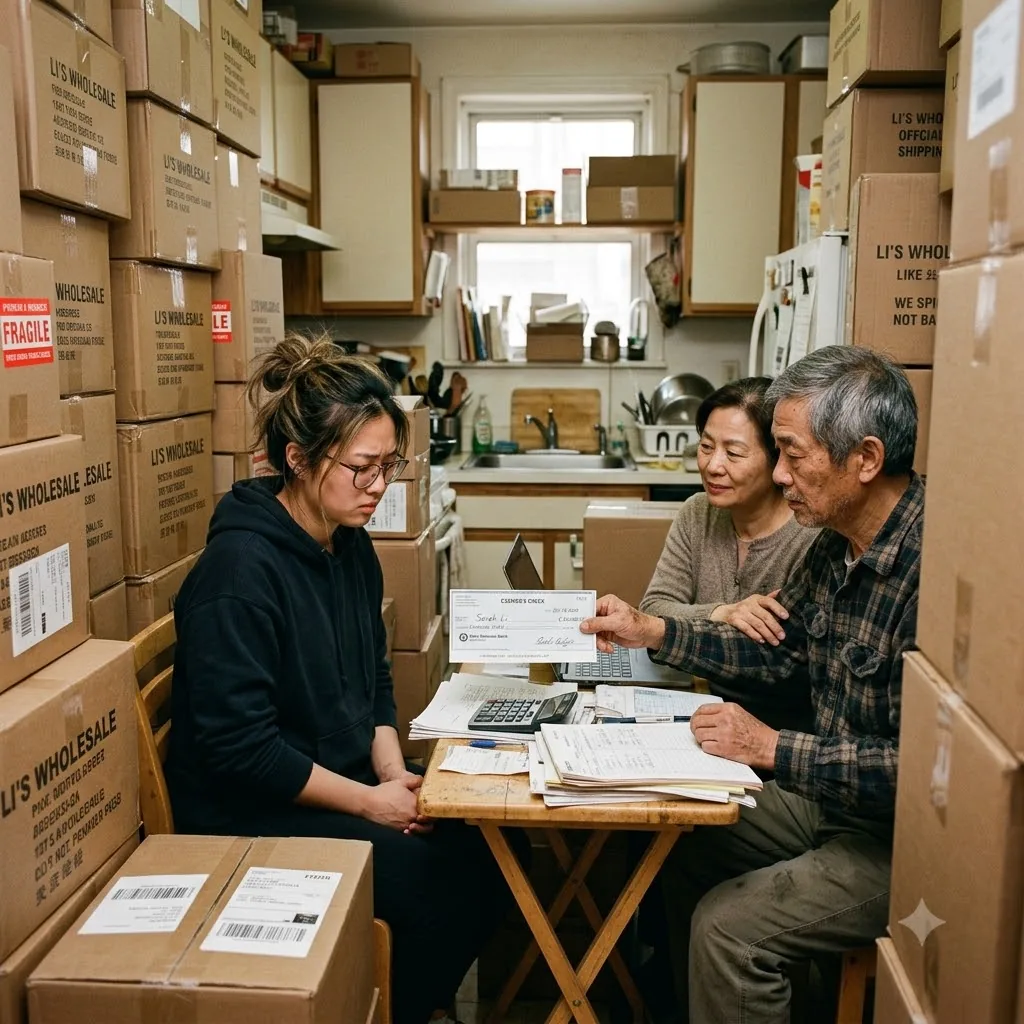
I closed my eyes, pressing the back of my head against the cold brick. I didn’t need to be in Queens to know exactly what was happening in that cramped kitchen. The state investigation was dragging on, but the bank’s interest payments on the second mortgage were strictly scheduled and completely indifferent to our public disgrace. To stave off default, my parents had been forced to sub-contract their massive, unsold inventory to a private prison liquidator for fractions of a penny on the dollar.
It was Thursday. The freight truck would be idling on the avenue at midnight.
In my mind, the image was sharper and more vivid than any photograph hanging in the gallery behind me. I could see the harsh fluorescent light above our stove. I could see my mother’s exhausted, bruised fingers folding the cardboard flaps. I could see my father, his back bent, his shoulders aching with the weight of a broken American dream.
There were no words spoken between them anymore. There was no celebratory dumpling dinner on the vinyl tablecloth. There was only the brutal, rhythmic mechanics of survival.
*Craaaack.*
I could hear it echoing across the miles of city blocks. The heavy, metallic shriek of the industrial tape gun sliding across corrugated cardboard.
*Craaaack.*
Over and over again in the dark. Boxing up the soap. Boxing up the razors. Sealing away the last remnants of our family, one box at a time, for the midnight prison freight.