Story code: ST-001237
Part 2: The Absurd Extension
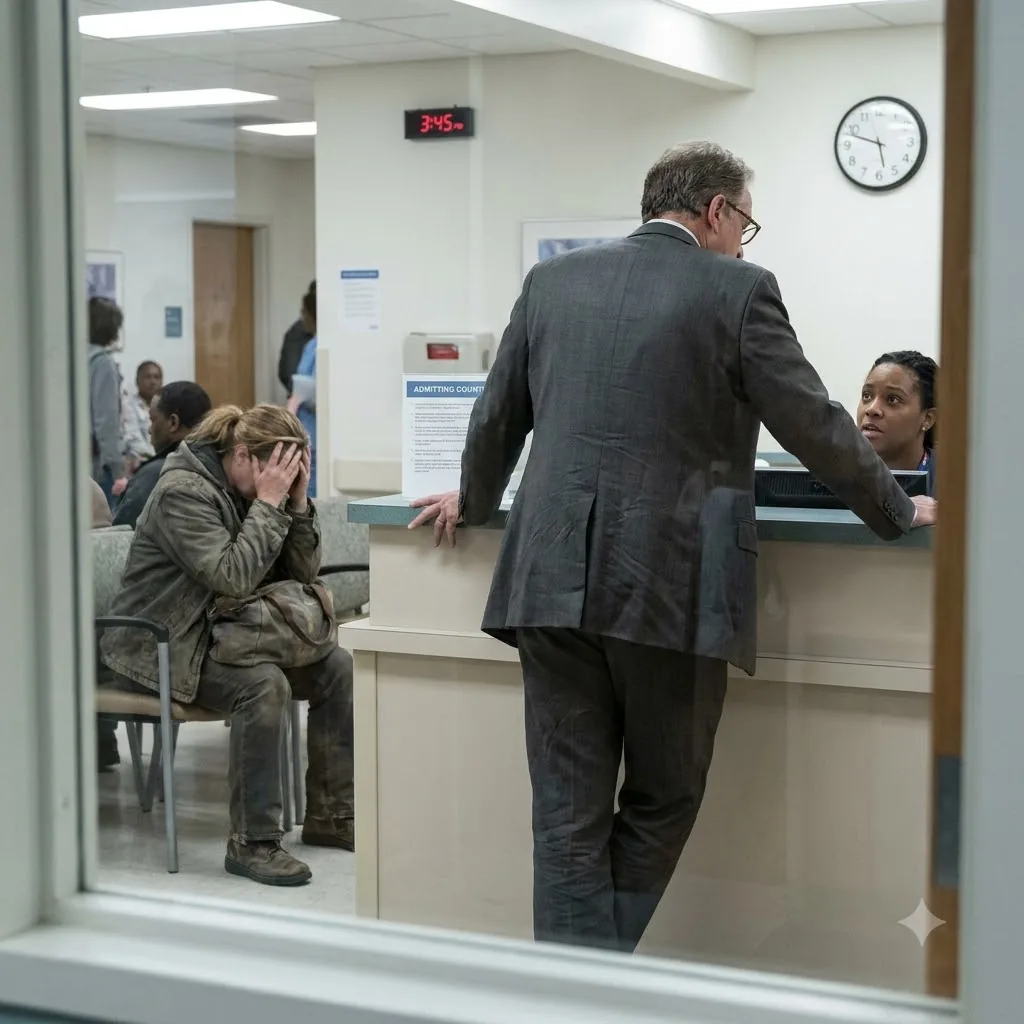
The standoff at the admitting desk continued as the clock on the waiting room wall clicked to 9:15 PM. Having failed to find the fictitious rule in the transplant section, Officer Davies attempted to cross-reference Harold’s claims with the general hospital charter.
On the security tape, Harold senses the administrator’s growing confusion and decides to push his advantage. He turns to the rest of the waiting room, gesturing broadly to the other families sitting in the plastic chairs.
“This isn’t just about my nephew,” Harold declares, his voice carrying across the entire lobby. “It’s standard administrative oversight. If this hospital starts ignoring family consent rules, none of your medical directives are safe. If they can take my nephew’s organs without his family’s final signature, they can do the same to any of your relatives lying in those beds.”
A man sitting in the corner, holding a plastic cup of coffee, looks up in confusion. The absurdity of Harold’s claim begins to warp the atmosphere of the room. He is applying a fabricated, estate-level co-signature rule to immediate, state-registered organ donations, implying that the hospital routinely operates as an unregulated body.
“Mr. Vance,” Davies says, trying to lower his voice to de-escalate the room. “That is not how the donor registry works. The registry is a legally binding document.”
“Only when verified by the proper administrative channels,” Harold snaps back, leaning heavily on the counter. “And as his uncle and the head of the family estate, I am telling you the verification is incomplete. If you scan that blue silicone donor bracelet, you are committing a compliance violation. Go ahead. Look up the liability clause.”
I reviewed the system access logs from that exact minute. Davies, pressured by Harold’s public performance, typed Harold’s name into the visitor access database. But the system did not show Harold Vance as a legal guardian or healthcare proxy. It showed him only as an unverified visitor.
Sarah Vance finally steps forward. She ignores Harold entirely and places the blue silicone donor bracelet onto the desk, pushing it toward the barcode scanner. Her face is pale, but her hands are now steady.
“Scan it,” Sarah says clearly. “My brother signed the registry. He wore this bracelet. The decision is his, not Harold’s.”
Harold reaches out, his hand hovering inches from the bracelet as if to snatch it away, but he stops himself when Davies warns, “Sir, do not touch the patient’s medical property.”
Davies looks at the computer screen, then at the bracelet. The proof lane-the actual, coded database of the state donor registry-is right there, waiting for the physical scan to match the digital record. The automated system does not require a relative’s login or signature to proceed; it simply requires the confirmation of the physical token.
Yet, Davies’ hand hovers over his mouse, still paralyzed by the fear of violating a policy that Harold has so confidently invented. The digital record and the physical bracelet sit in direct contradiction to the loud authority of the man standing at the counter.