Story code: ST-001850
Part 2: The Integration Questionnaire
“Campus Security. I know you’re in there. Roll it down.”
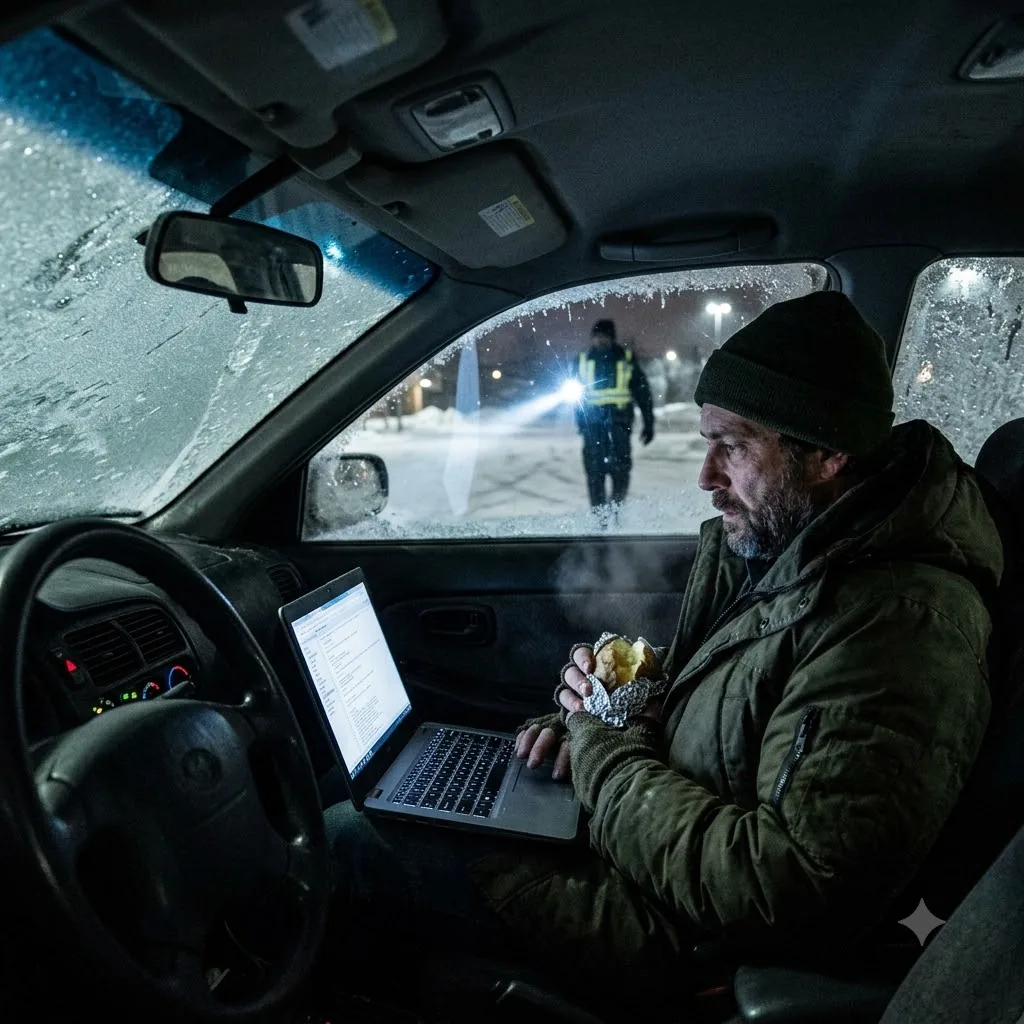
The voice was muffled but carried the heavy, unmistakable authority of someone who had the power to ruin Elias’s life. Elias’s breath caught in his throat, a sharp inhale of freezing air that burned his lungs. He couldn’t play dead. The flashlight beam had already swept over his shape under the sleeping bag.
Moving with stiff, frantic urgency, Elias kicked the heavy sleeping bag down into the footwell, shoving it beneath the steering column to hide it from view. He grabbed his keys from the passenger seat, fumbling with freezing fingers, and twisted the ignition to auxiliary power. The car’s electrical system hummed weakly. He pressed the window button. The glass whined in protest against the ice, eventually rolling down two inches.
A blast of frigid January air hit his face, accompanied by the blinding glare of a tactical flashlight.
“Lot C is closed to commuters at midnight,” the guard said. The beam didn’t waver from Elias’s eyes, making it impossible to see the man’s face.
Elias held up a hand to shield his vision. “I’m sorry. I’m faculty. Adjunct in the English department. I was just… I was grading papers and lost track of time. Must have nodded off.”
The flashlight beam drifted down. It illuminated the battered Chromebook on the passenger seat, the crumpled foil potato wrapper, and the condensation that had frozen on the inside of the windshield-a dead giveaway that someone had been breathing in the confined space for hours.
“Engine’s dead cold,” the guard noted, his voice flat. “You’ve been ‘nodded off’ a while. Let me see your university ID.”
Elias reached into his coat pocket, his hand trembling so violently he could barely extract his wallet. He passed the plastic card through the narrow gap. The guard inspected it, shining the light on the barcode.
“Mr. Vance,” the guard said. “You don’t have an overnight residential permit. And it looks like you’ve got a lot of blankets shoved down there for a guy just grading papers. Policy says I write a fifty-dollar citation, report the infraction to administration, and you vacate the premises immediately.”
Fifty dollars. It might as well have been five thousand. A citation on his record would give Provost Caldwell the perfect excuse to terminate his contract before the spring semester even began, voiding his final paycheck.
“Please,” Elias whispered, his voice cracking. The cold was sinking into his bones, but the panic was worse. “I’m leaving right now. Please don’t write the ticket. If you flag my ID, I lose my classes. I can’t afford the fine.”
The guard stood in silence for a long, agonizing moment. The heavy beam of light flicked back up to Elias’s shivering frame, lingering on his pale, drawn face. “Ten minutes,” the guard finally said, sliding the ID back through the window. “I swing back around in ten minutes. If this vehicle is still in Lot C, I’m calling a tow truck and logging it with the Dean. Get moving.”
“Thank you. Leaving now,” Elias gasped.
The guard turned and crunched his way back to a waiting patrol vehicle. Elias rolled the window up and turned the key all the way. The old Honda’s starter whined, struggling violently against the thick, freezing oil. For three terrifying seconds, it just clicked. Finally, the engine coughed and sputtered to life. The gas gauge rested perilously below the empty line, the orange warning indicator glaring at him from the dashboard.
He shifted into drive and crawled out of the parking lot, his tires crunching over the frost-heaved asphalt. He had nowhere to go. The street parking was metered, and the local police were unforgiving. His only option was the loading dock alley behind the Humanities building. It was technically city property, a narrow, unlit trench wedged between the university brickwork and a row of commercial dumpsters. More importantly, it was just close enough to catch the edge of the campus Wi-Fi network.
Elias guided the Civic into the dark alley, killing the headlights and shutting off the engine immediately to conserve what little fuel remained. The silence of the alley was oppressive, broken only by the distant hum of the university’s massive HVAC units.
He hauled the sleeping bag back up to his chest and opened the Chromebook. The battery icon in the bottom corner showed twenty-two percent. The freezing temperatures were draining the lithium-ion cells at an alarming rate.
He connected to the university network. One fragile bar of signal strength.
He opened Caldwell’s email and clicked the portal link. The screen flashed white, loading a sterile, minimalist interface titled ‘Humanities Auto-Assessor V.1.2’. The instructions were cold and imperative: ‘Upload Course Rubrics and Upload Annotated Student Samples (Min. 50 files).’
Fifty files. Five years of his life. Late nights agonizing over how to encourage a struggling freshman without giving false hope, carefully worded marginalia meant to spark critical thought-all of it about to be ground down into algorithmic weights by a machine that didn’t know what a poem was.
With a heavy heart, he selected his master archive folder, a forty-five-megabyte zip file containing every syllabus, rubric, and graded paper he possessed. He clicked upload.
A progress bar appeared. ‘Estimated time: 14 minutes.’
The laptop battery ticked down to nineteen percent. He watched the blue bar crawl forward. Ten percent complete. Twelve percent.
Suddenly, the progress bar turned a harsh crimson, freezing in place. A dialogue box popped up over the screen.
‘ERROR: Rubric formatting unrecognized. The automated system requires the mapping of personal grading criteria to standard University Core Metrics before upload can proceed. Please complete the integration questionnaire.’
Elias stared at the screen in horror. They didn’t just want his files. They wanted him to manually translate his humanity into their machine language. He clicked the questionnaire. A spreadsheet loaded, containing over a hundred drop-down menus. He was expected to link his subjective, empathetic criteria-like ‘Emotional Resonance’ and ‘Originality of Thought’-to rigid data points like ‘Matrix Variable 4A: Lexical Density’ and ‘Variable 7C: Syntactical Conformity.’
He was being forced to build the very walls of his own obsolescence, brick by digital brick.
The battery ticked down to fifteen percent.
Before he could map the first variable, a sudden sweep of blinding high-beam headlights flooded the narrow alley. A large, battered pickup truck had turned into the trench, effectively boxing Elias’s Honda against the dumpsters. There was no room to back out.
The truck’s engine rumbled aggressively. A heavy side door creaked open, and a tall, shadowed figure stepped out into the glare of the headlights. The figure began walking slowly toward Elias’s driver’s side door, holding something long and metallic in their right hand that gleamed sharply in the harsh light.
Elias reached for the ignition, but the battery gauge on his screen flashed to twelve percent. If he started the car now, the electrical surge would kill the freezing laptop, wiping out the upload connection and costing him his final paycheck. If he didn’t, the figure approaching his window would reach him in seconds.