Story code: ST-000770
Part 2: Ordinance 402
“Sarah Jenkins?” the man asked, his voice entirely devoid of inflection.
Sarah nodded, her hands still numb from the damp cold.
He extended the heavy bond paper. “You are formally served notice by the Department of Municipal Code Enforcement.”
He did not wait for a reply or ask for a signature. He turned, careful to keep his Oxford shoes on the dry plywood ramp, and walked back to a silver sedan idling at the curb.
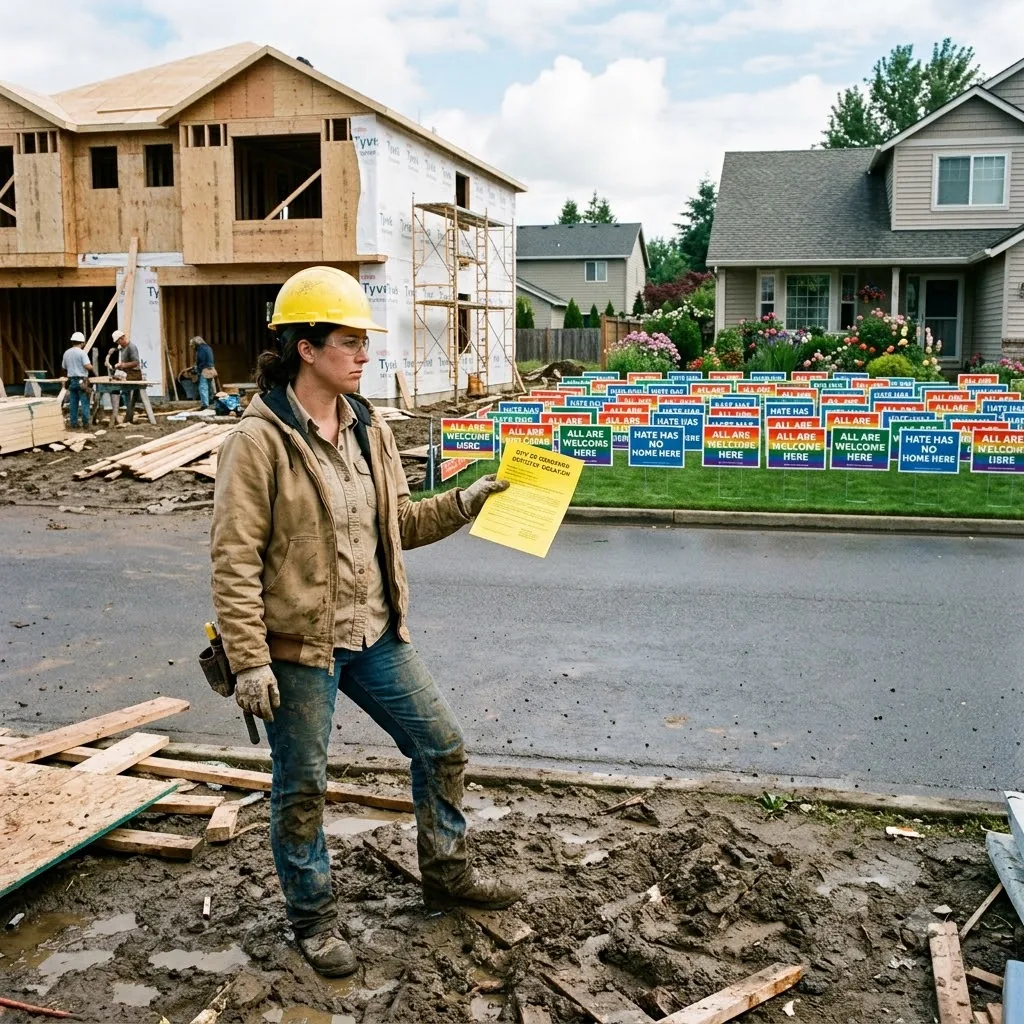
Sarah unfolded the sheet. The letterhead bore the official gold seal of the city. The bold text at the top read: *PRELIMINARY DECLARATION OF CHRONIC NUISANCE*.
She read the text, her breath pluming in the crisp air. The document cited Municipal Ordinance 402.B, a “Safe Neighborhoods” provision enacted in the late nineties. It had been designed during a tough-on-crime era to shut down crack houses and illegal dumping sites. The bureaucratic mechanism was brutally simple: if a property generated five verified police dispatches within a thirty-day period, the city would automatically suspend all active building permits and certificates of occupancy. If the property hit seven dispatches, the city was legally obligated to initiate civil forfeiture proceedings to seize the lot for public auction.
Five dispatches.
Sarah looked back toward her makeshift plywood desk and the logbook sitting on top of it.
Monday: an idling commercial vehicle. Tuesday: construction debris extending an inch into the right-of-way. Wednesday: suspicious persons on the roof. Thursday: a fourteen-millimeter fence setback violation.
That was four. Four times flashing lights had bathed the exposed timber of the duplex. Four times armed officers had been compelled to respond to trivial zoning complaints called in by a woman whose yard was currently bristling with signs demanding the demilitarization of the police.
Sarah looked across the asphalt. Elaine’s front door was closed, but the shadow remained perfectly still behind the sheer white curtains.
The cognitive dissonance was so profound it made Sarah’s teeth ache. Elaine was not just being a difficult neighbor with a laser level. She was not just trying to delay construction with red tape. She was deliberately using armed police officers as a weapon to artificially trigger a property seizure ordinance. And to hit her quota, Elaine was perfectly willing to put minority tradesmen and paroled carpenters directly in the line of fire. Marcus was currently sitting in a precinct holding cell, his life and freedom entirely upended, simply because he was the necessary collateral damage in Elaine’s administrative game.
Sarah pulled her phone from her heavy canvas jacket with shaking fingers and dialed David, the hard-money lender who had bankrolled the infill project.
He answered on the second ring. “Tell me the framing is done, Sarah. The bank is asking for the second-phase inspection photos.”
“Marcus got arrested,” Sarah said, her voice hollow.
A long pause. “What? Why?”
“Parole violation. A cop ran his ID after responding to a temporary fence setback complaint from the neighborhood president. And David, a city courier just handed me a Chronic Nuisance warning. We have four police dispatches on record this week.”
David swore, a sharp, ugly sound. “Ordinance 402.B?”
“Yes.”
“Sarah, you have to shut the site down. Right now. Padlock the fence and send everyone home.”
“I already sent the crew home. But if we stop work, we miss the framing deadline. The weather is turning. If the roof isn’t sealed by next week, the moisture damage to the subfloor will ruin us. I need Marcus out of jail, and I need to keep building.”
“If you get one more police call, the city suspends the permit,” David snapped. “If the permit is suspended, my bank’s automated risk-management software freezes the construction escrow. I won’t be able to release a single dime to you. You won’t be able to pay for materials, you won’t be able to pay a lawyer to bail out your carpenter, and you will default on the land contract.”
Sarah stared at the churned mud where Marcus had been handcuffed. “I can fight the nuisance declaration. Every single call was fabricated or grossly exaggerated.”
“It doesn’t matter!” David’s voice echoed from the phone speaker. “The ordinance doesn’t measure convictions or valid citations. It measures *dispatches*. It was written to bypass the courts so the city could seize drug houses without waiting for warrants. If a cruiser shows up, it counts against you. Period. Elaine knows exactly what she’s doing. Shut it down, Sarah. Do not let anyone step foot on that dirt until I can get a municipal attorney to file an injunction against the neighborhood association.”
The line went dead.
Sarah lowered the phone. She was standing in the middle of a quarter-million dollars of exposed lumber. She had a sixty-day hard deadline to get the duplex weather-tight and appraised, or she lost everything. She had poured her life savings into this project to prove that gentle, affordable density could work here.
Instead, she was one 911 call away from total financial ruin.
She looked back at her phone screen and opened the digital property records she had been trying to access before the courier arrived. She pulled up the plat map for the neighborhood. She tapped Elaine’s property, then tapped the neighborhood association’s public financial filings. She needed to know why this specific lot was worth weaponizing police against innocent workers.
As she scrolled through the association’s treasury documents, a municipal grant application approved six months ago caught her eye.
*The Historic Green Canopy Initiative.*
The neighborhood association, led by Elaine, had been awarded a half-million-dollar city grant to construct a “Community Restorative Justice Park.” The funds were allocated, but the project had stalled. Sarah clicked on the grant contingencies. The funds expired at the end of the fiscal year if the association did not acquire a vacant lot within the neighborhood boundaries. But property values had skyrocketed. The association couldn’t afford to buy a lot on the open market.
Unless, of course, the city seized a lot through civil forfeiture under Ordinance 402.B and transferred it to the neighborhood association for pennies on the dollar.
A heavy, rhythmic rumble shook the muddy ground beneath Sarah’s boots, pulling her attention away from the screen.
Turning the corner onto the narrow, historic street was a massive eighteen-wheel flatbed truck. Stacked on the back were the heavy prefabricated wooden roof trusses Sarah had ordered three weeks ago.
In the chaos of Marcus’s arrest, she had forgotten to cancel the delivery.
The truck ground its gears, the diesel engine roaring as the driver tried to navigate the tight angle of the historic street. In doing so, the rear wheels of the massive trailer hopped the curb, sinking deep into the soft grass of the public parkway directly in front of the duplex. Thick tracks of mud tore through the manicured municipal grass. The truck’s air brakes hissed violently as the chassis bottomed out.
It was stuck. The massive trailer was completely blocking the public right-of-way.
Across the street, Elaine’s front door opened.
The neighborhood president stepped out onto her porch. She was wearing a hand-knit cardigan over a shirt that read *Be Kind*. She had a steaming ceramic mug in one hand.
In her other hand, she held a silver smartphone.
Elaine looked at the stranded truck, the torn grass, and the blocked street. Then she looked directly across the asphalt at Sarah. A slow, serene smile spread across Elaine’s face as she raised the phone to her ear.