Story code: ST-000770
Part 3: Second Chance Compliance
The flashing lights returned at exactly 2:14 PM.
Sarah watched numbly as two officers stepped out of their cruiser. They didn’t even look angry, just bored. The massive flatbed truck was still hopelessly mired in the parkway mud, its hazard lights blinking a yellow rhythm across the raw lumber of Sarah’s duplex.
Across the street, Elaine remained on her porch, her hands wrapped around her ceramic mug, a portrait of civic concern.
“Dispatch said a commercial vehicle was blocking a designated emergency route,” the older officer said, pulling a ruggedized tablet from his vest. “Is this your site, ma’am?”
“The truck got stuck trying to make the turn,” Sarah said, her voice flat. She didn’t argue. She didn’t explain the unyielding geometry of the historic street or point fingers at the house across the asphalt. “We’ve called a heavy wrecker.”
“I still have to log the response,” the officer said, tapping his screen. “That makes five dispatches to this address in thirty days.”
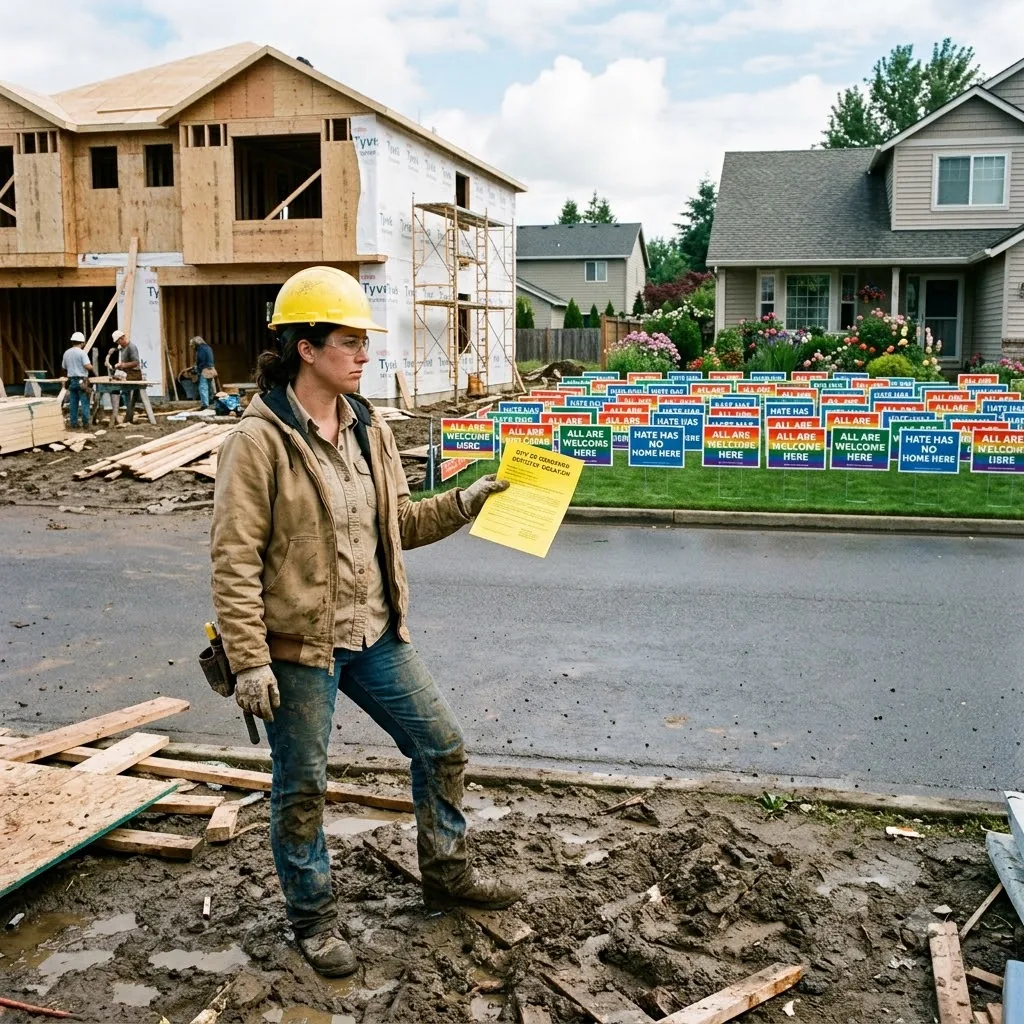
He walked over to the temporary construction fence-the same fence that had cost Marcus his freedom that morning-and zip-tied a bright red, weather-proof envelope to the chain-link. The bold black letters on the plastic read: *MUNICIPAL STOP WORK ORDER. PENDING ORDINANCE 402 REVIEW.*
When Sarah looked back across the street, Elaine was softly closing her front door. The neighborhood president had won.
By midnight, the temperature had plummeted, turning the deep ruts in the yard into jagged ridges of ice. Sarah sat alone at her makeshift plywood desk inside the uninsulated ground floor of the duplex. A single battery-powered work lamp cast stark, long shadows against the exposed studs. The hard-money loan was frozen. Her crew was gone. Her dream of infill housing was dead.
She had stayed behind in the freezing dark for one reason: Marcus.
Her laptop screen glowed brightly against the chill. She had spent the last four hours on her mobile hotspot, talking with Marcus’s wife, trying to untangle the bureaucratic nightmare of his sudden arrest. Marcus wasn’t going back to state prison, but the minor police interaction had triggered an automatic suspension of his standard parole. To get him out of county holding, the local magistrate had mandated his immediate transfer to an intensive private probation program, complete with GPS ankle monitoring.
The paperwork Marcus’s wife had forwarded was a labyrinth of user-funded justice. The county didn’t pay for the monitor; Marcus did. The invoice demanded an initial setup fee of two hundred dollars, plus a daily usage rate of thirty-five dollars, payable exclusively to the court-contracted vendor managing his district.
Sarah scrolled down the digital invoice. The vendor was listed as *Second Chance Compliance, LLC.*
The name gnawed at her. It sounded exactly like the wooden plaque hanging on Elaine’s porch, the one advocating for “criminal justice reform and second chances.”
Sarah rubbed her freezing hands together, her breath fogging in the halo of the LED work lamp. She opened a new tab and navigated to the Secretary of State’s business portal. She typed *Second Chance Compliance, LLC* into the corporate registry search bar.
The state database loaded slowly. The LLC was registered locally. The registered agent was a generic shell corporation in a downtown high-rise. Sarah clicked through the annual filing history, bypassing the summaries and pulling up the raw PDF of the original incorporation documents from three years ago.
She scrolled to the bottom of the second page, looking for the authorizing signature.
There, written in precise, looping blue ink, was the name of the managing principal: *Elaine Vance*.
Sarah stopped breathing.
She stared at the signature, then scrolled back to the top of the document. The corporate mailing address for the LLC wasn’t a commercial office. It was a residential address. It was the exact street number of the immaculate, progressively landscaped house directly across the asphalt.
The puzzle pieces violently snapped together, forming a picture far uglier than a simple land grab.
Elaine wasn’t just trying to seize Sarah’s lot to fulfill a restorative justice park grant. Elaine was farming the very people she claimed to champion. As neighborhood president, Elaine had unparalleled access to construction permit filings, which listed the site subcontractors. She knew exactly which framing crews and concrete pourers employed men working through community transition programs. By weaponizing hyper-specific municipal codes-calling in fourteen-millimeter setback violations on temporary fences-Elaine wasn’t just generating nuisance strikes against the property. She was intentionally baiting police into running the IDs of vulnerable, paroled workers.
Every time an officer ran a name like Marcus’s, it triggered a technical violation. The worker was forced onto an electronic monitor to avoid returning to a cell, and Elaine’s private LLC collected thirty-five dollars a day from a man who could barely afford groceries.
Elaine was the one calling the police. Elaine was the one supplying the ankle monitor. Elaine was the one cashing the checks. The “criminal justice reform” sign in her front yard wasn’t a political statement. It was an advertisement for her business model.
Sarah slammed the laptop shut.
She grabbed the printed copy of the LLC filing from her portable printer, shoved open the heavy plywood construction door, and marched out into the freezing night. The frozen mud crunched under her boots. She didn’t care that it was one in the morning. She didn’t care about the wind biting through her canvas jacket.
She crossed the street, stepping up onto the pristine curb. She walked straight past the massive rainbow placard and the tricolor banner of radical inclusivity.
She mounted the wooden steps of Elaine’s porch and hammered her fist against the heavy oak door.
Silence hung in the cold air for a long moment. Then, the porch light flicked on, bathing Sarah in a harsh yellow glare. The deadbolt clicked.
Elaine opened the door just enough to leave the chain engaged. She wore a plush silk robe, her face tight with sleepy indignation.
“Sarah? Are you out of your mind?” Elaine whispered sharply, glancing nervously up and down the quiet, historic street. “It is one in the morning. You are trespassing on private property. I will call the police.”
“You’re not going to call the police, Elaine,” Sarah said, her voice dangerously calm. “Because dispatch would send an officer here. And I’d have to show them this.”
Sarah held up the state incorporation document and pressed it flat against the glass of the storm door, right in Elaine’s line of sight.
Elaine’s eyes darted to the paper. They locked onto her own signature, and then up to the bold printed words *Second Chance Compliance, LLC*.
“Marcus’s wife just got the invoice for his GPS monitor,” Sarah said, stepping closer to the glass. “Thirty-five dollars a day. Payable to you. How many guys on my site were you hoping to tag before you stole the land? Was Marcus just a bonus check?”
The serene, compassionate mask Elaine had worn all week didn’t just slip; it shattered. The neighborhood president stared at the paper, her mouth opening slightly, but for the first time since Sarah had broken ground, Elaine had absolutely nothing to say.