Story code: ST-000053
Part 4: The Pastel Fortress
By one-fifteen that afternoon, the cardboard box in Arthur’s hands felt heavier than the combined weight of his thirty-year career. He stood in the center of his third-floor office in the science building, his breath shallow and uneven. The young campus security officer-the same one who had unclipped his zip-ties at dawn-stood inside the doorway, his thumbs hooked casually into his heavy duty belt.
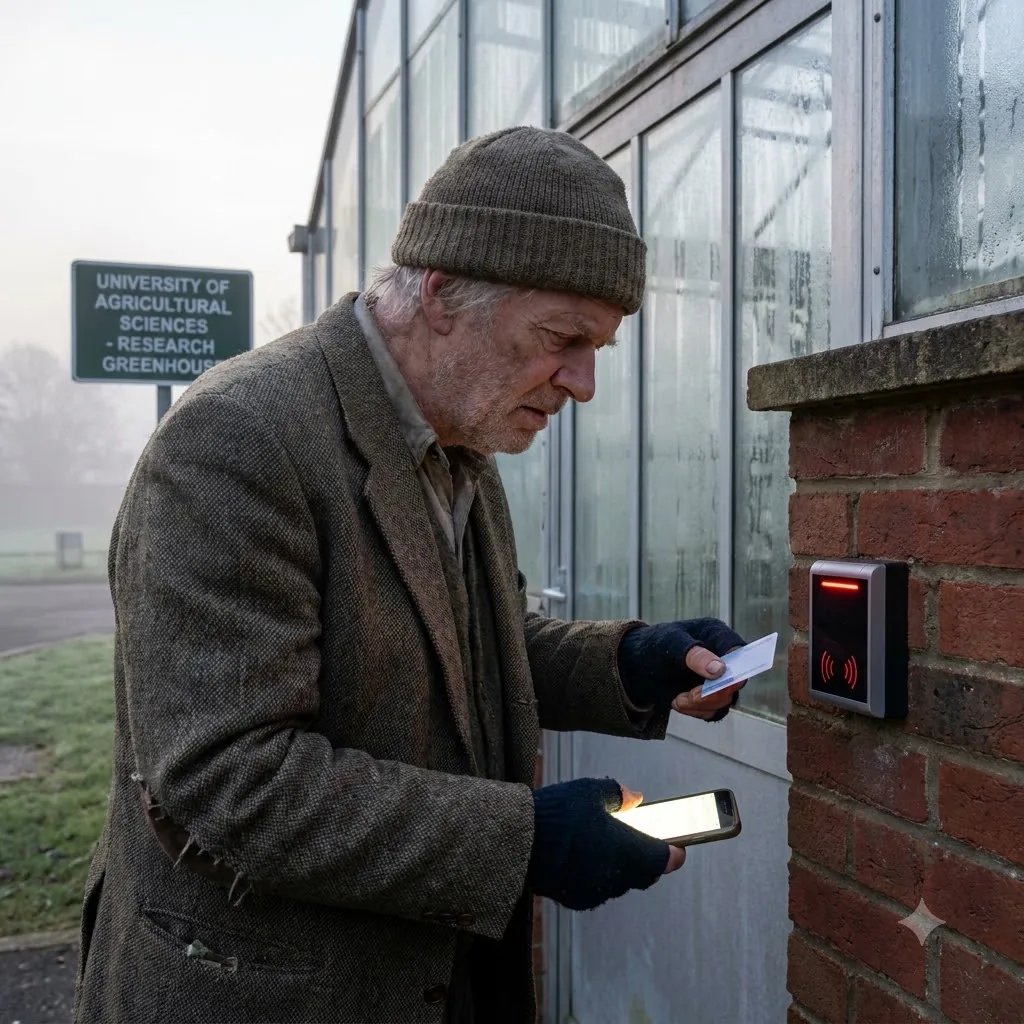
Arthur’s tenure had not ended with a formal tribunal, a peer review, or a union representative stepping in to mediate. It had been dissolved at exactly noon via an automated HR notification, citing a termination under the university’s “Immediate Threat to Community Wellness” clause. David had sent a cowardly, two-sentence text message shortly after, explaining that the Dean had bypassed standard disciplinary protocols entirely to appease the student coalition. The pastel machinery had moved with terrifying, unobstructed speed. Greenhouse 4 was already gone. Facilities had changed the digital access codes and physically padlocked the exterior doors at twelve-thirty.
Arthur placed his framed doctoral diploma into the box, wedging the sharp wooden corner against a stack of heavy botany journals. He turned to the corner of his desk, where a small, glass-encased incubation tray sat unplugged. Inside the tray were twelve microscopic experimental orchid seedlings, the fragile results of a six-year crossbreeding project. They required a precise, unbroken mixture of humidity and synthetic light to survive the winter. The tray’s digital thermometer was blank. The university had cut the power to all his departmental outlets at noon, categorizing his research equipment as unapproved biological assets.
The tender green shoots were already beginning to curl inward, the edges of their microscopic leaves turning a sickly, translucent yellow in the cold room. Cellular necrosis. Exactly as he had warned them on the video call.
Arthur reached out, his trembling fingers hovering over the glass lid.
“I need to take these,” Arthur said, his voice barely a whisper in the quiet office. “They’re in a portable tray. I can keep them alive if I get them to a heated car.”
“No biological assets,” the young officer said, his tone flat and heavily practiced. “And the incubation hardware belongs to the university. You are only authorized to remove personal texts and photographs. Leave the plants.”
Arthur stared at the dying seedlings. They were entirely innocent, governed only by photosynthesis and cellular biology, completely indifferent to the administrative theater that was currently executing them. He pressed his hand flat against the cold glass of the tray, feeling a profound, hollow ache open up in his chest. He was abandoning them to die on a desk he no longer owned.
“Time is up, Arthur,” the officer said, taking a deliberate step into the room. “You need to head to the exit.”
Arthur withdrew his hand. He picked up his cardboard box, adjusting his grip on the unyielding edges, and walked past the officer without another word.
The corridors of the science building were deserted, the students safely tucked away in their afternoon lectures. Arthur’s dress shoes echoed heavily against the linoleum as the officer trailed exactly six feet behind him, enforcing the mandated distance. When they reached the ground floor lobby, Arthur did not head immediately for the rear exit doors. Instead, he paused by the massive, floor-to-ceiling windows that overlooked the main campus quad.
The afternoon sun cast long, brilliant shadows across the frost-bitten lawns. Just outside the student union, a local news van was parked on the brick walkway, its satellite dish extended toward the sky. A small, vibrant crowd had gathered around a camera crew.
Arthur stepped closer to the glass, the winter cold radiating through the thick pane. In the center of the camera’s frame stood a young woman in a bright, heavy winter coat. Arthur recognized her instantly. She was the sophomore who sat in the back row of his Tuesday seminar-the one who had held her smartphone up to record his impassioned lecture on the root structure of Japanese knotweed.
She was beaming. She held a microphone, speaking animatedly to the local reporter, gesturing toward the botanical science building with an expression of profound, triumphant relief. Beside her, Silas and a group of students held up a hastily painted banner that read *Botanical Equity Now: Reclaiming Our Space.* They were smiling, hugging one another, performing a joyful pantomime of survival for the camera.
They had defeated the monster. They had made the community safe.
Arthur watched the silent broadcast through the window, the heavy cardboard box digging sharply into his forearms. A cold, absolute clarity washed over him. The truth of the video-the trowel, the syllabus, the invasive weed-did not matter, and it never would. The campus had successfully insulated itself from objective reality. They had built an impenetrable fortress of pastel jargon and weaponized empathy, a place where evidence was considered violence and fiction was rewarded with prime real estate.
“Move along,” the officer prompted, pointing toward the heavy double doors at the end of the lobby.
Arthur did not argue. He turned his back on the window, on the beaming journalist, and on the dying seedlings three floors above. He pushed open the glass doors and walked out into the freezing afternoon, carrying the remnants of a lifetime of science into a world that no longer required it.