Story code: ST-001019
Part 2: The Faraday Cage
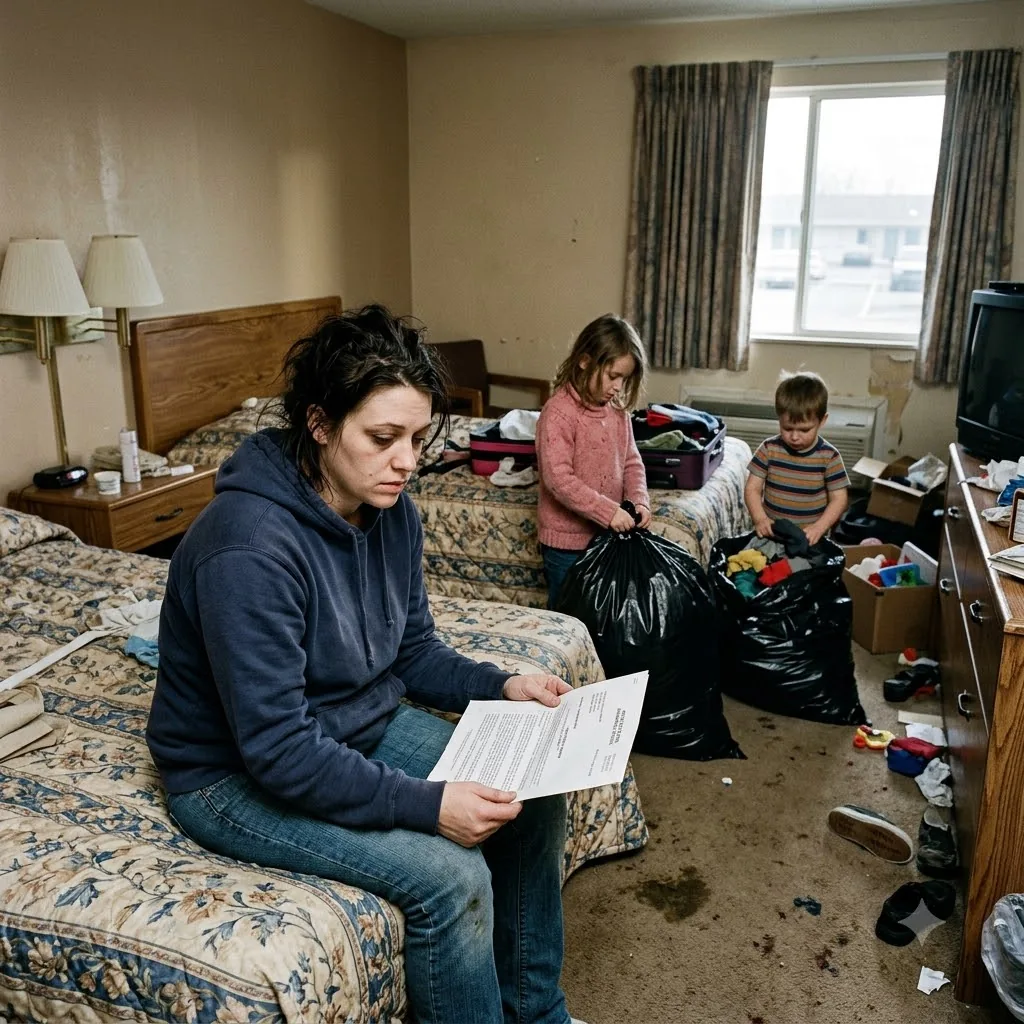
“Coming!” Sarah called out, her voice cracking as she shoved the Gulf Coast Mutual denial letter into her purse. She wiped her palms on her jeans and turned to the beds. “Leo, Maya, time to go. Tablets off.”
The motel manager didn’t wait. The door handle rattled, followed by the electronic beep of the master keycard. Sarah lunged and grabbed the handle from the inside just as the door cracked open, holding it against the pressure of the man standing in the walkway.
“We’re leaving,” she said through the two-inch gap, staring at a silver nametag pinned to a sweat-stained blue polo.
“Check-out was eleven,” the man said, his voice devoid of any sympathy. “FEMA system locked your folio. If you’re in the room at eleven-oh-five, I have to charge the card on file for another night.”
She didn’t have enough on her debit card to cover a night. If he ran it, it would bounce, or overdraw and bury her in fees. “We are walking out right now.”
She threw the door open, grabbed the garbage bags stuffed with clothes, and herded the children out into the suffocating, humid air. The oppressive heat of the parking lot instantly clung to her skin. The Corolla sat baking on the asphalt, the rear bumper held on by a strip of duct tape, a casualty of a flying branch during the evacuation.
Getting the kids buckled in felt like moving through wet concrete. The car’s interior was an oven. When she turned the key, the engine wheezed twice before catching, the air conditioner blowing hot, dusty air for the first five miles of their drive.
Sarah navigated away from the interstate, keeping to the secondary highways just as Arthur had demanded. The roads were a graveyard of shattered pine trees, twisted metal siding, and downed power lines pushed haphazardly to the shoulders. Without the distraction of the tablet, which had died ten minutes into the drive, Maya began to whine about being thirsty.
“I know, baby,” Sarah murmured, her eyes darting between the road and the fuel gauge. The needle hovered precariously near the quarter-tank mark.
Arthur’s warning echoed in her head: *Bring iodine.*
It was absurd. It was madness. But Arthur’s paranoia operated on a strict, unyielding logic. If she arrived empty-handed, showing non-compliance, he might refuse to open the door. He had done worse for less. She couldn’t risk it, not with twenty dollars of gas left and nowhere else to sleep.
Spotting a weathered, independent pharmacy operating on a screeching gasoline generator, Sarah pulled into the cracked lot. “Stay in the car, lock the doors. I’ll be right back.”
Inside, the air was stifling, the shelves heavily picked over. She found a small, brown glass bottle of liquid iodine in the first-aid aisle. She grabbed two bottles of water and a pack of generic cheese crackers. At the register, the total came to twenty-six dollars and fifty cents. Water and iodine were apparently being priced at a premium.
Sarah handed over her debit card, her stomach twisting into a tight knot. The transaction went through, leaving her with twenty-five dollars and sixty-four cents to her name. She had traded half her remaining lifeline to appease a delusion.
Back in the car, she tossed the snacks and water to the back seat, ignoring the guilt that flared when Leo eagerly tore into the crackers. They were eating junk food because she had to buy a chemical her father thought would protect them from imaginary drones.
It took another forty minutes to reach Arthur’s property, located at the end of a long, rutted dirt road outside the city limits. The neighborhood was sparsely populated on a good day, but post-storm, it felt entirely abandoned. When Arthur’s house came into view, Sarah’s foot instinctively eased off the accelerator.
The structure was deeply unsettling. Every window on the single-story brick house was obscured by a grid of heavy-duty aluminum foil and duct tape. Two new security cameras were mounted to the eaves, their lenses angled upward, scanning the empty, cloudless sky. A massive, jury-rigged HAM radio antenna dominated the roof.
Sarah parked near the front walk. “Okay, guys,” she said, trying to keep her voice light and steady. “We’re at Grandpa Arthur’s. Remember the rules. We use our quiet voices, and we don’t touch his equipment.”
“Why are the windows shiny?” Leo asked, peering out the car window.
“To keep the sun out,” Sarah lied, unbuckling her seatbelt. “Let’s go.”
They carried their garbage bags up the cracked concrete path. Before Sarah could even raise her fist to knock, the heavy wooden door swung open.
Arthur stood in the threshold, framed by the dark interior. He had aged ten years in the six she hadn’t seen him. His gray hair was unkempt, his face gaunt, and his eyes burned with a frantic, sleepless energy. He wore a heavy canvas fishing vest, completely inappropriate for the ninety-degree heat.
“Did anyone follow you?” he demanded, looking past her shoulder, tracking the empty tree line.
“No, Dad,” Sarah said. “Can we come in? The kids are overheating.”
Arthur’s gaze snapped to the children. For a fleeting second, something like recognition softened his features, but it was quickly swallowed by the panic. “The iodine. Did you get it?”
Sarah reached into her purse, pulled out the brown glass bottle, and held it up.
Arthur grabbed her wrist, yanked her and the children inside, and slammed the heavy door shut. The interior was pitch black, lit only by the eerie glow of several computer monitors in the living room and small camping lanterns scattered on the floor. The air was stale and smelled sharply of ozone and old coffee.
Before Sarah could set her bags down, a terrifying, metallic cacophony echoed through the small entryway. Arthur was throwing locks. First the standard deadbolt. Then a heavy slide latch. Then a massive, industrial padlock on a steel bracket that had been newly bolted into the doorframe.
“Dad, what are you doing?” Sarah asked, her pulse spiking as the padlock snapped shut.
“Sealing the perimeter,” Arthur muttered, pocketing the heavy brass key. He turned to her, his hand outstretched. “Phone.”
Sarah gripped her purse. “What?”
“Your phone, Sarah,” he said, his voice dropping to a harsh, commanding bark. “The baseband processors in civilian devices can’t be turned off, even in airplane mode. They are pulsing the grid looking for unassigned MAC addresses. If you brought it in here, it’s actively pinging our coordinates to the fleet.”
“I need my phone,” Sarah said, stepping back, putting herself between Arthur and the kids. “It’s my only way to check on my FEMA claim. It has the banking app.”
“There is no FEMA!” Arthur shouted, his voice echoing off the taped-up windows, making Maya whimper and press her face into Sarah’s leg. Arthur pointed a trembling finger at Sarah’s purse. “It goes in the Faraday cage, or you go back out there. Right now. Hand it over.”
Sarah looked at the locked door, the heavy steel bracket, and then down at her terrified children. The keys to the Corolla were in her pocket, but the car was useless if they were locked inside a bunker without a key to the door. Her hand shook as she reached into her purse.