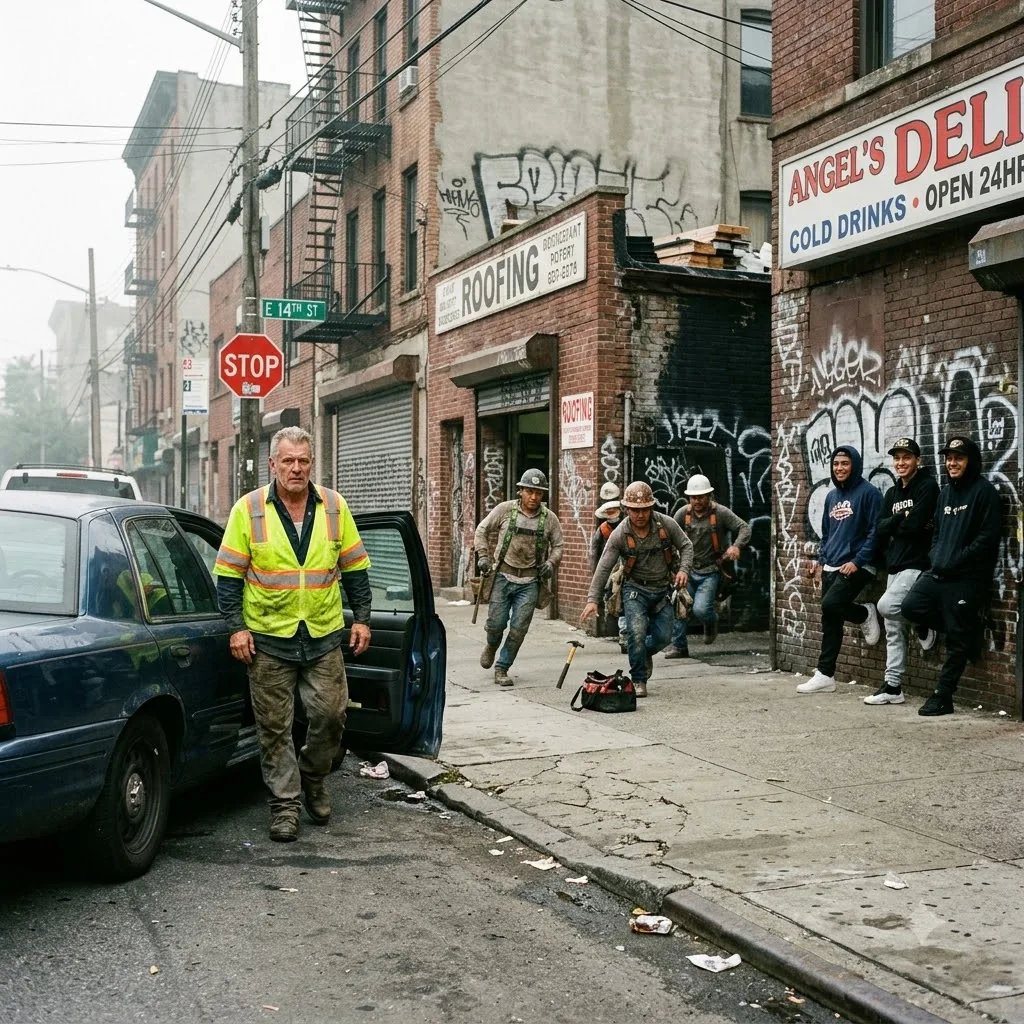
Story code: ST-000590
Part 2: The Yellow Sheet
Hector stared at the yellow triplicate forms in Tito’s hand. He recognized the heavy, fibrous texture of that specific paper. He knew the faint, chemical smell of the carbon backing. They were standard Department of Neighborhood Services intake sheets. They were the exact same blank pages currently clamped under the heavy metal clip of his own board.
“Where did you get those?” Hector kept his voice low, strictly regulating his breathing. A violence interrupter never yelled. A violence interrupter never showed a spike in adrenaline.
Tito just tapped the stack against his palm, a slow, rhythmic smack. “City hall leaves a lot of trash in the recycling bins, Hector. Whole boxes of it out by the loading docks. You guys waste so much paper trying to save the world.”
Hector shifted his weight, keeping the three lieutenants in his peripheral vision. One was picking dirt out from under his nails with the corner of a boxcutter. Another had his hands deep in his hoodie pockets, slouching against the brick wall of the hardware store. They were not moving to attack. They were just building a human fence, sealing off the pavement.
“You’re shaking down day laborers,” Hector said, his eyes tracking the yellow sheets. “That’s bottom-feeder work, Tito. Even for you. What are you charging them? A corner tax?”
“I ain’t charging them a tax,” Tito smiled, displaying a dull gold-capped incisor. “I’m collecting processing fees. Official city business.” Tito pointed the rolled-up forms directly at Hector’s neon vest. “Just like you.”
In the alley behind Tito, the young worker let out a sharp, ragged breath. Hector looked past Tito’s shoulder. The kid was practically vibrating against the rusted metal of the dumpster, his work-stained hands pressed flat against the brick. Hector recognized the boy’s cement-scuffed boots. He remembered the kid’s name was Arturo. He had only been coming to this specific shape-up corner for three weeks.
Hector took a half-step sideways, trying to open a clear line of sight to the boy. “Arturo,” Hector called out in Spanish, keeping his tone perfectly level, dropping into the exact cadence he used to talk down shooters and jumpers. “It’s just Hector. You know me. I walked your uncle past the precinct lines last month. You’re safe.”
Arturo did not relax. Instead, the boy squeezed his eyes shut and violently shook his head. “Don’t write me,” Arturo whispered in Spanish, his voice cracking with pure, unadulterated panic. “Please. I have the money. I’ll pay him. Don’t put my name on the yellow paper.”
Hector felt a cold weight drop into his stomach. He looked down at his own aluminum clipboard. The blank yellow intake form stared back at him. *Client Name. Address. Known Affiliations. Immediate Relatives.* For three years, he had used these precise forms to get these undocumented men food vouchers, legal aid, and emergency medical services.
He looked back at Tito. The gang enforcer’s smile had widened into a genuine, delighted grin.
“What did you tell them?” Hector demanded. The strict training protocols of de-escalation were beginning to fray at the edges of his mind.
“I didn’t tell them nothing but the truth,” Tito said, taking a step closer. He casually invaded Hector’s personal space, carrying the heavy scent of cheap cologne and stale marijuana. “I told them the city is finally cleaning up the streets. I told them the Mayor’s office is making a new registry. Anyone whose name goes on the yellow paper gets flagged for the federal detention center upstate. No judge. No phone call. Just a bus ride in the dark.”
“That’s a lie,” Hector said flatly. “The Safe Streets initiative doesn’t report to federal enforcement. It’s a total firewall. We don’t share data with ICE.”
“You know that,” Tito sneered. “I know that. But Mateo and the roofing crew? They don’t know that. They just know the city sent men in bright green vests to collect names. And they know that last week, two guys from the framing crew got picked up by federal agents right off their front porches.”
Hector gripped his clipboard tighter. He remembered the neighborhood rumors about the framing crew. It had been a targeted raid, totally unconnected to his department. But Tito had ruthlessly spun the coincidence into a weapon.
“So I offered them a service,” Tito continued, unfolding the top yellow sheet. He held it up in the morning light. It was not blank. It was filled with dozens of handwritten names. Next to some of the names were green checkmarks. Next to others, heavy black lines were struck through the letters. “I told them I got a guy inside the records room. I told them for fifty bucks a week, I can make sure their intake forms mysteriously get lost. An administrative error. But if they don’t pay…” Tito trailed off, his eyes flicking toward Arturo in the alley.
Hector realized the horrifying perfection of the trap. Tito had not just extorted them; he had framed Hector as the executioner. Every time Hector walked down the block in his official uniform, checking on the workers, holding his clipboard, he was unknowingly proving Tito’s lie. Hector’s simple, friendly check-ins looked exactly like a government agent taking roll call for mass deportations.
“You made them terrified of the only people actually trying to keep them alive,” Hector said, his voice dropping to a low, tight rasp.
“I provided a visual aid,” Tito corrected him, stepping aside to leave a completely clear path to the trembling kid in the alley. “And you timed it perfectly today, Hector. Arturo here is short on his processing fee. He owes me eighty dollars.”
Tito reached into his pocket and pulled out a cheap plastic ballpoint pen. He clicked it once and held it out toward Hector’s chest.
“So go ahead, city man,” Tito said, his voice dripping with venom. “Do your job. Walk over there, ask him his name, and write him down on your little yellow sheet. Show him what happens when he doesn’t pay his taxes.”
Hector stared at the plastic pen. If he walked away, Tito would bleed the neighborhood dry, using the city’s own reputation to do it. If he stepped toward Arturo to explain the truth, the terrified kid would likely bolt, risking a fatal fall over the rusted razor wire behind the hardware store to escape the neon vest.
Before Hector could calculate a safe angle of approach, the lieutenant with the boxcutter let out a sharp, low whistle. A black SUV with heavily tinted windows was rolling slowly down the avenue, its heavy tires aggressively crunching over the workers’ abandoned tool bags, heading straight for the mouth of the alleyway.
“Looks like the collection agency is here,” Tito said, folding his yellow papers back into a neat, sharp square.