Story code: ST-000590
Part 4: Blood and Canvas
Tito’s hand shook violently. He did not hand over the yellow papers. Instead, the total collapse of his street authority curdled into sheer, desperate panic. He let the stolen city forms slip from his fingers, the pages fluttering to the cracked pavement, and frantically yanked a snub-nosed .38 from the waistband of his jeans.
Hector did not flinch. He read the mechanics of Tito’s panic before the gun even cleared the kid’s belt. A professional shooter locks their wrist and squares their stance; a terrified kid just points and squeezes.
The crack of the gunshot was deafening in the narrow alleyway, bouncing harshly off the brick wall of the hardware store.
Hector felt a sudden, white-hot tear across his left bicep. The kinetic force jerked his shoulder back a fraction of an inch, but his heavy steel-toed boots stayed firmly planted in the spilled blue chalk. He did not break eye contact. He did not reach up to cover the wound. He simply stood his ground, letting the hot blood begin to soak into the black cotton of his tight undershirt, turning the fabric a slick, heavy crimson.
Silence crashed back over the block, heavier than before. Flaco’s black SUV roared to life and violently reversed out of the street, its heavy tires screaming as the hired muscle abandoned a clearly sinking ship. Tito’s remaining lieutenants were already gone, sprinting blindly down the avenue to escape the fallout.
Tito stood entirely alone. His arm was still extended, the smoking pistol trembling so hard it looked like it might shake apart in his grip. He stared at the dark blood running down Hector’s arm. Then he looked up into Hector’s flat, unblinking eyes.
“You missed center mass,” Hector said, his voice a low, terrifying rumble.
Tito let out a choked gasp. He dropped the gun. It clattered uselessly against the asphalt. He turned and ran, his pristine white sneakers desperately pounding the pavement until he disappeared around the corner of 14th.
Hector did not chase him. He looked down at the scattered yellow papers. Kneeling, he grunted slightly as the torn muscle in his arm protested, and gathered every single sheet. He ripped the thick stack of triplicate forms in half, then in quarters, tearing the paper until his blood smeared the fake registry. He let the ruined confetti fall into the dirty water of the gutter grate.
A heavy boot scuffed the gravel behind him.
Hector looked up. Arturo stepped out from the deep shadow of the rusted dumpster. The kid was no longer hyperventilating. He looked from the torn paper washing down the drain to the blood dripping from Hector’s fingertips.
Slowly, the rest of the block began to move. Mateo, the oldest worker, climbed carefully back over the chain-link fence. Two more men emerged from the back of a parked work van. They did not run toward the avenue. They did not avert their eyes. They stepped completely out of the shadows and gathered around Hector, their paralyzing fear of the city replaced by a profound, silent awe for the man who had just bled to kill a lie.
Seventy-two hours later, the termination hearing took less than four minutes.
Hector sat in the sterile, fluorescent-lit office of the Department of Neighborhood Services, a thick white gauze bandage wrapped tightly around his bicep. His supervisor, a man who had never stepped foot on Mercer outside of a heavily escorted motorcade, pushed a carbon-copy termination form across the desk.
“You dropped your safety vest,” the supervisor said, his voice tight with bureaucratic disgust. “You engaged a hostile armed subject. You provoked the discharge of a firearm. The de-escalation manual is absolute, Hector. We cannot employ a violence interrupter who incites a gang shootout.”
Hector did not argue. He did not bother explaining that the manual would have left Arturo enslaved to a street gang, or that retreating would have turned the Safe Streets program into an instrument of neighborhood terror. The city only saw the liability of a gunshot wound. They did not see the block.
He signed the paper with his good arm. He unclipped his laminated city ID lanyard and set it gently on top of the termination form. He left the building without a word, leaving his pension and his legitimate career on the desk.
A week later, the morning air was sharp and cold on the corner of 14th and Mercer.
Hector stood by the curb. He was not wearing neon green. He wore a heavy canvas work jacket, the dark collar turned up against the wind. There was no aluminum clipboard in his hand. There was no official seal on his chest.
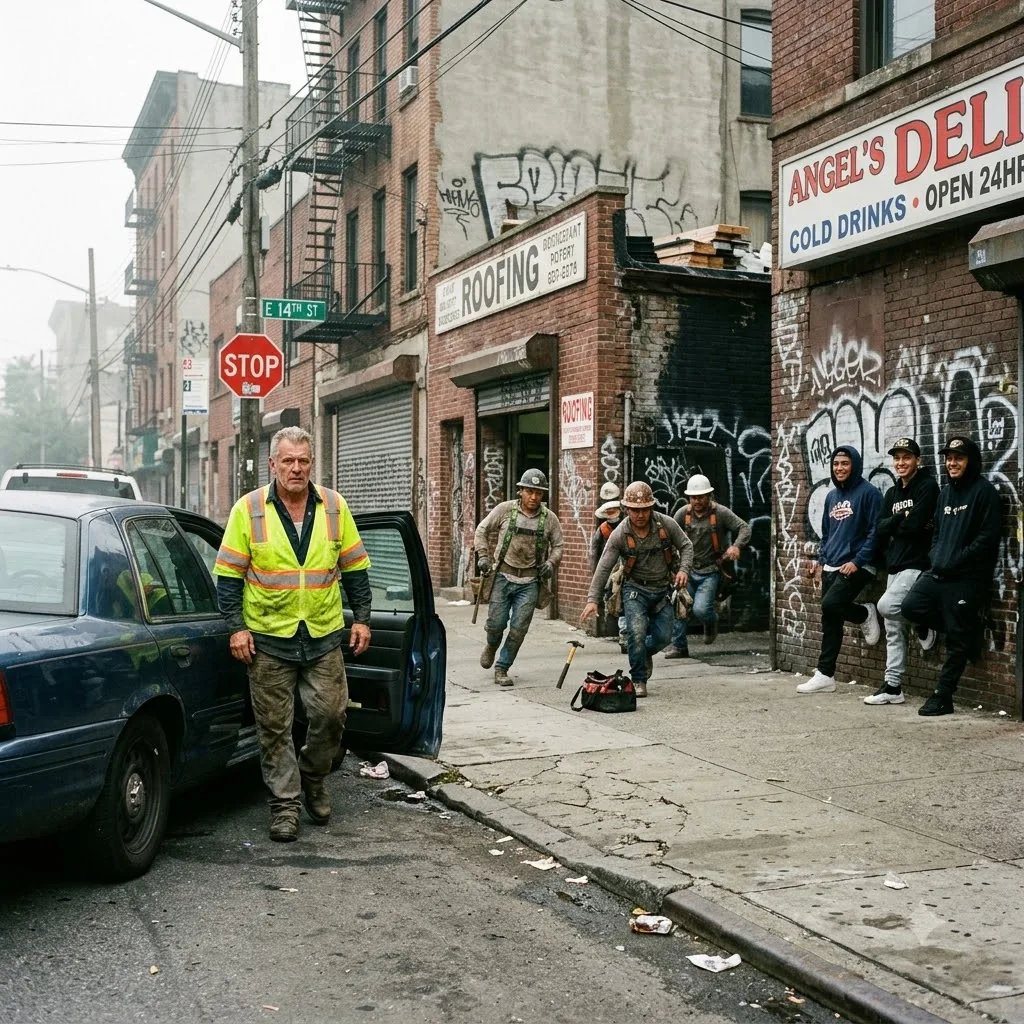
The shape-up crew was already there. Two dozen undocumented laborers stood openly on the sidewalk, drinking coffee from heavy thermoses. There were no lookouts posted. There was no panic when a white pickup truck slowed down to inspect the workers for a drywall job.
Mateo walked over, holding two foam cups of steaming coffee. He offered one to Hector.
“No trouble today?” Hector asked in Spanish, accepting the warm cup.
“No trouble,” Mateo smiled, the deep lines around his eyes crinkling. “Tito hasn’t been seen since Tuesday. Word is, he left the borough entirely.”
Arturo trotted over from the hardware store, a heavy leather tool belt slung confidently over his shoulder. He stopped in front of Hector, giving a brief, highly respectful nod to the dark canvas jacket, his eyes lingering specifically on the left arm where the bandage still bulked under the sleeve.
“You working today, boss?” Arturo asked.
“Just watching the street,” Hector said, taking a sip of the bitter, black coffee.
He had lost the city’s protection, the steady salary, and the badge that proved he was a better man than he used to be. He had traded a secure, legitimate future for a bullet graze and a permanent mark on his record. But as he looked down the avenue, watching the men laugh and negotiate their daily wages in the open daylight, Hector felt the solid ground beneath his boots. The neon vest was gone, but the neighborhood was his again.