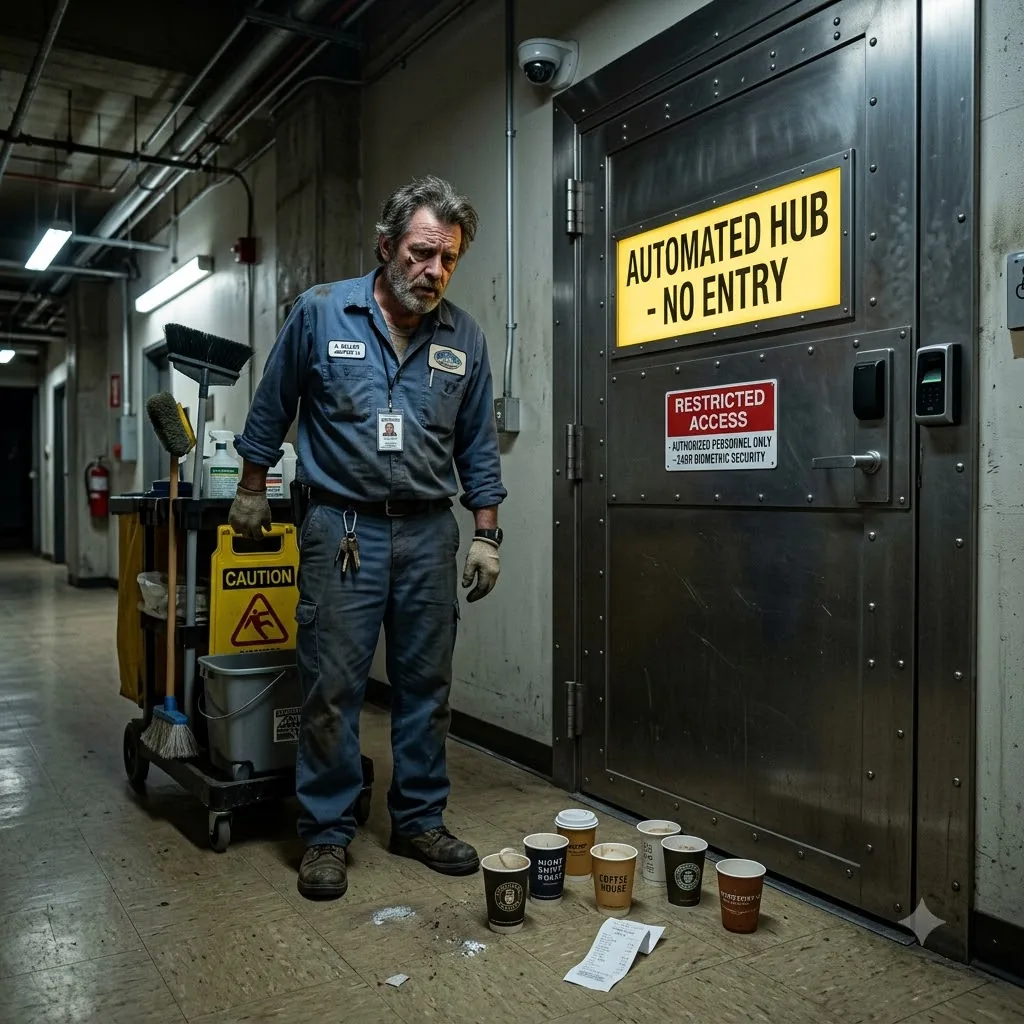
Story code: ST-001454
Part 2: The Mechanical Turk
Arthur didn’t move. The echo of shattering glass faded, swallowed by the relentless, deafening roar of industrial cooling fans. He kept his hand near the heavy brass key ring in his pocket, a poor substitute for a weapon, but the only thing he had. He stepped deeper into Sector 4, the soles of his work boots crunching over discarded zip-ties and sticky patches of dried soda.
This was supposed to be the company’s crown jewel, a sterile, dust-free vacuum chamber where proprietary AI orchestrated thousands of data streams. Instead, the floor was a disaster. The multi-million-dollar automated track-arms, designed to seamlessly hot-swap failing hard drives, were shoved haphazardly to the far walls. Their hydraulic joints were locked in place, coated in a thick layer of static dust. In their place stood a fleet of cheap aluminum stepladders, their rungs scuffed and bent by heavy use.
“Who’s there?” Arthur called out, his voice fighting the drone of the servers.
No answer, just the frantic scuffling of rubber soles against linoleum.
Arthur rounded the corner of Rack 12, stepping into what used to be the main diagnostic corridor. He stopped dead. The narrow aisle between the humming server banks had been transformed into a squalid encampment. Soiled sleeping bags were wedged between the heat exhausts. Cheap folding tables were daisy-chained together down the center of the walkway, groaning under the weight of dozens of laptops, tangled power strips, and towering piles of fast-food wrappers. The overwhelming stench of ammonia and unwashed bodies made Arthur’s eyes water.
At the far end of the aisle, a young man was backed against a blinking mainframe cabinet. He looked barely out of his teens, his pale face slick with terrified sweat. At his feet lay the shattered remains of a glass French press, a dark pool of Rosa’s Panaderia coffee seeping into the floor tiles. The kid’s hands were shaking violently. He wore a cheap headset clamped over one ear, the microphone boom pushed up to his forehead.
“I dropped it,” the kid stammered, staring at Arthur’s blue janitorial uniform, then locking his eyes on the Level 5 management badge still clipped to Arthur’s chest pocket. “I’m sorry. I tripped. Please don’t log a violation. If I get another penalty, they won’t pay out my week.”
Arthur stared at him, trying to process the words. “Pay out your week?”
Before the boy could answer, three more heads poked out from the adjacent aisles. Two young women and an older, hollow-eyed man peered through the gaps in the server racks. They all wore identical cheap headsets. They all looked exhausted, their skin carrying the sickly, pale glow of people who hadn’t seen the sun in days.
“Who are you people?” Arthur asked, keeping his voice low.
“We’re the engine,” the hollow-eyed man said, stepping cautiously out from behind Rack 14. He gestured to the rows of folding tables and laptops. On every screen, complex routing software was running-the exact same load-balancing interfaces Arthur’s team used to manage before the mass layoffs. “We’re the mechanical turk. The AI.”
Arthur stepped up to the nearest folding table. He looked at the active laptop screen. A massive digital dashboard was open, bearing the corporate logo and the words *Proprietary Neural Network – Live Routing*. Below the grand title were hundreds of manual chat windows, script prompts, and server allocation sliders. It wasn’t an AI. It was a digital sweatshop. The company had fired thirty salaried technicians with benefits and replaced them with an army of off-the-books gig workers, locked in a room to manually simulate an artificial intelligence.
“They lock the doors from the outside,” the young kid whispered, wiping a bloody cut on his thumb on his jeans. “Twelve-hour shifts. We slide our food orders under the gap when the delivery guy comes. The recruiter said it was a dark-site data entry job. Three dollars an hour, plus a completion bonus if we hit the metric.”
Arthur felt a sickening knot twist in his stomach. His entire department had been gutted for a lie. He was pushing a floor buffer for minimum wage to keep his wife alive, while the executives were making millions off a fake algorithm powered by desperate kids locked in a basement.
“You need to get out of here,” Arthur said, turning back to the kid. “If a fire breaks out in here, the suppression system sucks all the oxygen out of the room. It’s designed to save machines, not people. You have no override.”
“We can’t leave,” the hollow-eyed man said, stepping closer, a heavy steel server rail gripped tightly in his right hand. “If we walk out before the end of the quarter, the NDA kicks in. They seize our pay. All of it. We agreed to the terms.”
Arthur backed up half a step, eyeing the steel rail in the man’s hand. The other workers were beginning to slowly emerge from the shadows of the aisles, forming a tight ring around Arthur. There were at least fifteen of them.
“Look, I’m just the night cleaner,” Arthur said, holding up his empty hands. “I’m not corporate. This badge is old. I don’t care what you do.”
“But you opened the door,” a voice said from the back of the crowd.
Suddenly, the overhead fluorescent lights snapped off, plunging the room back into the flat, bloody glow of the server LEDs. The dull roar of the cooling fans pitched up into a screaming whine. A digitized voice echoed from the ceiling speakers, perfectly calm and artificially smooth.
*”Warning. Unauthorized atmospheric breach detected in Sector 4. Manual override card compromised. Initiating total thermal lockdown.”*
The heavy steel security door at the end of the hall slammed shut with a deafening metallic boom. The hiss of the vacuum seal engaging echoed through the dark room. Arthur spun around, rushing toward the entrance, but the biometric panel was completely dead. He slammed his palm against the glass scanner. Nothing.
The air conditioning vents above them snapped shut. The temperature in the room instantly began to rise.
*”Oxygen suppression protocols armed,”* the automated voice chirped happily. *”Have a productive shift.”*
Arthur turned slowly back to the aisle. The fifteen workers were staring at him, their faces illuminated by the red server lights. The hollow-eyed man raised the steel rail, stepping over the shattered glass of the coffee pot.