Story code: ST-000732
Part 3: The Green Button
Smoke burns Donna’s eyes. She drops to her knees, frantically swiping at the burning stack of papers wedged in the ticket slot. The heavy government bond paper doesn’t burn quickly; it smolders, generating thick, greasy plumes of grey smoke that the negative pressure HVAC system greedily sucks into the confined booth.
She grabs her half-empty plastic water bottle from the desk, twisting the cap off with trembling, sweaty fingers. She splashes the lukewarm water directly onto the burning wedge of denied claims. The fire hisses violently, dying instantly into a wet, blackened mass, but the damage to the air quality is already done. The small security pod has become a fishbowl of trapped, bitter smoke. Every breath scrapes against the back of her throat like sandpaper.
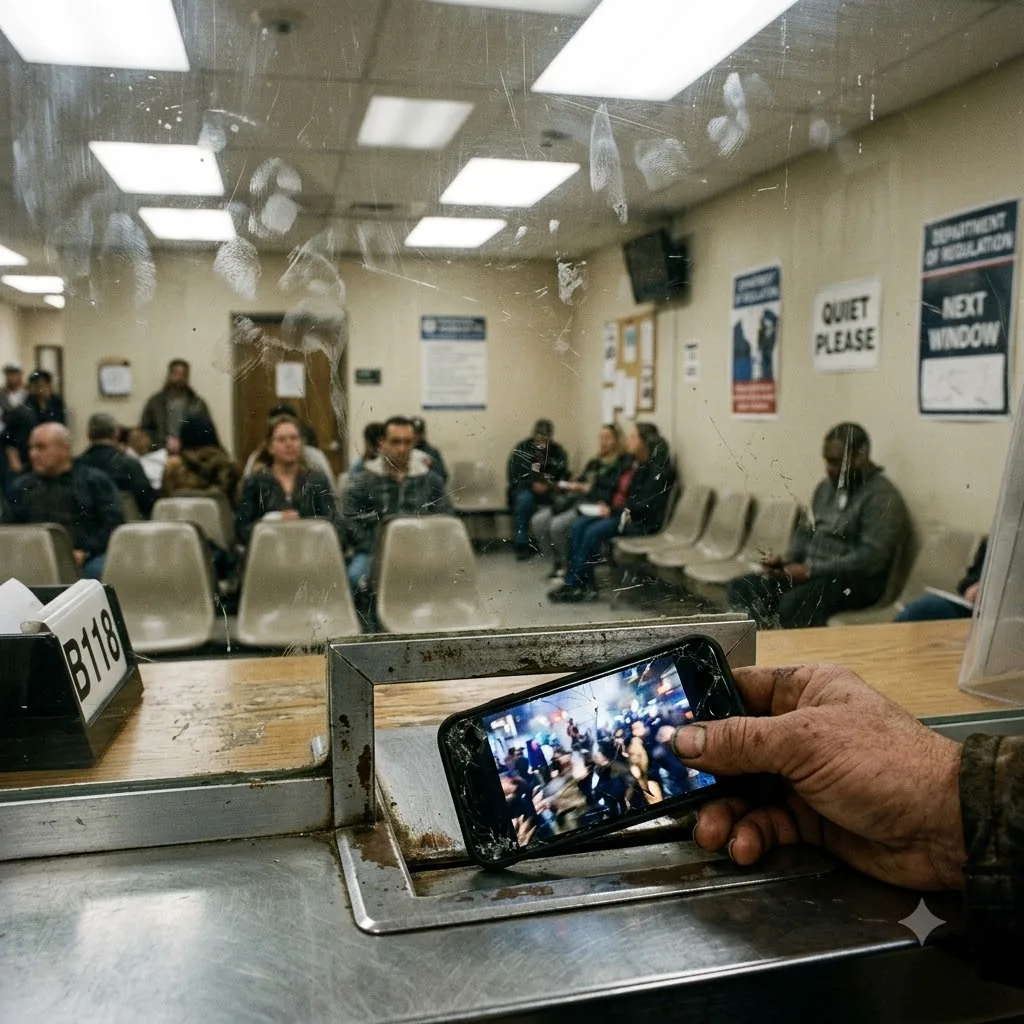
Through the water-stained, smoke-smudged plexiglass, the veteran remains perfectly still. The strobe lights from the fire alarm flash rhythmically across his shadowed face, casting erratic, harsh shadows over his features. Down the east corridor, the muffled, heavy thudding of Federal Protective Services guards slamming their fists and equipment against the magnetic-sealed fire doors reverberates through the floorboards. They are locked out. She is locked in.
“You’re insane,” Donna rasps, pressing her face close to the tiny speaker vent on her side of the partition. Her eyes stream with tears. “They’re going to put you in federal prison for this! I didn’t do anything to you!”
The man leans closer to the glass. When he speaks, his voice is not the unhinged, violent roar from the cellphone video. It is unsettlingly calm, low and resonant, carrying effortlessly through the narrow gaps in the partition.
“You didn’t do anything,” he repeats. It isn’t an agreement. It’s an indictment.
“I’m a clerk!” Donna yells, coughing a wet, rattling cough into her elbow. “I process intake forms! I’m not a doctor. I’m not a cop! What did you want me to do? You were tearing up the lobby! Look at the video you made me watch!” She points a shaking finger at the cracked smartphone still resting on her keyboard, its screen dark now, the loop finally ended. “There were fifty people out there! Fifty people watching you! Go lock them in a room!”
“They were strangers,” the veteran says, his gaze never leaving her watering eyes. “Kids waiting for their grandfathers. Delivery drivers. Teenagers holding up their phones for TikTok. They didn’t know me. They saw a crazy guy in a coat kicking chairs.”
He reaches out and taps a single, calloused finger against the thick plexiglass, pointing directly at the glowing, dual monitors of Donna’s workstation.
“But you weren’t a stranger, Donna.”
Donna freezes, her breath hitching despite the smoke. She stares at the tip of his finger pressed against the glass, then follows the trajectory of his point to her primary monitor. The screen is locked now, requiring her badge, but the standard intake dashboard layout is permanently etched into her brain.
“When I walked up to your window that Tuesday,” he says, his voice cutting clearly through the mechanical wail of the fire alarms. “Before the noise got too loud. Before the fluorescent lights started vibrating in my skull. I handed you my VA identification card.”
Donna swallows hard. The smoke burns, but the memory burns worse. A man in a heavy coat. A plastic ID card slid through the slot.
“You scanned it,” he continues relentlessly. “You pulled up my file. You saw my name. Elias Thorne. You saw the big red banner across the top of my digital chart. The one that flags a severe traumatic brain injury. The one that details combat-induced auditory triggers and severe panic responses.”
“I… process hundreds of cards a day,” Donna stammers, her voice sounding small, paper-thin against the overwhelming blare of the sirens. She wipes a streak of soot and tears from her cheek. “I don’t memorize them.”
“You didn’t have to memorize it,” Elias says. “It was on your screen the entire time I was on the floor.”
He shifts his point from her monitor, aiming his finger slightly lower, toward the underside of her desk.
“The strangers in the lobby didn’t know what was happening to me,” Elias says softly, the calm devastation in his voice somehow louder than the sirens. “They thought I was high. They thought I was a threat. But you had my medical history glowing right in your face. You knew exactly what was happening.”
Donna looks down at her hands, trembling over her keyboard.
“You have two buttons under that desk,” Elias states. “The red one calls Federal Protective Services for an active threat. The green one calls the rapid response psychiatric medical team for a veteran in distress. The team with the sedatives. The team trained to handle a flashback.”
The truth drops into the smoke-filled air like an anvil. Donna’s eyes dart involuntarily toward the underside of her desk, where the two distinct, colored buttons sit side-by-side in their recessed plastic housing. She had pressed the red one today.
“You didn’t press the green button,” Elias says. “You had my diagnosis. You had the button to get me medical help. You knew it wasn’t a crime, but a symptom. And instead of reaching down, you picked up your coffee. You watched me break, knowing exactly why I was breaking, and you let the teenagers film me like an animal.”
Donna opens her mouth to speak, to offer some bureaucratic shield, some policy or protocol that makes her inaction acceptable. But there is nothing. The defense crumbles entirely. The stark reality of what she chose to do-or chose not to do-echoes in the tiny, enclosed space. The heavy steel fire doors down the hall shudder under the renewed pounding of the trapped security team, but inside the booth, Donna has nowhere left to hide.