Story code: ST-001190
Part 1: The Uncropped Log
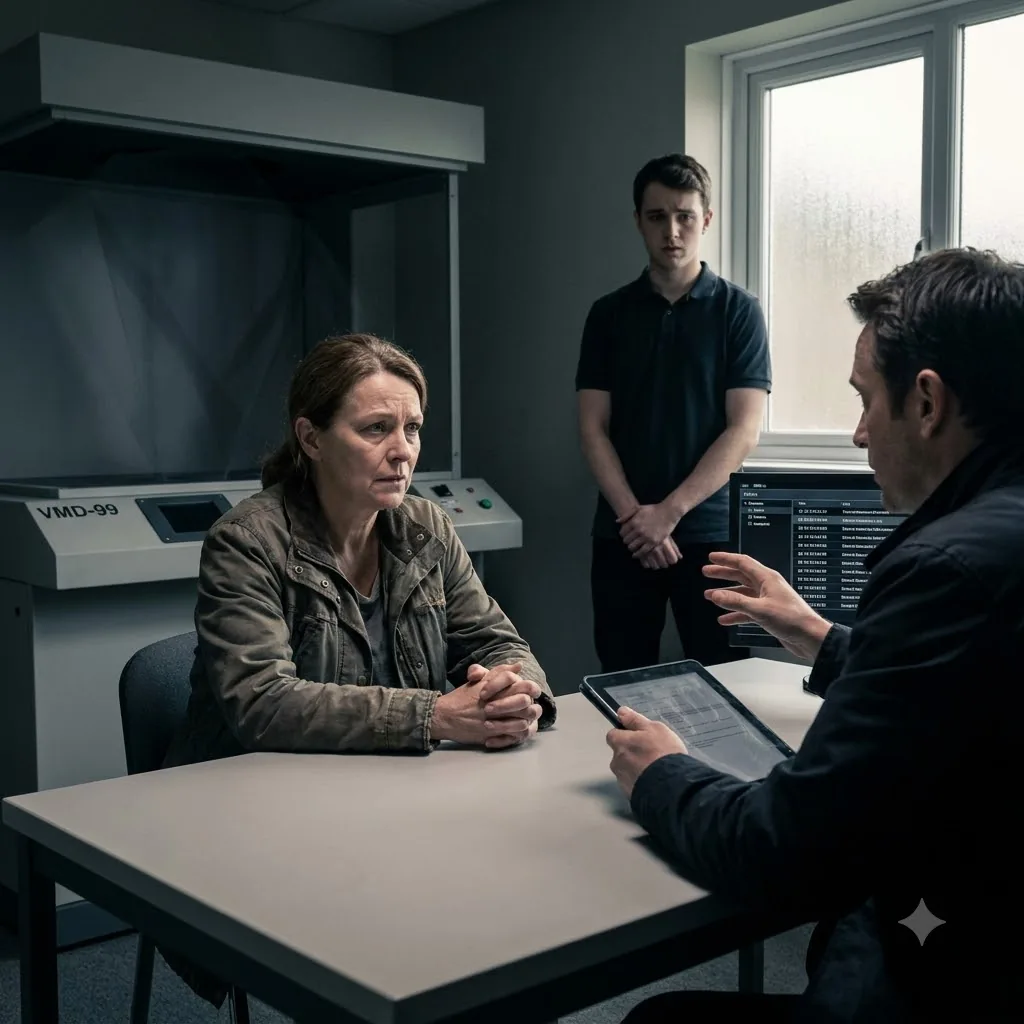
The system logs at the Eternal Memories Showroom document a severe breach: operator Greg Finch livestreamed client Sarah Mercer’s private session with her late husband’s Voice Model Drive (VMD-99) directly to a public group chat. In the soft light of the carpeted showroom, Mercer stood clutching her coat collar, unaware that her intimate dialogue was being broadcasted as live entertainment. The recovered data packets show a screen-share stream initiating the exact second the matte-black drive’s blue indicator ring began to glow.
Marcus Vance, the compliance auditor, stood in the center of the showroom with hands clasped behind his back. He cross-referenced the timestamps on his digital tablet, his voice flat. “The transmission began at 14:02:11,” Vance said, looking from the tablet to the primary terminal. “The client was still seated in the demonstration chair, and the system log shows the stream was established before she even began speaking.”
Finch stood near the terminal, fidgeting with the connection cables behind the primary terminal. “It was a standard system check,” Finch said, using a rehearsed, cheerful customer-service phrase. “We always run diagnostics to ensure high-fidelity vocal projection. The system must have automated a backup sync to the cloud. I was simply monitoring the signal quality from my console.” He tapped his phone screen repeatedly, his eyes shifting away from Vance to the blinking lights of the projector.
The reconstructed video logs showed a different sequence. On the recorded screen-share feed, Mercer’s face was visible in the corner of the operator’s interface. Her hands trembled as the synthesized voice of her husband began to speak from the console speakers. She looked down at the status lights, avoiding direct eye contact with Finch, who was positioned behind the glass partition. The console records showed that the voice model drive was operating at full capacity, translating her whispered prompts into synthesized audio responses.
Vance zoomed in on the reconstructed screen-share logs. The stream had not merely broadcasted the audio; it displayed the entire operator desktop, including a chat window with active user comments from external accounts.
“The feed was sent to an address labeled TechGroup-East,” Vance observed. He did not look at Finch, keeping his focus on the code lines. “Thirty-two active participants watched the voice model initialize. The log shows they were commenting on the voice modulation in real time.”
“That is a default developer channel,” Finch said, his voice rising slightly as he shifted his weight. “The backup software automatically pings the channel for error logs when the drive is loaded. It’s an automated feature of the software license.”
Vance did not look up from his tablet. He pulled up the cropped screenshot that Finch had submitted in his initial incident report. That crop showed only the error dialogue box, isolating it from the rest of the active desktop. However, the investigator had now retrieved the raw, uncropped server logs from the terminal’s physical drive. The uncropped data changed the nature of the accusation entirely, showing that this was no simple automated error.
The system logs at the Eternal Memories Showroom document a severe breach: operator Greg Finch livestreamed client Sarah Mercer’s private session with her late husband’s Voice Model Drive (VMD-99) directly to a public group chat. In the soft light of the carpeted showroom, Mercer stood clutching her coat collar, unaware that her intimate dialogue was being broadcasted as live entertainment. The recovered data packets show a screen-share stream initiating the exact second the matte-black drive’s blue indicator ring began to glow.
Marcus Vance, the compliance auditor, stood in the center of the showroom with hands clasped behind his back. He cross-referenced the timestamps on his digital tablet, his voice flat. “The transmission began at 14:02:11,” Vance said, looking from the tablet to the primary terminal. “The client was still seated in the demonstration chair, and the system log shows the stream was established before she even began speaking.”
Finch stood near the terminal, fidgeting with the connection cables behind the primary terminal. “It was a standard system check,” Finch said, using a rehearsed, cheerful customer-service phrase. “We always run diagnostics to ensure high-fidelity vocal projection. The system must have automated a backup sync to the cloud. I was simply monitoring the signal quality from my console.” He tapped his phone screen repeatedly, his eyes shifting away from Vance to the blinking lights of the projector.
The reconstructed video logs showed a different sequence. On the recorded screen-share feed, Mercer’s face was visible in the corner of the operator’s interface. Her hands trembled as the synthesized voice of her husband began to speak from the console speakers. She looked down at the status lights, avoiding direct eye contact with Finch, who was positioned behind the glass partition. The console records showed that the voice model drive was operating at full capacity, translating her whispered prompts into synthesized audio responses.
Vance zoomed in on the reconstructed screen-share logs. The stream had not merely broadcasted the audio; it displayed the entire operator desktop, including a chat window with active user comments from external accounts.
“The feed was sent to an address labeled TechGroup-East,” Vance observed. He did not look at Finch, keeping his focus on the code lines. “Thirty-two active participants watched the voice model initialize. The log shows they were commenting on the voice modulation in real time.”
“That is a default developer channel,” Finch said, his voice rising slightly as he shifted his weight. “The backup software automatically pings the channel for error logs when the drive is loaded. It’s an automated feature of the software license.”
Vance did not look up from his tablet. He pulled up the cropped screenshot that Finch had submitted in his initial incident report. That crop showed only the error dialogue box, isolating it from the rest of the active desktop. However, the investigator had now retrieved the raw, uncropped server logs from the terminal’s physical drive. The uncropped data changed the nature of the accusation entirely, showing that this was no simple automated error.