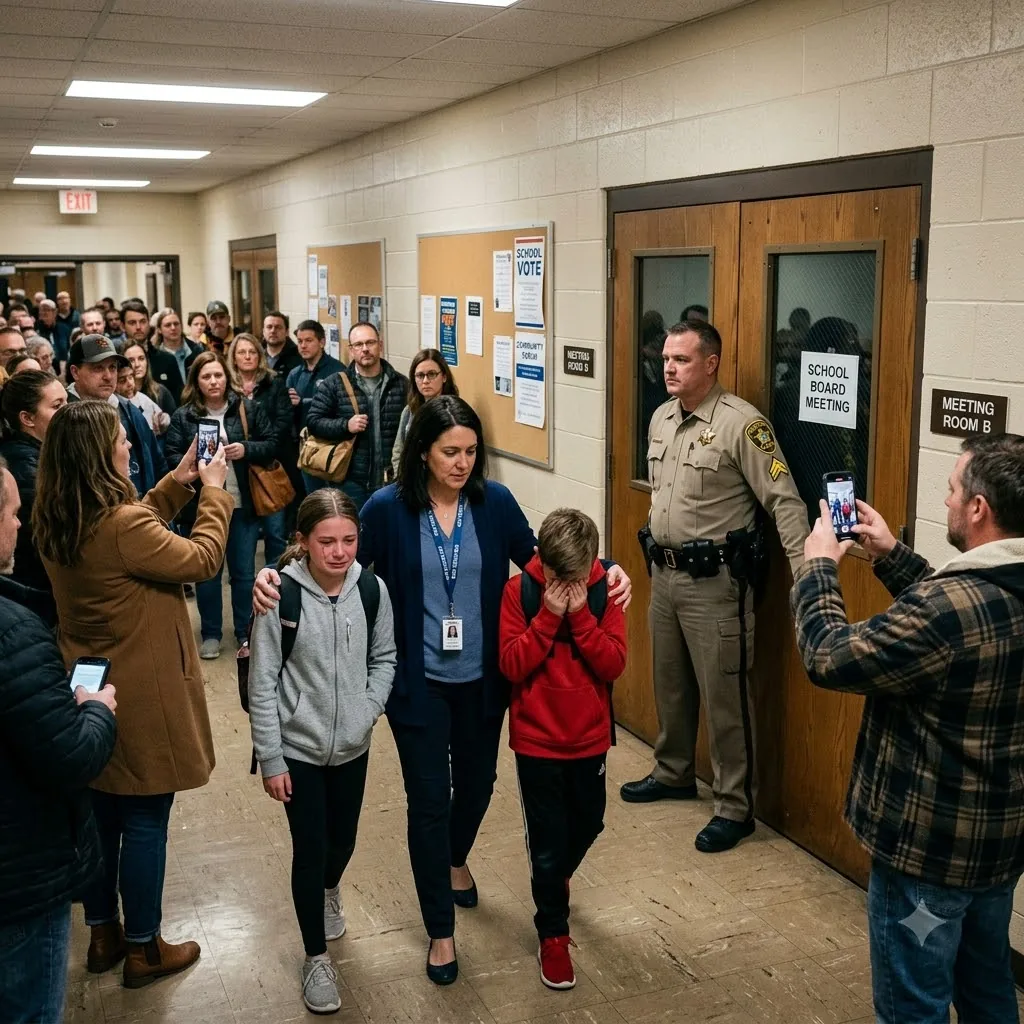
Story code: ST-001584
Part 3: What Eli Said at Home
Mr. Larkin’s head moved once.
Not enough for anyone across the room to notice. Just a small, tight shake meant for Elena alone, as if he could still manage a private warning inside a public collapse.
Then an officer bent, scooped the paper from under the chair, and folded it against his palm.
“Evidence,” somebody in the hallway said immediately, though nobody had asked.
The board room broke into motion again. Parents began talking over one another, each voice trying to become the official version before the next one landed. Elena saw Wade turn toward the officer with the paper and lurch half a step, and both officers tightened on him at once.
“Easy,” the deputy snapped.
“Don’t you touch that like it belongs to you,” Wade said.
His voice was hoarse now, scraped down to something that barely carried, but Elena heard it because she was already moving.
She did not think about permission. She slipped past the first row of folding chairs while people were still arguing about whether anyone should leave, ducked around a woman clutching her purse to her chest, and stopped just inside the room.
“Ma’am,” one officer said sharply.
Elena kept her eyes on the folded sheet in his hand. “I’m school staff. Those students were in the hall.” It was not exactly an answer, but it bought her one second. “That paper has a student’s name on it.”
The superintendent turned toward her with the stunned, exhausted look of a person furious to find one more problem still standing. “Ms. Ruiz, this is not the time.”
“No,” Wade said, breathing hard. “This is exactly the time.”
His gaze caught hers. Up close he looked older than he had ten minutes ago. Sweat stood at his temples. His shirt collar had twisted under the deputy’s grip. Elena had seen parents angry, grieving, humiliated, all the school-adjacent forms of adult unraveling. This was different. There was fury in it, yes, but underneath it something less stable and more frightened, as if the anger had been built to hold back a flood and had finally failed.
Mr. Larkin was still near the back wall. He had not come forward to claim innocence, had not walked out, had not crossed to the board table for protection. He just stood there with one hand on the folding chair, eyes fixed now on Elena in a way that made the fine hairs along her arms rise.
“What page is that?” Elena asked.
The officer holding it glanced at the superintendent instead of answering.
Wade gave a rough laugh that broke in the middle. “Read the header. Go on. Read it out loud if everybody likes microphones so much.”
“Mr. Mercer,” the board president said, “you are making reckless allegations in a public meeting.”
“Then say they’re reckless because they’re false,” Wade shot back. “Not because they’re public.”
No one did.
That silence changed the room more than the shouting had.
Elena looked from face to face: superintendent, board president, deputy, Larkin. Not one of them touched the actual accusation. Procedure. Disruption. Personnel matter. Public setting. Everything except no.
The folded paper made a dry sound in the officer’s hand as his grip shifted.
Elena heard herself ask, “Who is Eli?”
The name had come from nowhere she could point to at first. Then memory caught up. A spring afternoon outside the nurse’s office: Jonah Mercer sitting with his knees apart and his shoulders folded in, another boy beside him, thinner, dark hair falling into his face. Jonah saying, low and urgent, You can’t make me go back there with him tonight, and the other boy-Eli, maybe-watching the floor like the tiles had opened under him.
Wade’s head snapped toward her. So did Larkin’s.
That was answer enough to keep going.
“I heard Jonah say it,” Elena said, more to herself than anyone. “Near the nurse’s office. He wasn’t alone. Eli was with him.”
Larkin straightened so suddenly the chair legs screeched against the floor. “This is getting distorted,” he said. “These are minors.”
“Then stop hiding behind that and say what happened,” Elena said.
The room stilled around her. She was aware, dimly, that she had just spoken to a colleague in a voice she had never used at school and might never be able to take back. But Larkin had color in his face now where before there had been only shock. Not wounded color. Alarmed color.
Wade was staring at her like a drowning man who had just seen something float within reach.
“He came to you,” Wade said to Larkin, each word forced out separately. “My son came to you because you told kids your room was safe.”
“Jonah was upset,” Larkin said. “I followed reporting guidelines.”
“Reporting what?” Elena asked.
Larkin looked at her with open dislike now, as if she had crossed into a territory reserved for administrators and men who believed themselves in charge of damage. “A conflict at home.”
Wade made a strangled sound. “Conflict.”
The deputy shifted his hold, uneasy now in a way that had nothing to do with physical control. “Mr. Mercer-”
“No, let him answer.” Wade’s chest was rising too fast. “Say the whole thing. Say why my son asked for help.”
Larkin’s eyes flicked to the superintendent again. “This should never have been discussed here.”
Elena took one step closer before anyone could stop her. “Was Eli there when Jonah talked to you?”
Larkin hesitated.
Wade closed his eyes for one brief second, and when he opened them there was something rawer than rage in his face. Fear, Elena realized. Not the broad, political fear he had come in wearing like armor, not the talk-radio certainty and school-board slogans from flyers and meetings. This was smaller and uglier and real. A father’s fear stripped of all its speeches.
“He told me Eli made him say it was about me,” Wade said.
The words fell badly into the room. Several people shifted at once. The board president began, “I don’t think-”
“No, you don’t,” Wade said without looking at her. His eyes stayed on Larkin. “You all liked that story because it made me the only problem in the room. My son comes in scared, Eli’s right there, and suddenly it’s my house, my temper, my night at home. Fine. I know what I sound like. I know what I look like. But say the rest. Say what happened after.”
Elena’s heartbeat thudded in her ears. She remembered Jonah at pickup in the rain, not looking at his father. She remembered Wade’s heavy hand on the backpack. She remembered hearing, later, that there had been yelling at the Mercer house that night, neighbors noticing, nobody calling it in because yelling was not yet proof of anything. Until now, she had let all those details line up the easy way.
Larkin wet his lips. “Eli reported being afraid to go home,” he said carefully.
Wade flinched like he had been struck, but Elena saw at once that Larkin had changed the noun.
Not afraid to go home.
Afraid to go home to who?
“That’s not what you told the counselor,” Elena said.
She did not know she knew that until she heard it. But she did. The memory arrived whole: the counselor’s office door half open two days after the spring incident, Larkin inside saying in a lowered voice, The friend backed him up, said he was scared of his father after that night. Elena had walked past carrying attendance folders and kept walking because staff learned, over time, what not to stop and hear.
Larkin looked at her fully then. “You were not part of that meeting.”
“No,” Elena said. “I was in the hallway, same as now. So were the kids, while all of you decided what counted.”
The officer with the paper unfolded it at last, just enough to check the top line. His eyes moved once, then again, and his posture changed.
Wade saw it. Elena saw Wade see it.
“Read the date,” Wade said.
The officer did not.
“Read it,” Wade said again, louder.
The man looked trapped between orders he had not been given and facts he had just put in his own hands.
Elena turned to him. “What date?”
He hesitated.
Behind her, Mr. Larkin said, too quickly, “That document is incomplete.”
And that, more than anything yet, cracked whatever was left of the lie.