Story code: ST-001584
Part 4: After the Applause Broke
The officer’s thumb stayed on the date as Wade stared at him, and across the room Larkin opened his mouth with no clean answer ready.
Then the superintendent moved.
“Give me that,” she said.
It was the first decisive thing Elena had seen from her all night. Not truth. Not protection. Control. She stepped around the board table, took the paper from the officer’s hand, and folded it in half so quickly Elena only caught the district letterhead and a line of typed text under Jonah Mercer’s name before it vanished.
“This meeting is over,” the superintendent said. “Everyone who is not board, district, or law enforcement needs to leave now.”
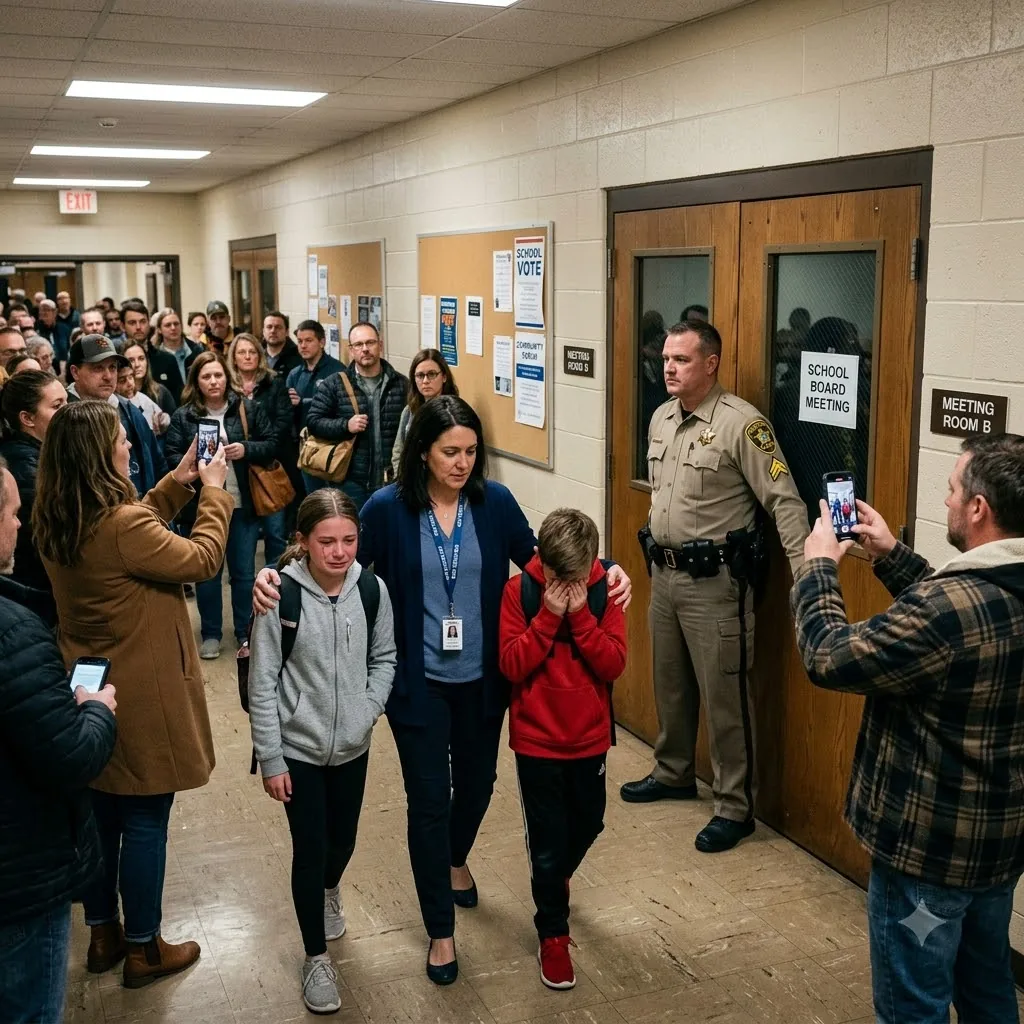
The order finally worked because people had heard enough to know there was more. That made them obedient in a different way. The room began to empty in a dragging shuffle of chairs and whispers and lifted phones. Not fast. Never fast enough when children had already heard too much.
Wade stopped fighting the deputy. He looked at the folded paper in the superintendent’s hand as if that was where his son had gone now too, filed down and carried off. “You did it again,” he said.
Nobody answered him.
The deputy took his arm and turned him toward the door. It was not a dramatic arrest. No shouting rights, no spectacle left. Just a large, exhausted man being walked out while people made a lane and would later call that lane safety. Elena saw faces harden as he passed. The same parents who had cheered him at assemblies, thanked him for service, repeated his name with that warm public pride reserved for useful symbols, now leaned away from him as if cost itself were contagious.
At the threshold Wade looked back once, not at the board this time. At Elena.
She did not know what promise her face made. She only knew she did not look away.
By morning he was barred from campus property pending review. The notice went out in the district email before first bell, wrapped in language about disruption, safety, and temporary restrictions. There was no mention of Jonah beyond a line about student privacy. No mention of Eli at all. Mr. Larkin was listed as on leave. The board called for calm.
Calm was what schools called the shape panic took once paperwork reached it.
Elena spent homeroom watching students pretend not to know what they had all already seen in pieces online. A blur of the hallway. Wade’s voice raised and broken. Somebody’s caption about a gun that still traveled faster than correction. Sixth graders repeated half facts in frightened little bursts. Eighth graders spoke with the brittle confidence of children trying on adult outrage. Jonah Mercer did not come to school.
Neither did Eli.
At lunch a girl asked Elena if teachers were going to start carrying guns now or if they were going to get taken away instead. The question was so earnest Elena had to grip the edge of the table before answering.
“What we are going to do,” she said, “is make sure students know where to go when they need help and that adults listen the first time.”
The girl nodded as if that were an answer to the same question. Maybe it was the only real one.
By afternoon, parents were in the office demanding schedules changed. Not for their own children. For other people’s. One mother wanted her son out of any class that included Eli once he returned. Another wanted assurance Jonah would not be allowed near campus if his father kept making scenes. A father who had posted pictures with Wade every Veterans Day asked the principal whether “families like that” had ever been properly vetted. Elena heard this while sorting dismissal slips and felt something cold settle under her ribs. It was not only that the town had turned. It was how quickly everyone insisted they had never been standing where they had stood.
At the end of the day Elena was called into the counselor’s office with the principal and a district administrator she had met only twice. The folded document lay on the desk inside a manila file, visible for one second before the administrator shut it.
“We need consistency from staff,” he said.
He spoke to her gently, which made it worse. He wanted chronology, not conscience. What had she heard in spring, what had she seen last night, what exactly had she meant when she challenged Larkin in public. He never told her what the date on the form signified, but she understood enough from their caution. Jonah’s statement had been recorded after the school had already begun treating Wade as the danger. Eli’s account had not been false, exactly. It had been arranged, pressed into the version adults found easiest to hold.
“Students can be afraid of more than one thing at once,” Elena said.
The administrator gave a tired nod that meant yes, but not here.
When she left, the principal walked her to the door and said, very softly, “Be careful.”
Careful of what was left unstated: parents, jobs, versions, loyalties, men whose names still sat on banners in the gym.
That evening Elena saw Jonah by accident.
She had stopped at the pharmacy for headache medicine and a notebook she did not need. Across the parking lot, under the buzzing light near the bus bench, Jonah stood with a plastic bag hanging from one hand. He had his father’s height coming in and none of his certainty. His face looked emptied out from the strain of being watched all day by people who were not even there.
Elena almost called his name. Then she saw the person with him.
Not Wade. A woman Elena knew only slightly from church fundraisers-Jonah’s aunt, she thought-guiding him toward an older sedan. Jonah opened the back door, then paused and looked across the lot. For one suspended second she thought he had seen her.
Maybe he had. Maybe he had only looked in her direction because that was where the school sat, three blocks over, dark now except for the security lights.
He got into the car without expression. No slammed door. No visible anger. That, more than anything, told Elena how little trust remained to spend.
On Thursday, Wade’s parking spot at the bus garage was empty. By Friday, someone had scraped the veteran-support decal off the back of his truck but left the outline behind. The town was good at removing the visible part and keeping the ghost.
Elena stayed late that same Friday stacking chairs in her classroom because order at least answered the hands. Outside, the field lights had come on for middle school practice. She could hear whistles, cleats, the ordinary machinery of a place insisting on itself. From the hallway came the soft sound of a student hesitating outside her door.
When Elena opened it, no one was there.
Only a folded piece of notebook paper on the floor.
Inside, in cramped pencil, were seven words:
I tried to tell them the first time.
There was no name under it. She stood alone in the fluorescent hum with the note open in her hand and the empty hallway ahead of her, feeling how thin safety was when it depended on who adults found easiest to believe.