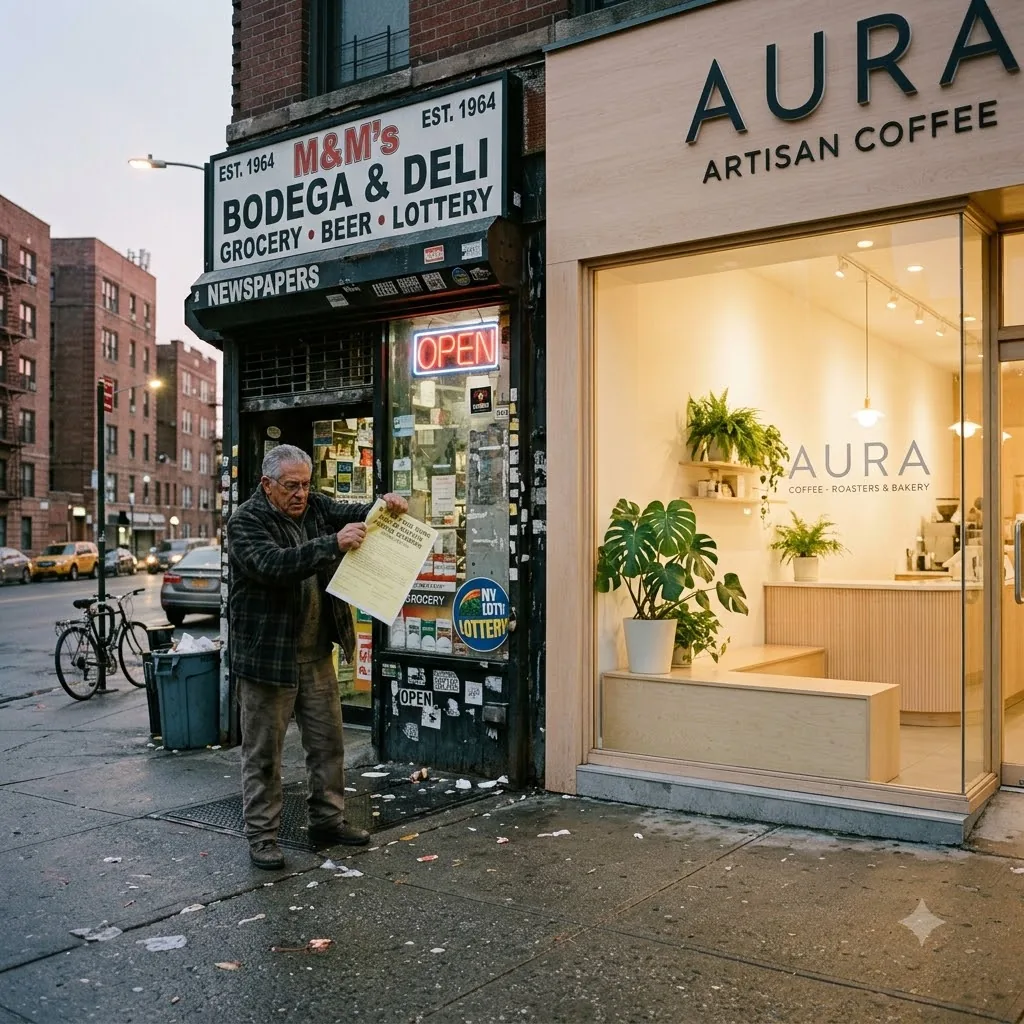
Story code: ST-000693
Part 2: The Cost of Compliance
Mateo’s stomach dropped as the inspector brushed past him, the heavy glass door chiming its familiar, cheerful greeting. Abuelo Tomas looked up from his stack of canned beans, wiping his hands on a faded apron. He smiled, his deeply lined face crinkling at the corners.
“Buenos días,” Tomas said, oblivious to the threat the red clipboard represented.
“Good morning,” the inspector replied flatly. His nametag read Davis. He did not look malicious, just profoundly tired, carrying the weight of bureaucratic obligation. “Tomas Ortiz? I am here regarding multiple urgent 311 complaints filed over the past seventy-two hours.”
Mateo hurried behind the counter, positioning himself between his grandfather and Davis. “Complaints? From who? Let me guess, an anonymous neighbor concerned about our ‘energy’?”
Davis flipped a page on his clipboard. “The caller identity is protected. But the sheer volume triggered an expedited field visit. I have reports of uncontained biological hazards, unregulated particulate emissions, and noise-induced psychological distress.”
“Psychological distress?” Mateo echoed, his voice rising. “It’s a Spanish radio station and two grandpas playing dominoes!”
“I just verify what’s in front of me,” Davis said. He turned his gaze toward the back corner of the store. There, sleeping peacefully atop the humming ice machine, was Barnaby. The orange tabby did not even twitch as Davis pulled out a digital camera and took a flash photograph.
“That is a feral animal occupying a food-adjacent surface,” Davis noted, scribbling furiously.
“He is a mouser,” Tomas protested mildly, stepping forward. “He keeps the basement clean. He doesn’t go near the food.”
“Code 44-B,” Davis said, his voice devoid of emotion. “No non-service animals permitted within fifty feet of an unsealed consumable staging area. That’s an immediate citation.”
Mateo felt the heat rising in his neck. He looked out the front window. Julian was still standing on the sidewalk, sipping his pour-over coffee, watching the scene unfold with a placid, satisfied expression.
“Fine,” Mateo said through gritted teeth. “I will take the cat home tonight. What else?”
Davis walked toward the back of the deli, stopping at the small, flat-top grill. The aroma of roasting pork shoulder and onions lingered in the air, a staple of the neighborhood for three decades. “The particulate emissions. The complaints state your exhaust hood is blowing toxic, aerosolized grease directly into the shared pedestrian airspace, compromising the respiratory health of adjacent wellness-oriented patrons.”
“It is meat,” Mateo snapped. “We are cooking meat. The hood was inspected and passed two years ago.”
“The codes updated last year,” Davis countered, shining a small flashlight up into the metal canopy. “Older models were grandfathered in, unless a formal health-risk complaint is filed. Once it’s filed, I have to test it against current commercial micro-filtration standards. Turn it on.”
Mateo hesitated. Tomas, sensing the shift in the room’s gravity, reached over and flicked the fan switch. The old motor hummed to life, rattling slightly in its housing. It drew the air up, just as it always had, but Davis immediately shook his head.
“Draw rate is insufficient for the new filtration metrics,” Davis said. He pulled a pad of bright orange stickers from his clipboard. He peeled one off and slapped it directly onto the stainless steel surface of the grill. CONDEMNED: DO NOT OPERATE. “I have to issue a cease-and-desist on all hot food preparation until a certified contractor installs a Class 1 compliant ventilation system.”
Mateo stared at the neon orange sticker. The hot food counter accounted for nearly half of their daily revenue. The breakfast rush of egg and cheese sandwiches, the lunchtime rush of pernil and rice-it was the only thing keeping their margins above water.
“Do you know how much a new Class 1 system costs?” Mateo asked, his voice trembling. “Fifteen thousand dollars. We don’t have that.”
“I do not set the prices, sir,” Davis said, handing Mateo a carbon copy of the citations. “Fines total twelve hundred dollars, payable in thirty days. Hot food stays off until reinspection. Have a good day.”
Davis walked out, the bell chiming behind him. Tomas reached out and touched the orange sticker, his fingers trembling slightly. “Mateo… the pernil is already prepped for the lunch crowd. What do we do?”
“I don’t know, Abuelo,” Mateo whispered, folding the yellow carbon paper. Twelve hundred in fines. Half their income instantly paralyzed. The ninety-day clock on the four hundred percent rent increase ticking louder than ever.
Before Mateo could comfort his grandfather, the door chimed again. Julian stepped inside. The bell seemed to ring differently for him, sharper, more intrusive. He walked down the narrow aisle, pausing to inspect a dusty can of espresso beans before approaching the counter.
“I saw the inspector leave,” Julian said, his voice dripping with practiced, mournful empathy. “I am so sorry, Mateo. That looks like a heavy hit.”
“Get out,” Mateo said, stepping forward.
Julian held his ground, his hands raised in a posture of peaceful surrender. “I just wanted to offer a lifeline. This block is evolving. The infrastructure demands are just too high for legacy businesses to keep up with. It is natural.” He reached into his raw linen apron and pulled out a thick, cream-colored envelope, sliding it across the counter next to the condemnation notice.
Mateo did not touch it. “What is that?”
“A buyout offer,” Julian said softly. “From my investment group. We cover your back rent, waive the DOH fines somehow, and give you a modest sum to help Tomas retire quietly. We want to expand the café into a holistic community space. We need the square footage.”
Mateo looked down at the envelope, a sickening realization washing over him. Julian wasn’t just a pretentious neighbor.
“You’re the one behind the rent increase,” Mateo realized, the words tasting like ash. “The management company hiked it so you could force us out.”
“We just recognized an underutilized asset,” Julian smiled, tapping the envelope. “Read the offer, Mateo. You have forty-eight hours before the buyout drops by half. Think of your grandfather’s blood pressure.”
Julian turned and strolled out, leaving the envelope sitting beside the bright orange sticker that was currently bleeding the bodega dry. Mateo picked up the heavy, textured paper. Printed in the corner was a familiar soft-pink floral border-the exact same design as the Community Wellness notices. It had never been about noise or air quality. It was a demolition masquerading as a rescue.