Story code: ST-000693
Part 4: The Weight of the Tiles
Julian stared at the blueprints, his chest rising and falling in rapid, shallow jerks. The projector’s bright light caught the faint sheen of sweat breaking out across his forehead.
“Mr. Julian,” Chairwoman Higgins said, her voice dropping to a glacial register. “The board asked you a question.”
“This is…” Julian stammered, pointing a shaking finger at Mateo. “This is stolen property. You are looking at illegally obtained corporate documents.”
“I paid twenty-five dollars on the Department of Buildings portal,” Mateo said, not moving an inch. “It is public record.”
“Because you don’t understand how development works!” The sudden, sharp volume of Julian’s voice made the board members jump. The restorative cadence was entirely gone. “You don’t understand what it takes to rehabilitate a dead zone! I am trying to bring value to this street!”
“By bankrupting a family business?” the older board member in the tweed jacket asked, leaning forward over the table.
Julian whirled on him. “It’s a filthy deli! It smells like oxidized grease and feral cats! Do you have any idea how much capital my partners sank into that dry cleaner space? Do you know what kind of demographic we need to attract to make those margins work? We can’t do it next to a dilapidated time capsule that blasts static and sells expired beans!”
Mateo watched the mask shatter. It was breathtaking in its ugliness. There was no holistic vision, no trauma-informed community alignment. Just naked, grasping entitlement.
“We are trying to clean up your mess!” Julian shouted, slamming his hand flat against the folding table, rattling Higgins’s water glass. “This neighborhood is a stagnant swamp! It needs curation. It needs elevated standards. You people should be thanking me for investing in this miserable block, not defending a pair of stubborn old men who don’t know when they’ve been outlived!”
Higgins slowly picked up her pen. She drew a single, thick line through the top page of Julian’s variance application.
“Your application for a commercial zoning variance is denied, Mr. Julian,” Higgins said, her voice cutting through the echo of his outburst. “And I will be forwarding a transcript of this meeting, along with Mr. Ortiz’s provided documents, to the Department of Buildings and the Health Inspector’s ethics oversight committee. I suggest you leave.”
Julian stood frozen, his chest heaving. He looked at the board, then at Mateo. The realization of what he had just done-on public record, in a room full of community leaders-finally seemed to penetrate his rage. Without another word, he turned and marched up the basement stairs, the heavy metal fire door slamming shut behind him.
Mateo let out a breath he felt like he had been holding for three weeks. He reached down, carefully rolled up the architectural plans, and slid them back into the cardboard tube.
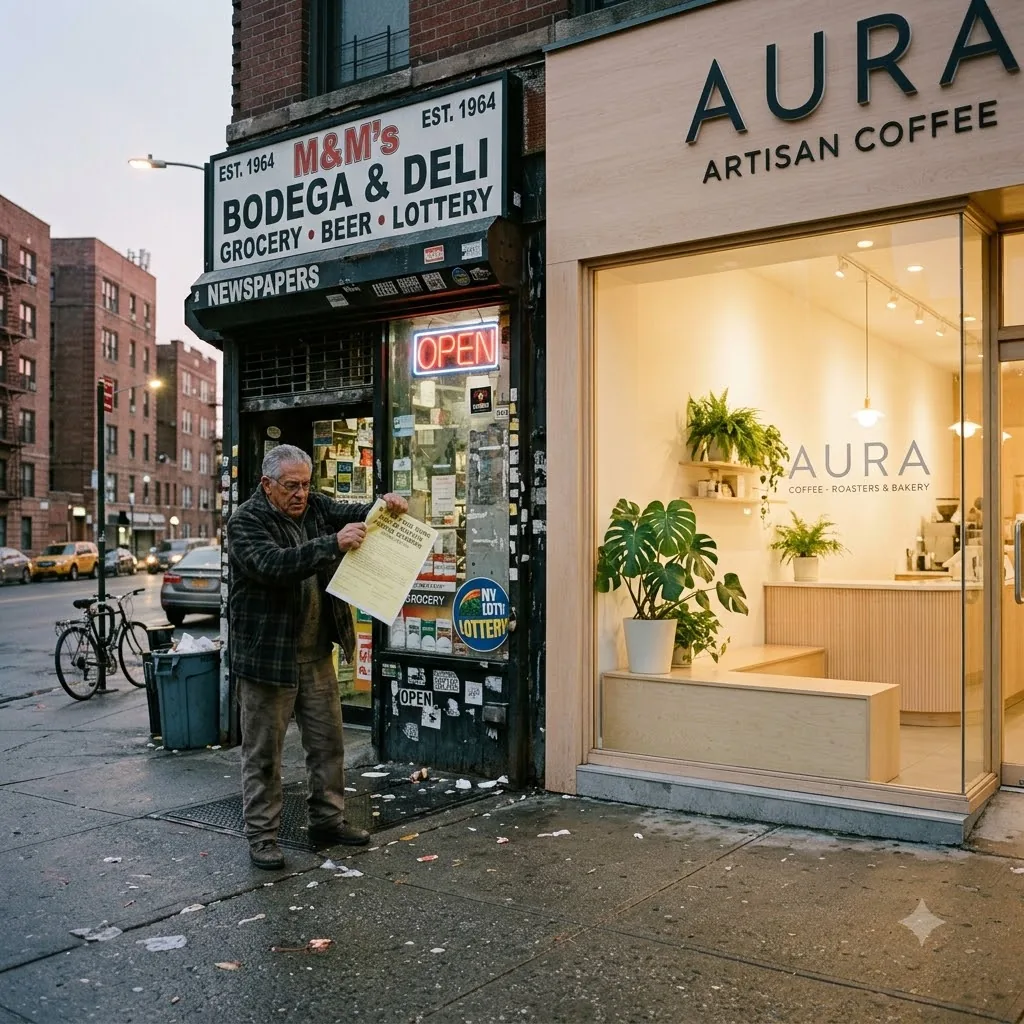
The morning air was crisp, carrying the familiar metallic tang of the city. Mateo stood on the sidewalk in front of the bodega, holding a steaming cup of Cafe Bustelo. He looked through the front window. Abuelo Tomas was behind the counter, wiping down the register. The neon orange Health Department sticker still glared from the stainless steel hood of the flat-top grill.
Mateo took a sip of his coffee. The victory at the community board had not magically fixed their reality. The twelve-hundred-dollar fine still had to be paid. The hot food counter, their primary source of daily revenue, was still legally paralyzed until they could afford the fifteen-thousand-dollar micro-filtration system. And the four-hundred-percent rent increase was still ticking down, a financial guillotine set to drop in eighty-eight days.
But the invisible noose Julian had wrapped around their necks was gone.
Next door, the bell to the coffee shop chimed. Julian stepped out onto the pavement. He wasn’t carrying a bamboo clipboard or a cup of pour-over. He wore his raw linen apron, but his posture was stiff, his eyes locked straight ahead. Two women in matching athleisure walking a golden retriever approached. They paused, looked at Julian, and then quickly crossed the street, whispering furiously to each other. Word traveled fast in the neighborhood. The local blog had already posted the minutes from the board meeting. Julian’s carefully curated brand of ethical wellness was poisoned.
Mateo didn’t gloat. He didn’t even look at Julian. Instead, he turned to the stack of heavy, scuffed plastic chairs leaning against the bodega’s brick facade.
He pulled down the folding table first, snapping the metal legs into place with a sharp, metallic clack that echoed down the street. He set it up right on the edge of the pedestrian corridor. He wiped down the vinyl surface, then arranged four chairs around it.
“Mateo!” a raspy voice called out.
Tio Hector and Mr. Suarez were walking down the block, shuffling slightly but moving with purpose. Mr. Suarez was carrying the familiar beaten leather case holding their dominoes.
“You got the table out early,” Hector said, clapping Mateo on the shoulder as he walked past.
“Had to make sure the pedestrian flow was properly disrupted,” Mateo said, a small, genuine smile breaking across his face.
“Good man,” Mr. Suarez grunted, taking his usual seat facing the avenue. He popped the latches on the leather case and dumped the heavy plastic tiles onto the table. The sharp, cascading clatter of the dominoes rang out like a declaration of existence.
Julian flinched at the noise. He turned sharply and went back inside his empty minimalist box, letting the door close behind him.
Mateo watched the two older men begin to shuffle the tiles, their hands moving in practiced, rhythmic circles. He stepped back inside the bodega, the old bell chiming its familiar greeting above his head. The fight for their lease was going to be brutal. They needed lawyers, they needed money, and they needed a miracle to survive the rent hike. But as Mateo walked behind the counter and stood shoulder-to-shoulder with his grandfather, listening to the sharp slap of dominoes outside their front door, he knew one thing for certain. They were not going to be quietly erased.